Do Containers Require Building Permits? What to Know
A shipping container can arrive ready for use, but that does not automatically mean it can be placed anywhere. So, do containers require building permits? Sometimes. The answer depends less on the container itself and more on how your local jurisdiction classifies its use, location, permanence, and modifications.
For a contractor needing secure job-site storage, a farmer protecting tools, or a homeowner planning a workshop, the fastest path is to check local rules before scheduling delivery. A container that is allowed as temporary storage may require approval once it is anchored, wired, connected to utilities, or converted into occupied space. Confirming those details early prevents relocation costs, permit delays, and avoidable site work.
Do Containers Require Building Permits in Your Area?
Cities, counties, and homeowners associations do not use one nationwide rule for shipping containers. Building departments may call them cargo containers, intermodal containers, portable storage units, accessory structures, or metal storage buildings. The label can affect which department reviews your plan, but the practical questions are usually consistent.
First, officials will want to know where the container will sit. Zoning rules control land use, setbacks, screening, lot coverage, and whether outdoor storage is permitted. A 20-foot storage container behind a commercial building may be acceptable, while the same unit in a front yard or residential side setback may not be.
Second, they will ask whether the placement is temporary or permanent. Some jurisdictions allow a container during active construction with a temporary permit, often tied to the building permit period. Others allow temporary storage containers for a defined number of days, such as 30, 90, or 180 days. Keeping it on site beyond that period can trigger a zoning violation even if no structural work has been performed.
Third, officials look at intended use. Unmodified, ground-level storage is treated differently from a container office, retail pop-up, workshop, or dwelling. The more a container functions like a building, the more likely it is to require permits and code review.
When a Permit Is More Likely
A permit is commonly required when a shipping container becomes a permanent accessory structure or an occupied building. That may include placing it on a slab, installing piers or footings, anchoring it for wind resistance, or connecting electrical, plumbing, sewer, or gas service.
Cutting openings also changes the conversation. A standard container gets much of its strength from its corrugated Corten steel sidewalls, roof rails, corner posts, and frame. Adding doors, windows, large roll-up openings, or joining multiple containers can require engineered reinforcement. Local reviewers may request stamped drawings that show how loads are transferred around each opening and how the structure will perform under local wind, snow, and seismic requirements.
Permits are also likely for these uses: a finished office with HVAC, a customer-facing retail space, an insulated workshop with permanent power, a container home, or a refrigerated container connected to electrical service. In these cases, expect separate reviews for building, electrical, mechanical, plumbing, fire, accessibility, and sometimes health regulations.
That does not mean every use is complicated. A Wind & Watertight container used solely to secure tools or inventory may have fewer requirements than a finished build. Still, zoning clearance or a simple placement approval may be necessary before delivery.
Zoning Can Matter More Than the Building Code
Buyers often ask the building department whether they need a permit, receive a narrow answer, and assume the project is cleared. That can be a costly mistake. Building permits address construction safety. Zoning determines whether the container is allowed in that location at all.
Before ordering, ask your planning or zoning office about permitted use, setbacks, height limits, lot coverage, exterior appearance rules, and screening. Some communities require containers to be behind the principal structure. Others prohibit visible shipping containers in certain residential districts or require landscaping, fencing, or a painted exterior.
If the property is subject to an HOA, restrictive covenants may be stricter than municipal rules. HOA approval is not a substitute for a government permit, and a government permit does not override HOA restrictions. Review both before committing to a container purchase.
For commercial and industrial properties, verify whether outdoor storage is permitted under the site’s zoning classification. A container used for construction equipment is often treated differently from a container used for retail inventory, hazardous materials, or waste handling. Fire access lanes, parking requirements, and visibility at driveways can also affect placement.
Temporary Storage Is Not Always Permit-Free
A container that sits on the ground without a foundation is often described as temporary. In practice, temporary is a local definition, not a universal exemption. A jurisdiction may consider a unit temporary because it is tied to a construction project, because it is removed within a stated time, or because it is not connected to utilities.
Do not assume that wheels, corner blocks, or a lack of concrete eliminates approval requirements. A 40-foot container can remain in one place for years and still be viewed as a structure or regulated outdoor storage. If you need long-term storage, ask for the rule in writing or request the relevant ordinance section from the local office.
For job sites, document the project address, expected duration, and container purpose when applying. Clear information helps the reviewer distinguish legitimate construction support from unauthorized permanent storage.
Foundation and Site Preparation Affect Approval
Even where a building permit is not required, a level, stable base is not optional. Containers are designed to carry loads through their corner castings. Supporting the unit unevenly along its side rails can twist the frame, affect door operation, and create drainage problems.
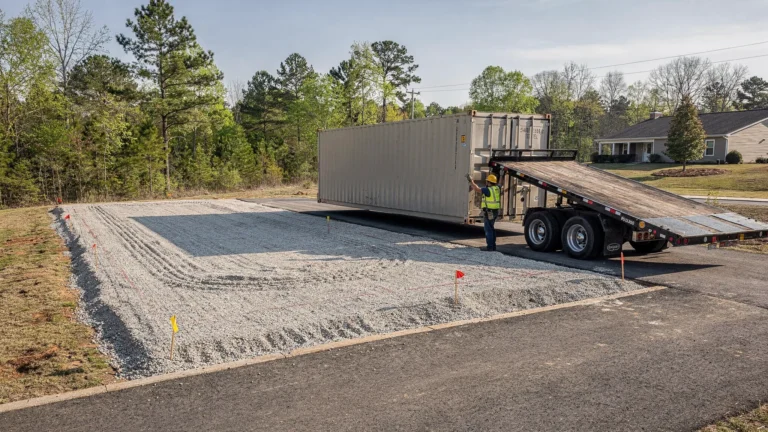
For short-term storage, compacted crushed stone with properly leveled support points may be appropriate, depending on soil conditions and container size. For long-term placement, many sites benefit from concrete pads, piers, or engineered footings. The best option depends on local frost depth, drainage, slope, wind exposure, intended use, and whether equipment will enter the container.
If you plan to anchor the container, ask whether the jurisdiction has wind-load requirements. This is especially relevant in hurricane-prone parts of the Southeast and coastal areas. Anchoring may be a safety requirement, but it can also make the installation more clearly permanent in the eyes of the permitting office.
Delivery access should be reviewed at the same time. Tilt-bed delivery requires adequate overhead clearance, turning room, and a firm approach. A permitted location that cannot be safely accessed by the delivery truck is not a workable location. Confirm the approach, gate width, low branches, power lines, and final placement area before the container is dispatched.
What to Ask Before You Buy
A short call to the right local offices can eliminate most uncertainty. Start with the planning or zoning department, then contact the building department if the container will be modified, anchored, or connected to utilities. Describe the project accurately: container size, number of units, condition, placement location, intended use, foundation type, duration, and any planned utilities or openings.
Ask whether the property needs zoning approval, a building permit, a temporary use permit, or a site plan review. Also ask about setbacks, screening, height limits, drainage, fire separation, and inspection requirements. If a container will be used as an office or retail space, ask whether accessible entry, emergency exits, insulation, ventilation, and fire-rated assemblies apply.
For a residential project, include the HOA or architectural review committee in the process. For agricultural land, verify whether an agricultural exemption applies and exactly what it covers. Exemptions can be limited to certain structures or uses, so they should not be assumed.
Match the Container to the Approved Use
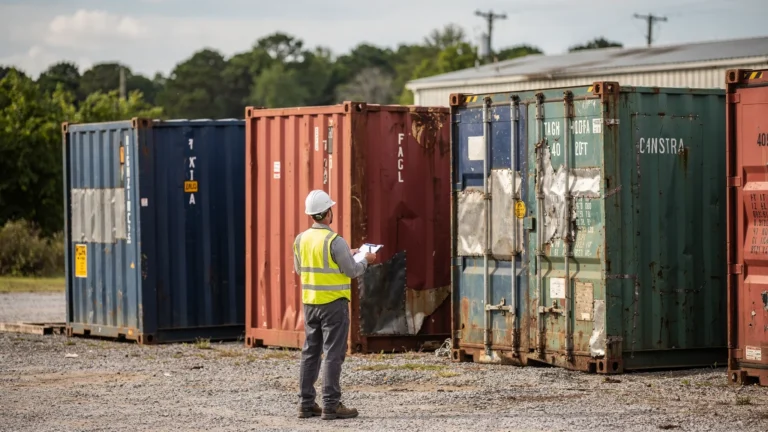
Permit requirements and container condition should be considered together. For basic storage, a used Wind & Watertight unit can be a practical choice when appearance is not the primary concern. For a visible retail site, residential property, or modification project, a one-trip container offers a cleaner exterior and more predictable starting condition.
Cargo Worthy containers meet standards for international transport, but that certification is not a building approval. Likewise, a structurally sound container does not replace local engineering when you cut major openings or stack units. Use the right grade for the job, then obtain approvals for the way the unit will be installed and altered.
A container is a durable, secure asset, but it works best when the site plan is just as solid. Verify local requirements before delivery, prepare a stable base, and keep the intended use clear from the start. That preparation is what turns a fast storage solution into one with no fine print and no surprises.