Seaworthy Containers for Sale: What Export Buyers Must Verify
Shopping for seaworthy containers for sale requires more than finding a clean steel box with working doors. Export buyers need to verify the actual unit’s structural condition, safety approval, examination status and acceptance by the intended ocean carrier. A seller’s description is useful, but it is not permission to load a container onto a vessel.
For buyers in Raleigh, North Carolina, and across the Southeast, those checks should happen before arranging inland transport to the port. This guide focuses on the evidence to request, the approvals to confirm and the purchase terms that can prevent expensive surprises.
What “Seaworthy Containers for Sale” Should Mean
“Seaworthy” is commonly used in sales listings, but it is not a substitute for recognized safety documentation or a carrier’s equipment requirements. Ask the seller to translate that description into a specific grade and supporting evidence.
| Description | What it generally tells you | What an export buyer must still verify |
|---|---|---|
| One-Trip | A relatively new container that typically carried cargo on its initial journey from the manufacturer | Actual condition, CSC approval, examination status and carrier acceptance |
| Cargo Worthy (CW) | A seller’s condition designation indicating suitability for cargo transport | Unit-specific inspection evidence, current examination status and acceptance for the planned shipment |
| Wind and Watertight (WWT) | A container intended to keep wind and rain out under ordinary storage conditions | Structural suitability and all transport approvals; WWT alone does not establish export eligibility |
A listing for seaworthy containers for sale should identify the grade without treating it as a blanket export guarantee. Neither fresh paint nor the words “Cargo Worthy” establish that every required check has been completed.
Lease Lane Containers LLC supplies One-Trip and used units, including CW and WWT options. For a fuller comparison, review the container grades used for export, then request documentation for the particular container being offered.
Verify the CSC Plate and Examination Status
The International Convention for Safe Containers, known as CSC, provides the safety framework for most freight containers used in international transport. The International Maritime Organization’s container safety guidance explains the convention and its approval and maintenance requirements.
Request a readable photograph of the CSC Safety Approval plate, together with photographs of the container identification markings. Check the approval reference, manufacturing date, maximum operating gross mass and relevant structural ratings. Any identification reference on the plate should correspond to the unit’s records, even where the manufacturer’s identification differs from the operational container number.
Examination status also matters. Under the periodic examination scheme, the first examination is due within five years of manufacture, with subsequent intervals no longer than 30 months. Alternatively, a container may operate under an Approved Continuous Examination Programme, or ACEP.
When reviewing seaworthy containers for sale, verify either the applicable next examination date or valid participation in an ACEP, rather than assuming a plate alone is enough. Ask how examination responsibility will be handled after ownership transfers; do not assume a previous owner’s programme automatically covers your operation.
A commercial condition survey can provide valuable evidence, but it does not automatically replace CSC examination requirements. Confirm exactly what the report establishes and who accepts it.
Obtain Written Acceptance for a Shipper-Owned Container
Buying a container does not guarantee that an ocean carrier will transport it. A unit you supply is generally handled as a shipper-owned container, often abbreviated SOC, rather than carrier-owned equipment.
Before paying, send your freight forwarder or carrier the proposed container type, identification number, CSC information and available survey documents. Obtain confirmation for the actual route and booking, including any transshipment arrangements.
Ask these questions in writing:
- Does the carrier accept SOC equipment on this service and booking?
- What inspection report, examination evidence or equipment declaration is required?
- Are there restrictions on container age, dimensions, repairs or modifications?
- What happens to the empty container at destination, and which charges remain your responsibility?
The carrier may require additional evidence even when the seller describes a unit as cargo worthy. Acceptance can also depend on the shipment, terminal or destination arrangements, so approval for a previous voyage is not enough.
The practical test for seaworthy containers for sale is whether the specific unit can be accepted for your planned movement, not whether a similar container has shipped before. Keep the written acceptance with your purchase and booking records, and confirm that it still applies if the seller substitutes a different unit.
Match Dimensions and Weight Limits to the Shipment
Choose equipment around the cargo and route, not simply the advertised capacity. Whether you are comparing 20ft containers or 40ft containers, the freight-container buying guide provides a useful starting point for size and type selection.
Common dry freight containers have a nominal standard height of 8 feet 6 inches. A High Cube is typically 9 feet 6 inches tall, providing additional vertical space. Internal dimensions and door openings vary by design, so request the specifications for the actual unit when cargo clearance is tight.
ISO standards address matters such as container dimensions, ratings and interfaces. However, a familiar ISO size or type code does not prove that a damaged container remains fit for transport.
Read the maximum operating gross mass from the relevant markings and documentation. Subtract the actual tare weight to determine the container’s theoretical payload, then account for any lower road, chassis, terminal or carrier limit. Dense machinery can also create concentrated floor loads even when total cargo weight is acceptable.
For seaworthy containers for sale intended to carry heavy exports, load distribution can be as important as total payload. Have the packing and securing plan checked for the cargo involved.
Under SOLAS requirements, the shipper must provide a verified gross mass (VGM) for the packed container before vessel loading. Confirm the permitted weighing method and submission deadline with your forwarder; an estimated cargo weight is not a substitute.
Request an Inspection Tied to the Actual Container
A useful survey report should identify the container number, inspection date, inspector and findings. Ask whether the inspection covered the underside and structural members, rather than only accessible exterior surfaces.
Corner castings, corner posts, rails and crossmembers deserve particular attention because they support lifting, stacking and cargo loads. Distortion, significant corrosion, cracked welds or questionable repairs need assessment by a qualified container inspector. Cosmetic dents are not equivalent to structural damage, but photographs alone may not distinguish them reliably.
Many dry freight containers use weathering steel commonly described as Corten Steel. It is not rust-proof. Persistent moisture, salt exposure and water trapped around damaged coatings can still cause serious deterioration, particularly in coastal environments.
Request evidence of door operation, gasket condition and floor integrity. Odors, residues or staining also matter when the cargo includes food, textiles or other contamination-sensitive goods. If prior cargo history is unavailable, assess that uncertainty against your shipment’s requirements.
Among seaworthy containers for sale, a unit-specific report is more useful than a seller’s generic sample certificate. Match the report to the container you will receive and establish what happens if a later inspection identifies defects.
For additional hands-on checks when evaluating used containers before purchase, examine both storage-related condition and the structural issues relevant to transport. Refrigerated units also require separate verification of refrigeration performance, including any pre-trip inspection required for the booking.

Keep Repairs and Decorative Work Separate
A repaint can improve appearance and help protect properly prepared surfaces. It cannot restore missing steel thickness, correct distorted structural members or establish transport compliance. Ask which repairs were made, who performed them and whether the repaired areas were inspected.
Modifications require additional care. Cutting openings, removing structural components or changing the container’s configuration can affect its approved design. Do not assume an office conversion or retail container can travel as ordinary freight equipment under its original approval. Obtain competent engineering and approval advice before committing to that transport plan.
If an export project supports a shop or office fit-out in Australia’s Illawarra or South Coast region, WM Painting & Decorating’s commercial painting services may be relevant to finishing the destination premises. That scope is separate from inspecting or certifying the freight container used to deliver the project materials.
When comparing seaworthy containers for sale, budget structural repairs and transport approval separately from cosmetic improvements. Keep identification markings and safety information legible, and do not let fresh coatings replace inspection evidence.
Put Documentation and Cost Responsibilities in the Contract
The purchase agreement should identify the actual container or explain how the final unit will be selected and approved. Include its grade, agreed condition, documentation to be supplied and any repairs that must be completed before release.
Ask for an invoice or bill of sale identifying the seller and container number. A recognizable owner prefix or identification marking is not, by itself, proof that the seller has authority to transfer ownership. Clarify any ownership or release concerns before payment.
Allocate responsibility for inspection fees, remedial work, depot handling, loading and inland transport. Also ask who bears additional costs if the container is rejected before shipment, and what remedy applies if it does not match the agreed description. Avoid assuming that a low purchase price includes every step needed to reach the vessel.
Quotes for seaworthy containers for sale are easier to compare when each one states the same delivery point and documentation scope. A depot price, a price delivered to a Raleigh property and a price delivered to an export terminal are different commercial offers.
For buyers moving equipment through Southeast ports, coordinate the seller’s release process with the forwarder’s booking and terminal receiving window. Survey validity requirements, repair completion and truck scheduling should align before the container starts its journey.
Pro-Tip: Prepare the Raleigh Site for Safe Delivery and Loading
If the container will first be delivered to your property, plan both the drop and the later pickup. A location suitable for leaving an empty box may not provide safe access once the container is packed and substantially heavier.
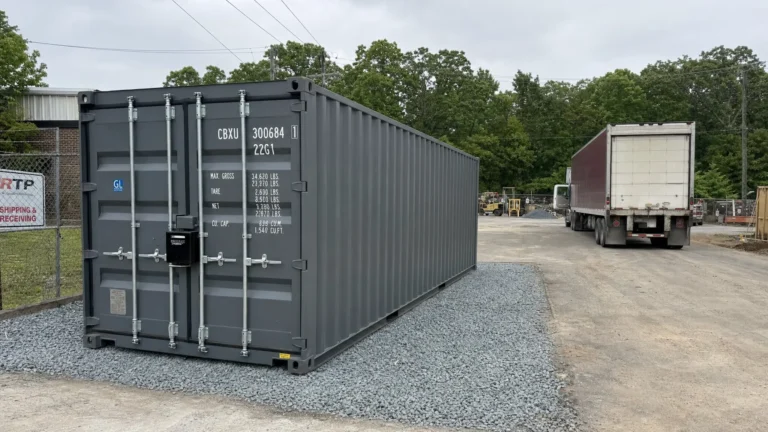
Use a firm, level support arrangement suited to the ground conditions, container loads and delivery equipment. A properly designed compacted gravel pad can be useful, but soft soil, poor drainage or settlement can leave supports uneven and cause the doors to bind. Support placement should follow competent site and container guidance.
Confirm the truck’s turning space, overhead clearance and operating area with the delivery provider. Do not assume the unloading equipment can also collect a fully loaded container; loaded handling may require different equipment and arrangements.
For Raleigh buyers evaluating seaworthy containers for sale, local site planning belongs in the export budget. Verify zoning, placement and permit requirements with the authority governing the specific address, particularly if the unit will remain on-site or be modified.
Across North Carolina and the wider Southeast, allow for wet-weather access and drainage. A washed-out approach or unstable loading area can disrupt an otherwise ready export shipment.
Complete a Final Check Before Payment
Before committing, assemble a single record containing the seller’s offer, unit identification, inspection evidence and carrier correspondence. Resolve discrepancies while you still have the option to reject the unit or change the purchase terms.
Your final approval should cover:
- The exact container number, agreed grade and proof of seller authority.
- Readable CSC information and applicable examination status.
- A condition report acceptable for the intended shipment.
- Written SOC acceptance and confirmed dimensional and weight requirements.
- Agreed repairs, release arrangements, delivery costs and rejection remedies.
If you are considering several seaworthy containers for sale, use the same evidence checklist for each one. That makes the comparison about export readiness and total cost rather than photographs or headline prices.
Keep documentation available to the party handling the booking. Complete cargo packing, securing, customs and VGM arrangements separately; buying an acceptable container does not complete the export process.
Frequently Asked Questions
Does Cargo Worthy mean a container is automatically approved for export? No. CW is a condition designation. Verify the actual unit’s safety documentation, examination status and acceptance by the intended carrier, along with any shipment-specific requirements.
Can a WWT container be used for international shipping? Possibly, if inspection and any necessary repairs establish its suitability and the required approvals are satisfied. The WWT label alone only addresses a more limited storage-related condition claim, so do not buy on that assumption.
Is a One-Trip container exempt from inspection requirements? No. Its relatively new condition can reduce some concerns, but damage, missing documentation or carrier requirements still need attention. Check the particular unit rather than relying on its age category.
Does a container survey replace cargo packing requirements? No. The survey addresses the equipment within its stated scope. Cargo suitability, load distribution, securing, contamination control and export documentation remain separate responsibilities.
Discuss Your Export Requirements With Lease Lane Containers
Lease Lane Containers LLC, headquartered in Raleigh, North Carolina, supplies new and used containers with nationwide delivery. When reviewing seaworthy containers for sale, share your destination, cargo weight, preferred size and carrier requirements so the discussion starts with the evidence your shipment needs.
Contact the sales team at sales@leaselanecontainers.com or arrange a visit to the Raleigh office to discuss available units, grading, documentation and delivery planning before you purchase.