How to Prepare Your Site for a Shipping Container
Table of Contents
- Table of Contents
- Assessing Site Accessibility and Delivery Routes
- Checking for Overhead Obstructions and Ground Clearance
- Calculating Turning Radius for Delivery Trucks
- Selecting the Ideal Foundation Type
- Concrete Slabs and Footings
- Gravel Pads and Railroad Ties
- Ground Leveling and Soil Stabilization
- Managing Drainage to Prevent Rust and Sinking
- Navigating Local Zoning and Permit Requirements
- Utility Hookups and Service Planning
- Electrical and Plumbing Rough-ins
- Final Site Clearing and Safety Checks
- Coordinating Delivery Day Logistics
- Choosing Between Tilt-Bed and Crane Offloading
- Final Checklist
Table of Contents
- Assessing Site Accessibility and Delivery Routes
- Selecting the Ideal Foundation Type
- Ground Leveling and Soil Stabilization
- Navigating Local Zoning and Permit Requirements
- Utility Hookups and Service Planning
- Final Site Clearing and Safety Checks
- Coordinating Delivery Day Logistics
- Final Checklist
A 20-foot steel shipping container weighs roughly 5,000 pounds empty. A 40-foot high cube tips the scale at around 8,500 pounds before you put a single item inside. Drop that kind of weight onto unprepared ground and you’re looking at sinking, tilting, blocked doors, and rust damage within the first year. Proper site preparation for a shipping container is the difference between a decade of reliable use and a costly headache that starts the day your container arrives. Most problems people experience with containers – doors that won’t close, pooling water underneath, structural stress from uneven settling – trace back to shortcuts taken before delivery day. Whether you’re setting up a job site storage unit in Wake County, building a container office on a rural property outside Raleigh, or placing a used shipping container on a farm for equipment storage, the ground work you do now determines how well that container performs for years to come. This guide walks through every step, from measuring your driveway to coordinating the truck driver on delivery morning.
Assessing Site Accessibility and Delivery Routes
Before you think about foundations or permits, you need to answer a basic question: can a delivery truck actually reach your placement spot? Shipping containers arrive on large commercial vehicles, typically tilt-bed trailers or flatbed trucks paired with a crane. These rigs need clear, firm routes from the public road to your final placement location, and the margins for error are slim.
Start by walking the entire route from the road to your intended container location. Measure the width of every gate, gap between structures, and narrow section along the path. A standard delivery truck is about 8.5 feet wide, and you’ll want at least 12 feet of clear width to allow for mirrors and minor steering corrections. Soft shoulders, drainage ditches, and low spots along the route can trap a loaded truck, so note any areas where the ground looks questionable.
If your property is accessed via a shared driveway, private road, or easement, confirm that the surface can support a gross vehicle weight of 50,000 to 80,000 pounds depending on the container size and truck configuration. Gravel roads generally handle this fine, but dirt roads softened by recent rain can become impassable quickly. Schedule your delivery during a dry stretch if possible.
Checking for Overhead Obstructions and Ground Clearance
Overhead power lines are the single most common delivery obstacle. A tilt-bed truck raises its bed to a height of approximately 14 to 16 feet during offloading, and a crane operation can go higher. Map every power line, tree branch, and overhang along the delivery route and at the placement site. If lines cross directly over your intended spot, contact your utility provider about temporary disconnection or relocation – this process can take two to four weeks, so plan early.
Tree limbs within 20 feet of the placement area deserve attention too. Even branches that seem high enough can catch on the top corners of a container as it swings from a crane. Trimming costs far less than rescheduling a failed delivery. Check for satellite dishes, exterior lighting fixtures, and building eaves near the path as well.
Ground clearance matters just as much. Tilt-bed trucks need a flat, firm surface at least 60 feet long to slide a 40-foot container off the back. If your site has a steep grade change, a dip, or a raised curb between the road and the placement area, the truck may not be able to complete the drop. Lease Lane Containers provides delivery planning support that covers these access details before your container ships, which prevents expensive surprises on delivery day.
Calculating Turning Radius for Delivery Trucks
A standard tractor-trailer carrying a 40-foot container requires a turning radius of approximately 55 feet. For a 20-foot container on a shorter truck, you still need around 40 feet. These numbers matter at every corner, intersection, and curve between the main road and your site.
If your property sits at the end of a cul-de-sac, the truck will likely need to back in from the street. Backing a loaded trailer down a residential driveway requires a straight approach of at least 100 feet. T-intersections, sharp 90-degree turns onto private roads, and narrow neighborhood streets all create potential problems. Use spray paint or stakes to mark the path and measure the available space at each turn.
Properties accessed from busy highways like I-40 or I-95 corridors present a different challenge: the truck needs a safe deceleration lane or wide enough shoulder to make the turn without blocking traffic. If your entrance is on a state road, check with NCDOT about any restrictions on commercial vehicle access to your specific address.
Selecting the Ideal Foundation Type
The foundation you choose affects container longevity, structural integrity, and total project cost. There is no single correct answer – the right foundation depends on your soil type, intended use, local codes, and budget. What matters is that the container sits level, stays dry, and distributes its weight evenly across all four corner castings.
A shipping container’s weight concentrates at its four corners, where the corner castings are located. These steel fittings are engineered to bear the full load, so your foundation must support these points specifically. Placing a container flat on the ground without any foundation creates moisture traps underneath, accelerates rust on the floor frame, and makes leveling nearly impossible.
Concrete Slabs and Footings
A full concrete slab is the most permanent and expensive foundation option. A typical 4-inch reinforced slab for a 20-foot container costs between $1,500 and $3,500 depending on your region and site conditions. For a 40-foot container, expect $2,500 to $6,000. Slabs work best for container offices, retail spaces, and permanent installations where utilities will run underneath.
Concrete pier footings offer a more economical alternative. Four piers – one under each corner casting – provide solid, level support at roughly one-third the cost of a full slab. Each pier should be at least 24 inches square and extend below the frost line in your area. In the Raleigh, North Carolina region, the frost line sits at approximately 12 inches, so piers typically need to reach 18 to 24 inches deep to provide adequate stability.
The concrete should cure for at least seven days before the container is placed. Pouring footings and immediately scheduling delivery is a common mistake that leads to cracking and settling.
Gravel Pads and Railroad Ties
For storage applications, agricultural use, or temporary placements, a compacted gravel pad is often the most practical foundation. A 6-inch layer of compacted #57 crushed stone over a geotextile fabric barrier provides excellent drainage, reasonable leveling, and enough bearing capacity for a fully loaded container.
The gravel pad should extend at least 2 feet beyond the container footprint on all sides. This extra margin helps with water runoff and gives you working space around the container. For a 20-foot container (20 ft x 8 ft), plan a pad of at least 24 ft x 12 ft. Budget around $500 to $1,200 for materials and basic equipment rental.
Railroad ties or treated timber beams placed under the container’s side rails offer a middle-ground solution. Two parallel beams running the length of the container keep the floor frame off the ground and allow air circulation underneath. This approach works well on relatively flat ground where full gravel pads aren’t necessary. Make sure the ties are level to within half an inch across their full length – even small discrepancies cause door alignment problems over time.
Ground Leveling and Soil Stabilization
A shipping container must sit level to function properly. The doors are designed to operate within tight tolerances, and even 2 inches of tilt across a 40-foot span can make them difficult to open or close. Beyond door function, an unlevel container places uneven stress on the steel frame, which can cause warping over months and years.
Use a laser level or a long spirit level to check your site’s grade. You’re looking for less than 1 inch of variation across the full container footprint. If the natural grade exceeds this, you have two options: cut the high side down or build up the low side. Cutting is generally preferred because it places the container on undisturbed soil, which is more stable than fill material.
Clay-heavy soils, common throughout central North Carolina, present specific challenges. Clay expands when wet and contracts when dry, creating seasonal movement that can shift a container off level. If your soil test reveals high clay content, consider over-excavating by 12 inches and backfilling with compacted gravel to create a stable base that won’t move with moisture changes.
Managing Drainage to Prevent Rust and Sinking
Water is a shipping container’s worst enemy over time. Standing water beneath the container accelerates corrosion on the floor crossmembers, which are the most expensive structural components to repair. Your site prep must ensure that water flows away from the container on all sides.
Grade the surrounding ground so it slopes away from the container at a minimum of 1 inch per foot for at least 6 feet in every direction. If the container sits in a natural low spot, install a French drain or gravel-filled trench along the uphill side to intercept groundwater before it reaches the foundation. A 4-inch perforated pipe buried in a gravel-filled trench 18 inches deep handles most residential drainage situations.
Check the site after a heavy rain before finalizing your placement. Puddles that form and linger for more than a few hours indicate poor drainage that needs correction. This simple observation saves you from discovering the problem after a 5,000-pound container is already in place.
Navigating Local Zoning and Permit Requirements
Zoning regulations for shipping containers vary dramatically between jurisdictions. In unincorporated areas of Wake County, a container used purely for agricultural storage on a qualifying farm may not require any permit at all. Place that same container in a residential neighborhood within Raleigh city limits, and you may need a zoning variance, a building permit, and site plan approval.
Start by calling your local planning department. In Wake County, that’s the Wake County Planning, Development, and Inspections office at (919) 856-6335. For properties inside Raleigh city limits, contact the City of Raleigh Development Services Center. Ask specifically about shipping containers – many zoning codes address them under “accessory structures” or “temporary storage,” and the rules differ based on classification.
Common restrictions include setback requirements (how far the container must sit from property lines), maximum height limits, screening or fencing requirements, and time limits on temporary placement. Some HOA covenants prohibit shipping containers entirely, regardless of what the municipal code allows. Check your deed restrictions and HOA bylaws before investing in site preparation.
If you’re converting a container into a habitable space like a container office or workshop, building code requirements escalate significantly. You’ll likely need engineered plans, inspections at multiple stages, and compliance with the International Building Code or your local equivalent. Budget four to eight weeks for the permitting process in most jurisdictions.
Utility Hookups and Service Planning
If your container will need electricity, water, or internet, plan the utility routing before the container arrives. Trenching for underground utilities after placement means working around a large steel obstacle, which adds cost and complexity. Running the lines first and stubbing them up at the container location is far more efficient.
For electrical service, determine your power needs based on the container’s intended use. A basic storage container with interior lighting needs a simple 20-amp, 120-volt circuit. A container office with HVAC, computers, and lighting may require a 60-amp, 240-volt subpanel. A container workshop running welders or compressors could need 100 amps or more.
Water and sewer connections apply mainly to container offices with restrooms or kitchenettes. These require licensed plumbing work and inspections in virtually every jurisdiction. Plan the container’s orientation so the plumbing wall faces the direction of your water and sewer connections to minimize pipe runs.
Electrical and Plumbing Rough-ins
Electrical rough-in for a shipping container typically involves trenching from your main panel or a utility pole to the container location. The National Electrical Code (NEC) requires underground feeder cable to be buried at least 24 inches deep for direct-burial rated cable, or 18 inches deep if run through rigid conduit. Stub the conduit up at least 12 inches above grade at the container location, capped and marked for the electrician who will make the final connection.
For plumbing, water supply lines should be buried below the frost line with a shutoff valve accessible at the container. In central North Carolina, burying water lines 18 to 24 inches deep provides adequate frost protection. Sewer lines need a minimum slope of 1/4 inch per foot toward the main connection or septic tank.
Mark all underground utility locations with stakes and photographs before the container arrives. Delivery trucks and equipment can easily damage shallow utility runs if the driver doesn’t know they’re there. Call 811 at least three business days before any digging to have existing underground utilities marked as well – this is free and required by law in North Carolina.
Final Site Clearing and Safety Checks
With your foundation prepared, utilities roughed in, and permits secured, the final step before delivery is a thorough site clearing and safety inspection. Remove any remaining debris, construction materials, tools, and vegetation from the container footprint and the delivery path. Even small objects left on the foundation can create pressure points that damage the container floor over time.
Verify your foundation is still level – settling can occur in the days or weeks between preparation and delivery, especially after rain. Recheck with a level and adjust as needed. Confirm that all stakes, string lines, and grade markers are in place so the delivery driver can see exactly where the container should land.
Walk the delivery route one final time and remove any obstacles that have appeared since your initial assessment. Parked vehicles, temporary fencing, trash cans, and landscaping equipment are common last-minute obstructions. If the route crosses a neighbor’s property, confirm access permission is still in place.
Do a final check on overhead clearances. If trees have leafed out since you first measured, branches may now hang lower than expected. Verify that any utility disconnections you arranged are confirmed and scheduled for the correct date.
Coordinating Delivery Day Logistics
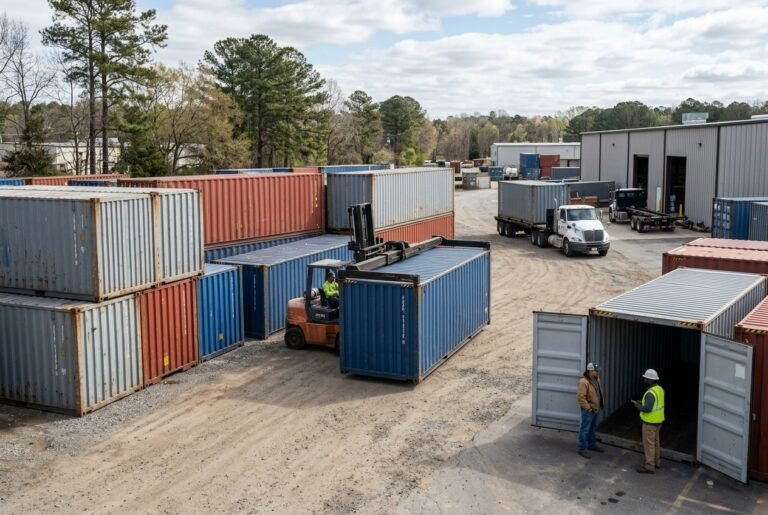
Delivery day is where all your preparation pays off – or where overlooked details create problems. Be on-site when the truck arrives. The driver needs someone who can confirm the exact placement location, flag any last-minute obstacles, and sign for the delivery.
Clear the area of all people, pets, and vehicles that don’t need to be there. A container sliding off a tilt-bed or swinging from a crane is not a spectator event. Establish a safe perimeter of at least 50 feet around the offloading zone. If you have workers on-site, brief them on the delivery plan and ensure they stay clear during placement. OSHA standard 29 CFR 1926.1400 governs crane operations and requires a designated signal person and defined swing radius – even on private property, following these guidelines protects everyone involved.
Have your foundation measurements written down and accessible. The driver may need to know exact distances from reference points to place the container precisely. A few inches off can mean the difference between a container that clears your fence line and one that doesn’t.
Choosing Between Tilt-Bed and Crane Offloading
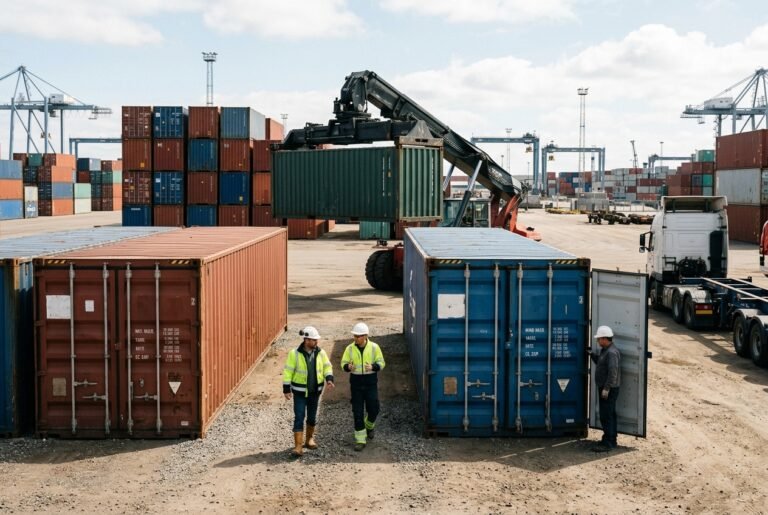
Tilt-bed delivery is the most common and cost-effective method. The truck backs up to the placement spot, tilts its bed hydraulically, and the container slides off onto the foundation. This method requires a straight, flat approach of at least 60 feet for a 40-foot container and about 40 feet for a 20-foot unit. The ground must be firm enough to support the truck during the tilting process.
Crane delivery costs more – typically $500 to $1,500 extra – but offers flexibility that tilt-bed cannot match. A crane can lift a container over fences, walls, and other structures, and place it in locations a truck can’t reach directly. If your site has tight access, obstacles between the road and the placement area, or requires the container to be placed parallel to the delivery path rather than in line with it, crane delivery is likely your only option.
Discuss the offloading method with your supplier before delivery day. Lease Lane Containers’ Raleigh-based team can help you determine which method works for your specific site based on the access details you provide during the delivery planning process. Making this decision early avoids day-of scrambles and rescheduling fees.
Final Checklist
Use this checklist to confirm your site is ready before scheduling delivery:
- Delivery route measured: minimum 12 feet wide, firm surface, no soft spots
- Overhead clearance verified: 16 feet minimum along entire route and at placement site
- Turning radius confirmed: 55 feet for 40-foot containers, 40 feet for 20-foot containers
- Foundation installed and level: within 1 inch across full container length
- Drainage graded: 1 inch per foot slope away from container for at least 6 feet
- Utilities trenched and stubbed: electrical, plumbing, and data lines in place and marked
- Permits obtained: zoning approval, building permits, and HOA clearance as required
- 811 called: underground utilities marked at least 3 business days prior to digging
- Delivery method confirmed: tilt-bed or crane, with supplier notified
- Site cleared: no debris, vehicles, or obstacles on foundation or delivery path
- Overhead lines addressed: utility company contacted for temporary disconnection if needed
- Someone on-site for delivery: available to direct placement and sign for the container
Thorough shipping container site preparation protects your investment from day one. Every dollar spent on proper grading, drainage, and foundation work pays for itself many times over in avoided repairs, easier access, and longer container life. If you’re planning a container project and want to compare your options before committing, browse our inventory to see available sizes, grades, and configurations. For questions about your specific site or delivery logistics, contact us and our team will help you plan a placement that works the first time.