Can a Shipping Container Fit in Your Driveway?
Table of Contents
- Table of Contents
- Standard Shipping Container Dimensions vs. Driveway Sizes
- Comparing 20-Foot and 40-Foot Footprints
- Width and Height Clearance Requirements
- Assessing Driveway Weight Capacity and Structural Integrity
- Concrete vs. Asphalt: Risk of Cracking
- Protecting the Surface with Wood or Steel Plates
- Logistics of Delivery: The Tilt-Bed and Crane Factor
- Necessary Clearance for the Delivery Truck
- Navigating Local Zoning Laws and HOA Restrictions
- Temporary vs. Permanent Placement Permits
- Environmental Obstacles and Overhead Hazards
- Managing Tree Branches and Power Lines
- Dealing with Steep Inclines and Sloped Driveways
- Site Preparation Checklist for a Successful Drop-Off
- Alternative Placement Options if the Driveway Fails
Table of Contents
- Standard Shipping Container Dimensions vs. Driveway Sizes
- Assessing Driveway Weight Capacity and Structural Integrity
- Logistics of Delivery: The Tilt-Bed and Crane Factor
- Navigating Local Zoning Laws and HOA Restrictions
- Environmental Obstacles and Overhead Hazards
- Site Preparation Checklist for a Successful Drop-Off
- Alternative Placement Options if the Driveway Fails
One of the most common questions we hear from homeowners, contractors, and small business owners is whether a shipping container can actually be delivered to a driveway. The short answer: yes, but only if the driveway meets specific size, weight, and access requirements. A surprising number of buyers assume that because a container fits the physical footprint, delivery will be straightforward. That assumption leads to cracked concrete, downed power lines, and costly rescheduling fees.
The reality is that getting a container from a depot to your property involves a chain of logistical considerations that go well beyond measuring length and width. You need to account for the delivery vehicle itself, overhead clearance, surface load-bearing capacity, local permit requirements, and the grade of your driveway. Skip any one of these, and you risk damage to your property or a failed delivery attempt. Whether you are planning a backyard workshop, on-site storage for a renovation project, or overflow inventory space for a small business, proper delivery planning is the difference between a smooth drop-off and an expensive headache. Here is everything you need to know before scheduling that delivery.
Standard Shipping Container Dimensions vs. Driveway Sizes
Before you even think about permits or surface prep, the first question is basic geometry: does the container physically fit? Most residential driveways in the U.S. range from 10 to 20 feet wide and 20 to 50 feet long. Those numbers might sound generous, but once you factor in the delivery method and the space the truck needs, things get tight fast.
Comparing 20-Foot and 40-Foot Footprints
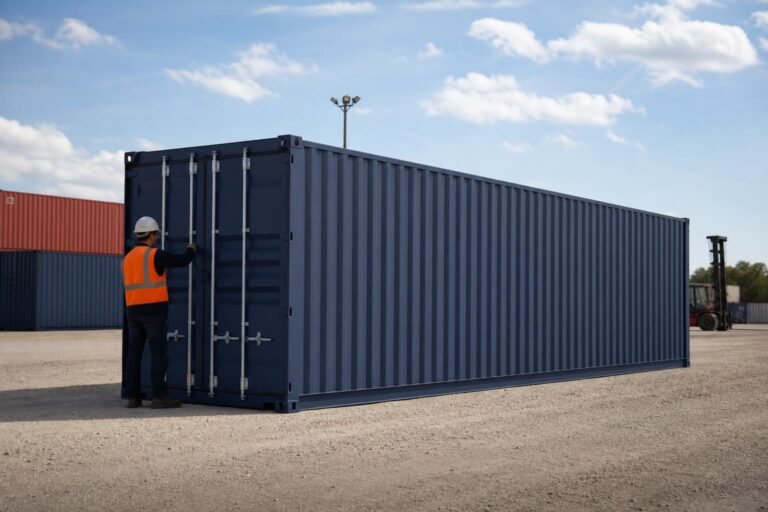
A standard 20-foot shipping container measures 20 ft long x 8 ft wide x 8 ft 6 in tall. A 40-foot container doubles the length to 40 ft while keeping the same 8-foot width and 8 ft 6 in height. High cube shipping containers add another foot of height, bringing the total to 9 ft 6 in.
For a 20-foot container, you need a minimum clear area of roughly 20 ft x 10 ft, giving yourself a foot of clearance on each side for positioning adjustments. A 40-foot container requires 40 ft x 10 ft of unobstructed space. Most single-car driveways are about 10 to 12 feet wide, which is technically sufficient for the container itself. Double-car driveways at 20 to 24 feet wide offer much more flexibility.
The catch is that the container doesn’t arrive on its own: it arrives on a truck that needs room to maneuver. A 20-foot container on a tilt-bed truck requires approximately 70 feet of straight-line clearance. A 40-foot container needs closer to 100 feet. If your driveway is shorter than these distances, the driver may need to use the street for part of the approach, which introduces its own complications with traffic, curbs, and municipal regulations.
Width and Height Clearance Requirements
Width clearance matters more than most buyers expect. You need at least 12 feet of horizontal clearance to allow the container to slide off the truck without scraping fences, walls, or parked vehicles. If your driveway narrows near the garage or has retaining walls on either side, measure at the tightest point.
Height is equally critical. The delivery truck with a container loaded on top sits between 13 and 14 feet tall. Garage door openings, carport roofs, and low-hanging tree canopies all become obstacles. If you have a covered entryway or a basketball hoop mounted above the driveway, measure that clearance before scheduling. Even a few inches short can halt a delivery entirely.
Assessing Driveway Weight Capacity and Structural Integrity
A standard 20-foot container weighs approximately 5,000 lbs (2,268 kg) empty. A 40-foot container comes in around 8,500 lbs (3,856 kg). Those numbers represent just the container. Once you load it with tools, building materials, furniture, or inventory, the total weight can reach 10,000 to 40,000 lbs depending on the container size and contents.
The delivery truck itself weighs 20,000 to 30,000 lbs before the container is even on it. That means your driveway needs to support 25,000 to 70,000 lbs of combined vehicle and container weight during the drop-off process.
Concrete vs. Asphalt: Risk of Cracking
Concrete driveways are generally the strongest residential surface, with a typical residential pour rated for about 3,000 to 4,000 PSI (pounds per square inch). A well-built 4-inch-thick concrete driveway can usually handle the weight of a loaded delivery truck and a 20-foot container without issues. Driveways that are older, cracked, or poured thinner than 4 inches are at higher risk.
Asphalt is softer and more vulnerable. On hot days, asphalt becomes pliable, and the concentrated weight of a container’s corner castings can punch right through the surface. A shipping container’s weight is distributed across four corner points, each bearing roughly 25% of the total load. That concentrated pressure is very different from the distributed weight of a car’s four tires. If your driveway is asphalt and you live somewhere with warm summers, like Raleigh, North Carolina, or anywhere in the Southeast, plan for surface protection.
Protecting the Surface with Wood or Steel Plates
The simplest protection method is placing pressure-treated lumber or steel plates under the container’s four corners. Railroad ties work well: they are dense, weather-resistant, and distribute weight across a larger area. A common setup uses two 6 ft x 12 in x 6 in timbers under each end of the container, spreading the load from a 6-inch corner casting across 12 square feet of surface.
Steel plates (typically 1/2-inch thick, 2 ft x 2 ft) are another option, especially on asphalt. They prevent the corner castings from sinking into the surface during hot weather. Some buyers use a combination: steel plates on the ground, then timbers on top, then the container. This sandwich approach distributes weight effectively and raises the container slightly, which also improves drainage underneath.
Budget roughly $100 to $300 for lumber or steel plates. It is a small investment compared to the $2,000 to $5,000 cost of repaving a damaged driveway.
Logistics of Delivery: The Tilt-Bed and Crane Factor
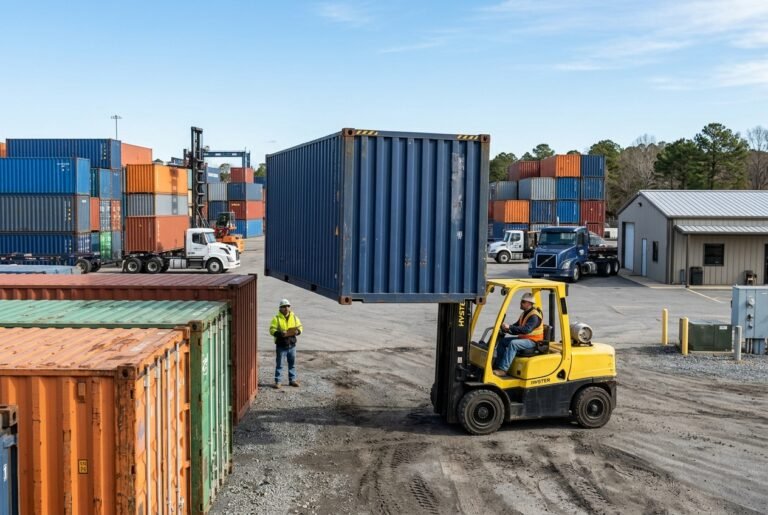
The delivery method determines how much space you actually need. Two primary methods are used for residential shipping container delivery: tilt-bed trucks and crane placement.
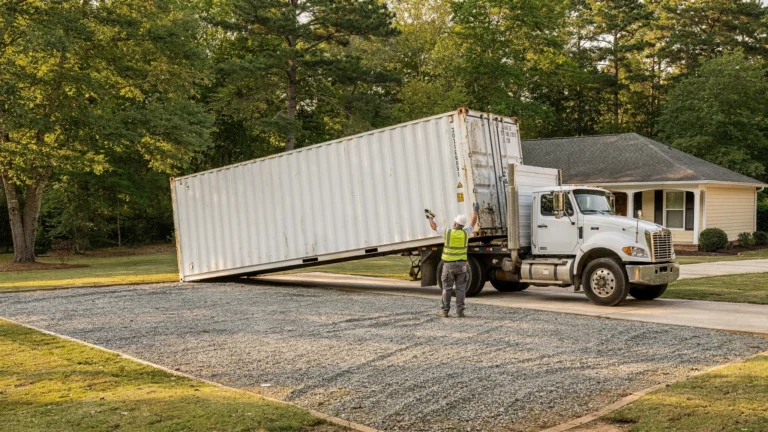
Tilt-bed (also called rollback or slide-off) trucks are the most common. The truck backs up to the placement spot, tilts the bed hydraulically, and slides the container off the back. This method is cost-effective, typically $200 to $500 for local delivery, but it demands the most space. The truck needs a straight, level approach with enough room to back in, tilt, and pull forward once the container is grounded.
Crane delivery costs more, usually $500 to $2,000 depending on the crane size and duration, but it offers far more flexibility. A crane can lift a container over fences, walls, or other obstacles and place it precisely where you want it. If your driveway is too short, too narrow, or has a tight turn, crane delivery may be the only viable option.
Necessary Clearance for the Delivery Truck
For tilt-bed delivery, the rule of thumb is the 3X rule: you need roughly three times the container length in straight-line clearance behind the placement spot. A 20-foot container needs about 60 to 70 feet. A 40-foot container needs 90 to 100 feet. This accounts for the truck length, the tilting mechanism, and the forward pull-away distance.
The truck itself is typically 8 ft 6 in wide. Add mirrors, and you are looking at about 10 feet of width. Your driveway entrance and any gates along the path need to accommodate this. Turning radius is another factor: if the truck has to turn off a street into your driveway, it needs a wide enough arc to avoid clipping curbs, mailboxes, or landscaping. Most delivery drivers recommend a minimum turning radius of 30 feet for a standard tilt-bed truck.
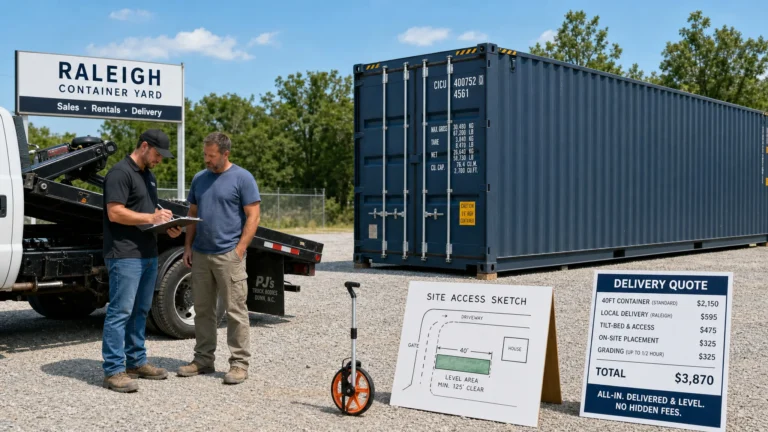
At Lease Lane Containers, our Raleigh-based team provides delivery planning support that includes reviewing your site photos, measuring access points, and recommending the right delivery method before a truck ever leaves the yard. Getting this right on the first attempt saves time and money.
Navigating Local Zoning Laws and HOA Restrictions
Even if your driveway can physically accommodate a shipping container, local regulations may prevent you from placing one there. Zoning laws vary significantly by municipality, and what is allowed in unincorporated Wake County may be prohibited within Raleigh city limits or vice versa.
Most municipalities classify shipping containers as accessory structures. This means they fall under the same rules as sheds, detached garages, and storage buildings. Common restrictions include setback requirements (how far the container must sit from property lines), maximum height limits, and aesthetic standards (some jurisdictions require containers to be screened from public view).
HOA restrictions add another layer. Many homeowners associations explicitly prohibit shipping containers, even temporarily. Others allow them during active construction projects with a time limit, typically 30 to 90 days. Check your HOA covenants before ordering. Getting a container delivered only to receive a violation notice and daily fines is an expensive mistake.
Temporary vs. Permanent Placement Permits
The distinction between temporary and permanent placement matters enormously for permit requirements. A temporary placement, usually defined as less than 60 to 180 days depending on the jurisdiction, often requires only a simple permit or no permit at all. This is common for renovation projects, moving storage, or seasonal inventory overflow.
Permanent placement triggers stricter requirements. You may need a building permit, a site plan review, and compliance with the International Building Code (IBC) or local amendments. Some jurisdictions require a foundation or anchoring system for permanent containers. Others mandate that the container be painted or clad to match surrounding structures.
Call your local planning department before scheduling delivery. In Wake County, the Planning and Zoning office can be reached at (919) 856-6335. For the City of Raleigh, contact the Development Services Center at (919) 996-2495. A five-minute phone call can prevent weeks of delays and hundreds of dollars in fines.
Environmental Obstacles and Overhead Hazards
Your driveway might check every box for size and weight, but the environment around it can still derail a delivery. Trees, power lines, slopes, and drainage patterns all factor into whether a container can safely reach its intended spot.
Managing Tree Branches and Power Lines
Overhead power lines are the single most dangerous obstacle during shipping container delivery. A loaded tilt-bed truck stands 13 to 14 feet tall. Standard residential power lines hang at 15 to 18 feet above ground, but they sag in hot weather and can dip lower over driveways that slope upward from the street. If there is any question about clearance, contact your utility company for a height measurement. In North Carolina, Duke Energy handles most residential power line inquiries.
Tree branches are less dangerous but equally problematic. A single thick branch at 12 feet can block a delivery truck entirely. Trimming branches before delivery day is far cheaper than rescheduling a failed delivery. Budget $200 to $500 for professional tree trimming if needed, and handle it at least a week before your delivery date.
If power lines cross directly over your driveway and clearance is insufficient, you can request a temporary line raise from your utility provider. This typically costs $300 to $1,000 and requires 2 to 4 weeks of lead time. Some delivery companies will not attempt a drop-off if power lines are within 10 feet of the truck’s path, regardless of measured clearance.
Dealing with Steep Inclines and Sloped Driveways
Tilt-bed trucks require a relatively flat surface to operate safely. Most drivers will not attempt a slide-off delivery on a grade steeper than 5% (about a 3-degree incline). On steeper slopes, the container can slide uncontrollably off the truck bed, and the truck itself may lose traction.
If your driveway has a significant slope, measure the grade. You can do this with a 4-foot level and a tape measure: place the level on the driveway surface, level it, and measure the gap between the low end of the level and the ground. Divide that gap by 48 inches and multiply by 100 to get the percentage grade. Anything above 5% means you should plan for crane delivery or consider an alternative placement location.
Driveways that slope toward the house present a drainage concern as well. A container placed at the low point of a sloped driveway can redirect rainwater toward your foundation. Grading the area or installing a French drain before delivery prevents long-term water damage.
Site Preparation Checklist for a Successful Drop-Off
Proper site prep is the difference between a 30-minute delivery and a two-hour ordeal that damages your property. Complete these steps at least one week before your scheduled delivery:
- Measure your driveway length, width, and height clearance at the narrowest and lowest points. Compare against the container dimensions and the delivery truck requirements.
- Check the driveway surface for cracks, soft spots, or drainage issues. Repair any significant damage before the truck arrives.
- Place lumber or steel plates at the container’s intended corner positions. Mark the exact placement with spray paint or stakes.
- Remove all vehicles, trash cans, basketball hoops, and portable structures from the driveway and the truck’s approach path.
- Trim tree branches to a minimum of 15 feet above the driveway surface along the entire delivery path.
- Confirm overhead power line clearance is at least 14.5 feet. Contact your utility provider if clearance is questionable.
- Verify your permit status with the local planning department. Have the permit number on hand for delivery day.
- Notify your HOA if required. Get written approval and keep a copy.
- Alert your neighbors, especially if the delivery truck will temporarily block the street or an adjacent driveway.
- Confirm the delivery time window with your container supplier and ensure someone is on-site to direct the driver.
This checklist covers about 90% of the issues that cause failed or delayed deliveries. The remaining 10% are weather-related or mechanical, and those are harder to plan around.
Alternative Placement Options if the Driveway Fails
Sometimes the driveway simply does not work. The approach is too narrow, the surface cannot handle the weight, or zoning restrictions prohibit driveway placement. That does not mean you cannot get a container on your property.
Backyard placement is the most common alternative. If you have a side yard or rear access point wide enough for a delivery truck or crane, the container can bypass the driveway entirely. Many rural properties and larger suburban lots in areas outside Raleigh have rear access through service roads or wide side gates. A gate opening of at least 10 feet and a path clear of underground utilities makes backyard placement feasible.
Gravel pads are another popular solution. A 6-inch-deep gravel pad slightly larger than the container footprint provides excellent drainage, weight distribution, and leveling. A gravel pad for a 20-foot container costs roughly $500 to $1,500 depending on your region and gravel type. Crushed stone (3/4-inch minus) compacts well and creates a stable, long-lasting base.
For commercial buyers or contractors working on job sites, placing the container on an adjacent lot or designated staging area may be the most practical option. Coordinate with your general contractor or property manager to identify a spot with better access. Some buyers also explore street permits for temporary curbside placement, though these are harder to obtain in residential neighborhoods.
If you are comparing container sizes and grades and are unsure which option fits your site, Lease Lane Containers offers guidance on matching the right container to your specific placement scenario. A one-trip container and a used shipping container have the same exterior dimensions, but understanding the condition and intended use helps you plan the full project, from purchase through delivery and setup.
Getting a shipping container delivered to your driveway is entirely doable for most properties, but it demands more planning than most buyers expect. The key factors: physical dimensions, surface strength, delivery truck clearance, local permits, and overhead hazards all need to line up before the truck arrives. Skipping even one of these steps risks property damage, failed deliveries, or municipal fines.
Start by measuring your space, checking your local zoning rules, and preparing the surface. If you are ready to move forward, browse our inventory to compare container sizes, grades, and pricing for your project. And if you have questions about delivery logistics or site access, contact us directly: our team is happy to help you plan a successful first-time delivery.