

7 Essential Shipping Container Placement Requirements
Table of Contents
- Table of Contents
- Evaluating Ground Stability and Soil Composition
- Assessing Load-Bearing Capacity
- Managing Moisture and Drainage
- Selecting the Right Foundation Type
- Concrete Footings vs. Gravel Pads
- Ensuring a Perfectly Level Surface
- Preventing Structural Stress and Door Misalignment
- Providing Clearance for Delivery and Access
- Vertical and Horizontal Space Requirements
- Adhering to Local Zoning and Permit Regulations
- Setback Requirements and HOA Compliance
- Optimizing Site Orientation for Long-Term Use
- Solar Exposure and Wind Protection
- Utility Proximity and Safety Clearances
- Connecting Electrical and Plumbing Lines
- Final Checklist
Table of Contents
- Evaluating Ground Stability and Soil Composition
- Selecting the Right Foundation Type
- Ensuring a Perfectly Level Surface
- Providing Clearance for Delivery and Access
- Adhering to Local Zoning and Permit Regulations
- Optimizing Site Orientation for Long-Term Use
- Utility Proximity and Safety Clearances
- Final Checklist
A 20-foot steel shipping container weighs roughly 5,000 lbs empty. A 40-foot container tips the scale closer to 8,500 lbs. Load either one with equipment, inventory, or building materials, and you could be looking at 30,000 to 60,000 lbs sitting on a single patch of ground. Where and how you place that kind of weight matters enormously, and getting it wrong leads to problems that are expensive to fix after the fact: sinking foundations, jammed doors, cracked welds, and even code violations that force you to relocate the entire unit.
The requirements for placing a shipping container correctly go well beyond picking a flat-looking spot in your yard or on a job site. You need to account for soil conditions, drainage, foundation type, delivery access, local building codes, sun exposure, wind patterns, and proximity to utilities. Skip any one of these, and you risk structural damage, permit issues, or a delivery truck that simply cannot reach your site. Lease Lane Containers works with buyers across the U.S. on delivery planning and site prep, and the most common regret we hear is “I wish I’d thought about placement before the truck showed up.” This guide covers the seven essential factors you need to address before your container ever leaves the yard.
Evaluating Ground Stability and Soil Composition
The ground beneath your container is doing all the structural work. Unlike a traditional building with deep footings and distributed loads, a shipping container concentrates its weight primarily at four corner castings, each roughly 6 inches square. That means the load-bearing pressure at each corner can exceed 7,500 lbs for a fully loaded 40-foot unit. If the soil underneath cannot handle that concentrated force, you will see settling, tilting, or outright sinking within months.
Different soil types behave very differently under load. Compacted gravel and sandy loam drain well and hold weight reliably. Clay soils are trickier: they expand when wet and shrink when dry, creating seasonal movement that shifts your container out of level. Organic topsoil, peat, and any recently filled or graded land are poor candidates without significant preparation. Before placing a container, you need a clear understanding of what is actually under the surface.
Assessing Load-Bearing Capacity
A simple test you can do yourself involves driving a 1/2-inch rebar stake into the ground at each proposed corner point. If the stake sinks easily past 12 inches with moderate hand pressure, the soil is too soft for direct placement without additional foundation work. Professional geotechnical testing provides more precise data, but most residential and small commercial placements do not require a formal soil report.
The 80% load rule is a useful guideline here: plan your foundation for at least 80% of the container’s maximum gross weight, not just its empty weight. A 20-foot container rated for a maximum gross weight of 52,910 lbs should have ground support capable of handling roughly 42,300 lbs even if you never plan to load it that heavily. Conditions change, and overbuilding the foundation slightly costs far less than correcting a failure later.
Managing Moisture and Drainage
Water is the single biggest threat to long-term container placement. Standing water around the base accelerates corrosion on the container’s steel underframe, and saturated soil loses its load-bearing capacity dramatically. A clay soil that supports 2,000 lbs per square foot when dry might drop to 800 lbs per square foot when waterlogged.
Grade the surrounding area so water flows away from the container on all sides, with a minimum slope of 2% (roughly 1/4 inch per foot). If your site sits in a low area or has a high water table, consider installing a French drain along the uphill side of the placement area. For properties in the Raleigh, North Carolina area, where annual rainfall averages around 46 inches, drainage planning is not optional. Failing to manage moisture will undermine even the best foundation within a few seasons.
Selecting the Right Foundation Type
Your foundation choice depends on three variables: soil conditions, how long the container will stay in place, and whether you plan to modify or build onto it. A temporary storage setup on a construction site has very different foundation needs than a permanent container office or workshop.
There is no single correct answer, but there are clearly wrong ones. Placing a container directly on bare earth is almost always a mistake. Even for short-term use, some form of prepared base protects both the container and the ground beneath it. The investment in a proper foundation is small relative to the cost of the container itself, and it pays off immediately in stability and longevity.
Concrete Footings vs. Gravel Pads
Concrete pier footings placed at each corner casting are the gold standard for permanent placement. A typical pier measures 24 inches square and 12 inches deep, poured on undisturbed or compacted soil below the frost line (which ranges from 6 to 12 inches in central North Carolina, but can exceed 36 inches in northern states). This approach keeps the container elevated, promotes airflow beneath the unit, and provides rock-solid support at the four load-bearing points.
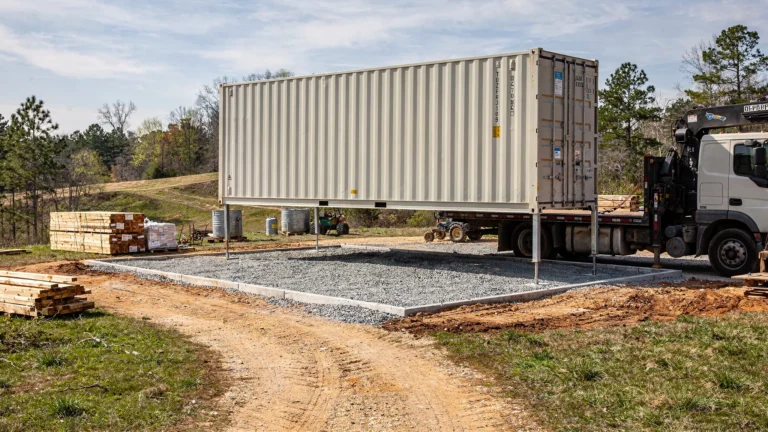
Gravel pads offer a faster, less expensive alternative that works well for semi-permanent installations. A properly built gravel pad uses 6 to 8 inches of compacted 3/4-inch crushed stone over a geotextile fabric layer. The fabric prevents the gravel from mixing into the native soil over time. Gravel pads distribute the load more broadly and drain naturally, making them a strong choice for storage containers on residential or farm properties.
Other options include concrete slab foundations (best for modified containers with interior finishes), railroad ties or treated timber beams (acceptable for temporary setups), and helical piers (ideal for sloped sites or areas with poor soil). Each has trade-offs in cost, permanence, and installation complexity.
Ensuring a Perfectly Level Surface
A shipping container is an engineered steel structure designed to stack and travel on flat surfaces: ship decks, rail cars, and chassis trailers. The structural integrity of the container depends on its frame sitting level. Even a 1-inch deviation across a 40-foot span creates measurable stress on the corner castings and side rails.
Most people underestimate how precise the leveling needs to be. Your eye is not a reliable tool here. A 4-foot spirit level or a laser level is essential equipment during site preparation. Check level both lengthwise and widthwise at multiple points, not just at the corners.
Preventing Structural Stress and Door Misalignment
The most immediate symptom of an unlevel container is doors that stick, bind, or refuse to latch. Shipping container doors are designed with very tight tolerances: the locking rods, cam handles, and hinges all depend on the frame being square. When the frame racks even slightly due to uneven support, those tolerances disappear. You will find yourself fighting the doors every time you open or close them.
Beyond the doors, an unlevel container experiences uneven loading on its corrugated wall panels and roof. Over time, this creates fatigue points where panels can crack or separate from the frame. Water pooling on a slightly tilted roof accelerates corrosion in spots that are difficult to inspect and repair. The 20-20-20 rule is a practical benchmark: check your container’s level at 20 days, 20 weeks, and 20 months after placement. Soil settles, gravel compacts, and seasonal moisture changes can gradually shift even a well-prepared foundation. Catching small deviations early lets you shim or re-level before damage occurs.
Providing Clearance for Delivery and Access
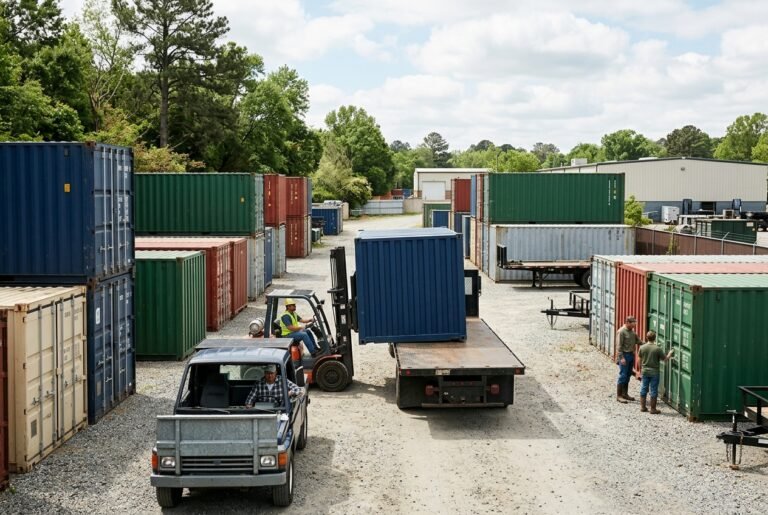
Your site might have perfect soil, an ideal foundation, and flawless leveling, but none of that matters if the delivery truck cannot physically reach the placement spot. Shipping container delivery is one of the most overlooked aspects of the entire process, and it is the source of most day-of-delivery problems.
A standard delivery uses either a tilt-bed trailer or a roll-off truck. Both require significant space to maneuver, and both need a clear path from the road to the final placement location. Planning this access route in advance is essential, and Lease Lane Containers provides delivery planning guidance to help buyers avoid surprises on delivery day.
Vertical and Horizontal Space Requirements
A tilt-bed truck carrying a 40-foot container needs approximately 100 feet of straight, level space to slide the container off the back of the trailer. The truck itself is about 65 feet long, and it needs room behind the placement spot to pull forward after the container is grounded. For a 20-foot container, plan for at least 70 feet of clear length.
Vertical clearance is equally critical. A high cube shipping container on a tilt-bed trailer sits approximately 14.5 feet above the road surface at its highest point during the tilt process. Low-hanging power lines, tree branches, carport roofs, and building overhangs all become obstacles. Measure every potential overhead obstruction along the entire delivery path, not just at the placement spot.
Width requirements are often the tightest constraint. The delivery truck needs a minimum of 12 feet of clear width along the entire route, and turning radius at corners or gate entries should allow for at least a 40-foot swing. Walk the entire route from the street to the placement area and note every pinch point: fence posts, mailboxes, parked vehicles, retaining walls, and drainage ditches. If a roll-off truck is required instead of a tilt-bed (common for tight sites), the space requirements change, but the truck still needs roughly 60 feet of straight clearance behind the drop point.
Adhering to Local Zoning and Permit Regulations
Zoning and permitting rules for shipping containers vary dramatically from one jurisdiction to the next. Some counties treat a container as a temporary accessory structure requiring no permit at all. Others classify it as a permanent building that must meet full commercial or residential building codes, including inspections. Assuming you know the rules without checking is a reliable way to end up with a removal order and a fine.
Start with your local planning or zoning department. In Wake County, North Carolina, you can contact the Wake County Planning Department at (919) 856-6335 or visit their website to verify zoning classifications for your parcel. Unincorporated areas often have more relaxed rules than city limits, but “more relaxed” does not mean “no rules.”
Setback Requirements and HOA Compliance
Setback requirements dictate how far a structure must sit from property lines, road rights-of-way, and other buildings. Typical residential setbacks range from 5 to 25 feet depending on the zone and the type of structure. A shipping container placed too close to a property line can trigger a violation even if you own the land outright.
HOA restrictions add another layer. Many homeowners’ associations explicitly prohibit shipping containers or restrict them to rear yards with screening requirements (fencing, landscaping, or both). Some HOAs ban them entirely regardless of placement. Review your HOA covenants before purchasing a container, not after. Getting a variance or exception approved after the container is already on-site is significantly harder than getting pre-approval.
For commercial properties, check whether your zoning allows container use for your intended purpose. A container used as on-site storage at a construction company may be permitted by right, while the same container used as a retail space might require a special use permit or conditional zoning approval. The permit process can take anywhere from a few days to several months depending on your municipality, so factor that timeline into your project planning.
Optimizing Site Orientation for Long-Term Use
Once you have confirmed your foundation, access, and permits, the specific orientation of the container on the site deserves careful thought. Which direction the doors face, how the long walls align with the sun, and how the container sits relative to prevailing winds all affect daily usability and long-term condition.
For storage-only use, orient the doors toward your most frequent access point. This sounds obvious, but many buyers place the container based on delivery convenience and end up with doors facing a fence, wall, or slope that makes loading and unloading awkward. Think about forklift paths, hand-cart access, and how you will actually move items in and out on a regular basis.
Solar Exposure and Wind Protection
If you plan to spend time inside the container, whether as a workshop, container office, or retail space, solar exposure matters significantly. A container with its long wall facing south (in the Northern Hemisphere) will absorb substantially more solar heat than one oriented east-west. In Raleigh’s summer heat, where temperatures regularly exceed 90°F from June through September, a south-facing long wall can push interior temperatures above 130°F without insulation or ventilation.
Orient the container so the narrow ends face the strongest sun exposure, minimizing the surface area absorbing direct heat. If that is not possible due to site constraints, plan for insulation, reflective roof coatings, or shade structures on the sun-facing side.
Wind protection follows similar logic. Position the container so the narrow end faces the prevailing wind direction, reducing the surface area exposed to wind load. In central North Carolina, prevailing winds generally come from the southwest. Placing the container behind an existing structure, tree line, or terrain feature that breaks the wind reduces both structural stress and heat loss during winter months. For exposed sites, such as open farmland or coastal properties, wind orientation becomes even more critical. A 40-foot container presents roughly 320 square feet of surface area on its long side, and sustained winds of 50 mph generate approximately 1,600 lbs of lateral force against that surface.
Utility Proximity and Safety Clearances
If your container will need electricity, water, or internet connectivity, plan those connections before placement, not after. Moving a loaded shipping container even a few feet is expensive and disruptive. Running utility lines to a container that is already in the wrong spot costs more and often requires longer trenching runs than necessary.
Map every existing utility line on your property before finalizing placement. Call 811 (the national utility locator service) at least two business days before any digging. Underground electric, gas, water, sewer, and telecom lines are not always where you expect them to be, and hitting one during foundation work creates serious safety hazards and repair costs.
Connecting Electrical and Plumbing Lines
For electrical service, most container installations require a dedicated circuit run from your main panel or a sub-panel mounted on or near the container. A basic lighting and outlet setup for a storage container typically needs a 20-amp, 120-volt circuit. A container office with HVAC, computers, and lighting may require a 50-amp, 240-volt sub-panel. Keep the container within 100 feet of your electrical source if possible: voltage drop over longer runs requires heavier gauge wire, which increases cost.
Plumbing connections are more complex and almost always require a permit. If your container will include a sink, restroom, or wash station, you need both supply and drain lines. Drain lines must maintain a minimum slope of 1/4 inch per foot toward the sewer or septic connection, which limits how far the container can sit from the tie-in point. In cold climates, all supply and drain lines running to the container must be buried below the frost line or insulated and heat-traced to prevent freezing.
Maintain minimum safety clearances from all utilities. Keep the container at least 10 feet from overhead power lines (more if the lines carry high voltage), 5 feet from gas meters, and 3 feet from water shut-off valves. Your local utility provider can confirm specific clearance requirements for your area. These setbacks protect both the container and the utility infrastructure, and violating them can void your homeowner’s insurance coverage.
Final Checklist
Before your container arrives, confirm each of these items:
- Soil tested or visually assessed for load-bearing capacity at all four corner points
- Drainage graded at a minimum 2% slope away from the placement area on all sides
- Foundation installed: concrete piers, gravel pad, or slab, appropriate to your soil and timeline
- Surface leveled and verified with a spirit level or laser level in both directions
- Delivery path measured: minimum 12 feet wide, 100 feet long for a 40-foot container, 14.5 feet vertical clearance
- Zoning and permits confirmed with your local planning department; HOA approval obtained if applicable
- Setbacks verified: container placed within required distances from property lines, roads, and structures
- Orientation planned for door access, solar exposure, and prevailing wind direction
- Utility lines located via 811 and marked on-site
- Electrical and plumbing runs planned with appropriate circuit sizing and permit applications submitted
- Safety clearances maintained from overhead lines, gas meters, and water valves
Getting your container placement requirements right the first time saves real money and prevents headaches that compound over the life of the installation. Every hour spent on site preparation before delivery pays back tenfold in avoided repairs, code issues, and operational frustration. If you are still comparing container sizes and grades for your project, Lease Lane Containers can help you match the right unit to your site conditions and intended use. Browse our current inventory to see what is available, or contact us to talk through your placement plan with our Raleigh-based team before you commit.
One Comment