

Best Conex Boxes for Sale in Raleigh, NC
Best Conex Boxes for Sale in Raleigh, NC
Table of Contents
- Overview of Shipping Container Solutions in Raleigh
- Standard Sizes and Capacity Options
- Condition Grades: Choosing Between New and Used
- Local Delivery Logistics and Site Preparation
- Customization Services for Raleigh Businesses
- Comparing Top Conex Box Suppliers in North Carolina
- Investment Factors: Pricing and Long-Term Value
Raleigh’s growth over the past decade has pushed demand for practical, cost-effective storage and workspace solutions across the Triangle. Contractors need secure laydown yards. Homeowners want backyard storage that doesn’t rot after two seasons. Farms in eastern Wake County need grain and equipment shelters that can handle humidity without falling apart. Shipping containers check all of those boxes, which is why so many buyers are searching for conex boxes for sale in Raleigh, NC.
But picking the right container isn’t as simple as choosing the cheapest listing online. Size, condition grade, delivery access, and local permitting all affect whether you’ll be satisfied with your purchase six months from now. If you’re a first-time buyer or upgrading from a previous unit, this guide covers the practical details you need to make a confident decision: from 20-foot versus 40-foot trade-offs to Wake County zoning rules and the real cost differences between one-trip and surplus inventory. Every section is written for buyers in the Raleigh area, though much of the sizing and grading advice applies anywhere in the Southeast.
Table of Contents
- Overview of Shipping Container Solutions in Raleigh
- The Rise of Conex Boxes in the Research Triangle
- Standard Sizes and Capacity Options
- 20-Foot vs. 40-Foot Containers
- High Cube Models for Maximum Vertical Space
- Condition Grades: Choosing Between New and Used
- One-Trip Units for Aesthetic and Longevity
- Wind and Watertight (WWT) Surplus Inventory
- Local Delivery Logistics and Site Preparation
- Zoning and Permitting in Wake County
- Customization Services for Raleigh Businesses
- Climate Control and Insulation for NC Humidity
- Security Modifications and Personnel Doors
- Comparing Top Conex Box Suppliers in North Carolina
- Investment Factors: Pricing and Long-Term Value
Overview of Shipping Container Solutions in Raleigh
Raleigh sits at a logistics crossroads. I-40 and I-95 run within easy reach, and the Port of Wilmington is roughly 150 miles southeast. That proximity to a major shipping port means containers flow into the region regularly, keeping local inventory relatively strong compared to landlocked markets. Buyers here benefit from shorter delivery distances and, typically, lower transport surcharges.
The practical appeal of shipping containers goes beyond simple storage. Small businesses along Capital Boulevard use them for retail pop-ups. General contractors stage them on job sites across Cary, Apex, and Holly Springs for tool and material security. Rural landowners south of Garner rely on them for hay storage and workshop space. Each of these use cases demands a slightly different container spec, which is why understanding your options before you buy matters more than chasing the lowest sticker price.
The Rise of Conex Boxes in the Research Triangle
The Research Triangle’s population growth has averaged roughly 2% annually over the past five years, and commercial construction has kept pace. That construction boom means more job-site storage demand, more inventory overflow from expanding businesses, and more homeowners looking for durable backyard solutions.
“Conex” is military shorthand for “Container Express,” a term that stuck from the 1950s. Today, the name is used interchangeably with shipping container across the Southeast. If you see “conex box” in a listing, you’re looking at the same ISO-standard steel container used on cargo ships worldwide: corrugated Corten steel walls, marine-grade plywood flooring, and standardized corner castings for stacking and transport. That standardization is part of what makes them so versatile for secondary use.
Standard Sizes and Capacity Options
Two sizes dominate the market: 20-foot and 40-foot units. Other lengths exist (10-foot mini containers, 45-foot high cubes), but they’re specialty items with limited local availability. Your choice between the two standard sizes depends on what you’re storing, how much ground space you have, and your delivery access.
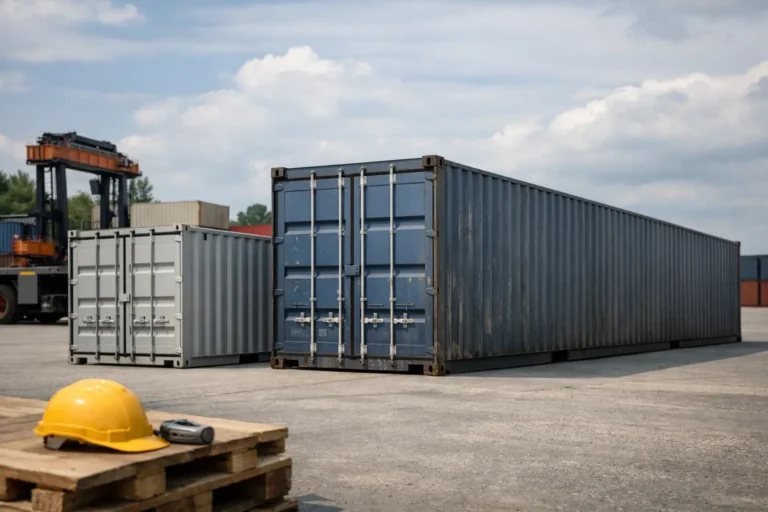
A 20-foot container offers roughly 1,170 cubic feet of interior volume and can hold about 47,900 pounds. A 40-foot container doubles the length and provides approximately 2,390 cubic feet with a max payload around 58,700 pounds. The rule of thumb: if you’re storing the contents of a two-bedroom apartment, a 20-foot unit works. If you’re staging materials for a commercial build-out, you’ll likely need 40 feet.
20-Foot vs. 40-Foot Containers
A 20-foot container measures 20 feet long by 8 feet wide by 8 feet 6 inches tall on the exterior. It fits comfortably on most residential driveways and requires a shorter delivery vehicle turning radius, typically around 60 feet. For homeowners in older Raleigh neighborhoods with narrow lots, this is often the only practical option.
A 40-foot container doubles the storage footprint but requires a straight-shot delivery path of at least 100 feet and a turning radius closer to 80 feet. If your site is off a cul-de-sac or behind a tight gate, measure twice before ordering. Lease Lane Containers provides delivery planning support that covers access width, overhead clearance (watch for power lines at 14 feet or lower), and turning geometry so the truck can place your container correctly the first time.
High Cube Models for Maximum Vertical Space
High cube shipping containers add one extra foot of interior height, bringing the total to 9 feet 6 inches on the exterior and roughly 8 feet 10 inches inside. That additional foot matters more than you’d expect. If you’re building out a container office, installing HVAC ductwork, or stacking pallets, the clearance makes a real difference in usability.
High cubes are available in both 20-foot and 40-foot lengths, though the 40-foot high cube is far more common in the used market. Expect to pay $300 to $800 more than a standard-height unit of the same grade. For anyone planning a conversion project or needing vertical clearance for shelving systems, the upcharge is usually worth it.
Condition Grades: Choosing Between New and Used
Container grading can be confusing because terminology isn’t fully standardized across the industry. Three grades cover the vast majority of what you’ll find in the Raleigh market: One-Trip, Cargo Worthy (CW), and Wind and Watertight (WWT). Each grade reflects a different balance of appearance, structural integrity, and price.
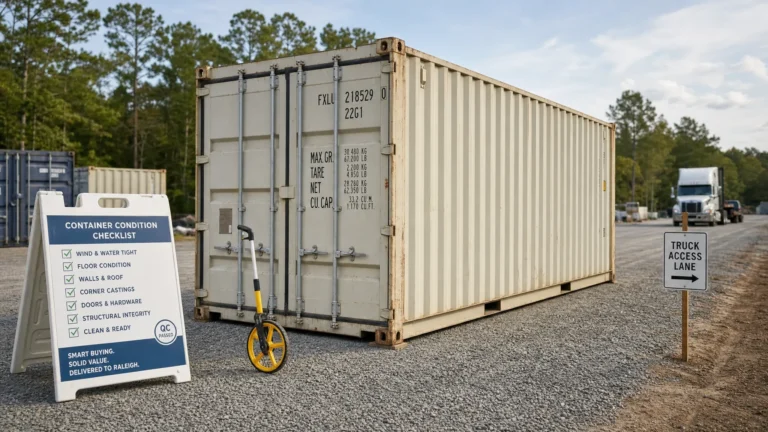
Understanding the distinction between exterior cosmetics and functional performance is key. A container with surface rust and dented panels might still be perfectly wind and watertight, while a cleaner-looking unit could have compromised door seals. Always ask for a clear grading explanation and, ideally, photos of the specific unit you’re buying.
One-Trip Units for Aesthetic and Longevity
A one-trip container has made a single ocean voyage, typically loaded with goods from an overseas manufacturer and shipped to a U.S. port. These units arrive in near-new condition: minimal surface wear, factory-fresh paint, intact rubber door gaskets, and clean marine-grade plywood floors (usually 28mm Apitong or bamboo composite).
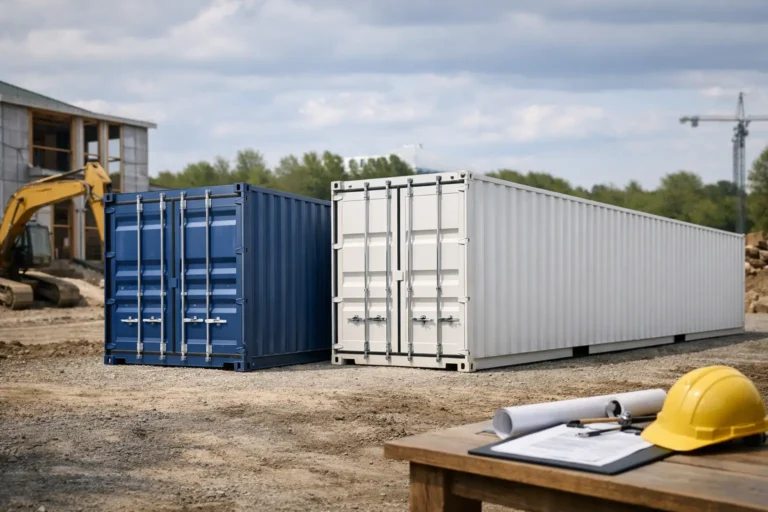
One-trip units cost more, generally $1,000 to $2,500 above a used unit of the same size. But they offer the longest remaining service life (25+ years with basic maintenance) and the cleanest appearance for visible placements. If your container will sit in a customer-facing area or serve as a converted workspace, the cosmetic premium pays for itself.
Wind and Watertight (WWT) Surplus Inventory
WWT containers have been retired from active shipping service. They’ve made multiple ocean crossings and show it: expect surface rust, dents, patched panels, and older paint. What they guarantee is that the container won’t leak. The doors close and seal, the roof is intact, and the walls have no perforations.
For pure storage on a farm, construction site, or back lot, WWT units are the most cost-effective option. Prices in the Raleigh area typically range from $1,800 to $3,500 for a 20-foot WWT and $2,200 to $4,500 for a 40-foot, depending on specific condition and market availability. Inspect the floor for soft spots and check that both door handles operate smoothly before finalizing your purchase.
Local Delivery Logistics and Site Preparation
Getting a shipping container to your property is half the project. The container itself might be perfect, but if your site isn’t ready, delivery day turns into a headache. Most containers in the Raleigh area are delivered by tilt-bed truck or chassis-mounted trailer, each requiring different clearance and ground conditions.
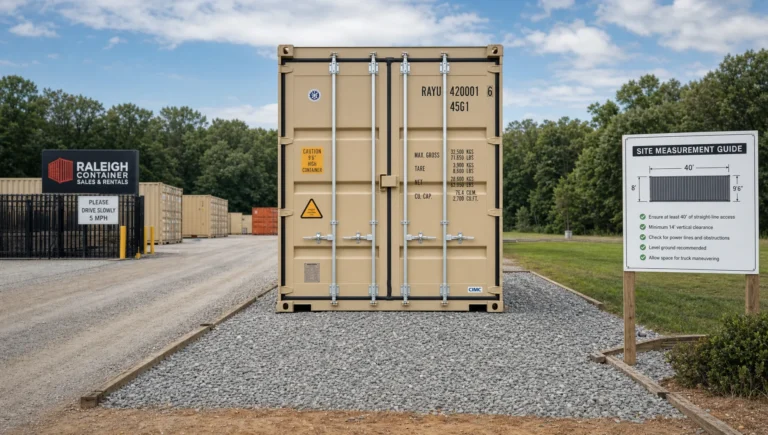
A tilt-bed truck needs roughly 80 to 100 feet of straight, level ground behind the delivery point for a 40-foot container. Overhead clearance should be at least 14 feet 6 inches to account for the tilted bed. Soft ground is the most common delivery problem: a loaded 40-foot container weighs over 8,000 pounds empty, and the truck adds another 20,000+ pounds. A compacted gravel pad (at least 6 inches deep, extending 2 feet beyond the container footprint on all sides) prevents sinking and keeps the unit level.
Zoning and Permitting in Wake County
Wake County and the City of Raleigh treat shipping containers differently depending on your zoning district and intended use. In most residential zones (R-4, R-6, R-10), a container used for temporary storage during an active building permit is generally allowed. Permanent placement as an accessory structure typically requires a zoning review.
Contact the Raleigh Planning and Development office at (919) 996-2626 or visit raleighnc.gov to confirm requirements for your specific parcel. If you’re outside city limits in unincorporated Wake County, the county’s Planning, Development, and Inspections division handles these reviews at (919) 856-6335. Don’t skip this step. A container placed without proper approval can result in code enforcement action and forced removal.
Customization Services for Raleigh Businesses
A standard shipping container is a steel box with double doors on one end. That’s enough for basic storage, but many Raleigh buyers need more. Container modifications range from simple additions like lock boxes and vents to full build-outs with electrical panels, lighting, and climate control.
The most requested modifications in the Triangle area fall into two categories: climate control for humidity management and security upgrades for high-value contents. Both are straightforward to implement before delivery if you work with a supplier who coordinates modifications in advance.
Climate Control and Insulation for NC Humidity
North Carolina’s average relative humidity hovers around 70% year-round, spiking higher in summer. Inside an uninsulated steel container, that moisture condenses on walls and ceiling, creating “container rain” that can damage stored goods, tools, and documents.
Closed-cell spray foam insulation (2 to 3 inches on walls and ceiling) is the most common solution. It provides both thermal insulation (R-13 to R-19) and a vapor barrier in one application. For containers used as offices or workshops, a mini-split HVAC system rated at 12,000 to 18,000 BTU handles the cooling load for a 20-foot or 40-foot unit, respectively. Budget $2,500 to $5,000 for insulation and climate control on a standard-size container.
Security Modifications and Personnel Doors
The standard container lock rod system is decent but not exceptional. A puck lock and hasp welded over the existing lock rod is the minimum recommended upgrade. For higher-security applications, some buyers add crossbar lock systems or electronic keypads.
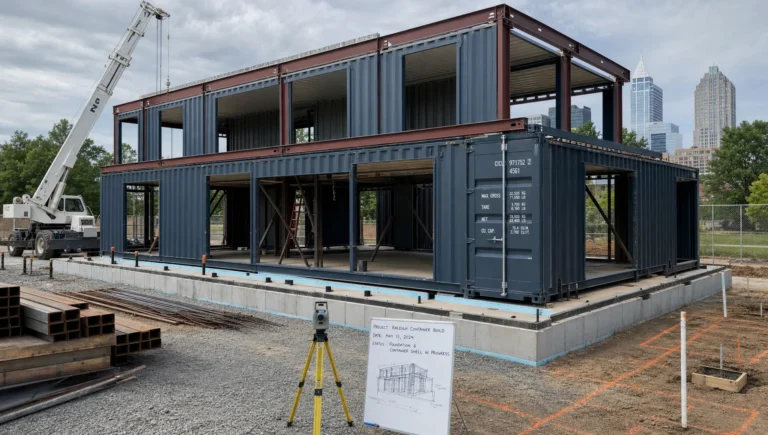
Personnel doors (a standard 36-inch man door installed in the side wall) are essential if your container serves as a workspace. Walking through the cargo doors every time is impractical for daily use. Roll-up doors on the side wall are another popular option for inventory access. These modifications require professional cutting and welding to maintain the container’s structural integrity, so they’re best ordered before delivery rather than attempted on-site.
Comparing Top Conex Box Suppliers in North Carolina
The Raleigh market has several container suppliers, and they aren’t all equal. Some operate as brokers who never physically handle the containers they sell. Others maintain local inventory yards where you can inspect units before purchase. A few key questions help you separate reliable suppliers from middlemen.
Ask whether you can see photos of your specific unit (not stock photos). Ask where the container is currently located and who handles delivery. Confirm whether the quoted price includes delivery or if transport is billed separately. Lease Lane Containers, based in Raleigh at 5832 Lease Ln, Ste B, offers transparent grading guidance and delivery planning for buyers across North Carolina and nationwide. Their team walks you through grade differences, site access requirements, and sizing decisions before you commit, which reduces the chance of surprises on delivery day.
Investment Factors: Pricing and Long-Term Value
Shipping container prices in the Raleigh area fluctuate with global shipping rates, steel prices, and seasonal demand. As a general benchmark, expect to pay $2,800 to $5,500 for a 20-foot one-trip unit and $4,000 to $7,500 for a 40-foot one-trip. Used WWT units run 30% to 50% less, depending on condition.
A well-maintained shipping container holds its value better than almost any other storage structure. After 10 years, a one-trip container typically retains 50% to 60% of its purchase price. Compare that to a wood-frame shed, which depreciates faster and requires ongoing maintenance (paint, roof repair, pest treatment). The steel container needs little beyond occasional door hinge lubrication and a rust-inhibiting touch-up every few years.
When evaluating total cost, factor in delivery ($150 to $500+ locally, more for rural sites), site prep (gravel pad runs $500 to $1,500 depending on size), and any modifications. A 20-foot WWT container with a gravel pad and basic lock upgrade might total $3,500 all-in, which is competitive with a comparable pre-built shed that won’t last as long.
Final Checklist for Raleigh Container Buyers
- Measure your delivery path: width, length, overhead clearance, and turning radius
- Confirm your zoning district allows container placement for your intended use
- Decide between one-trip (appearance, longevity) and WWT (budget storage)
- Choose 20-foot for tighter sites or 40-foot for maximum capacity
- Request photos of the specific unit, not stock images
- Budget for delivery, site prep, and any modifications beyond the base price
If you’re ready to compare options, browse available inventory from Lease Lane Containers to see current sizes, grades, and pricing. Their Raleigh-based team can help you match the right container to your project and plan delivery logistics before you buy.

This article is really a pleasant one it helps new net viewers, who are wishing for blogging.