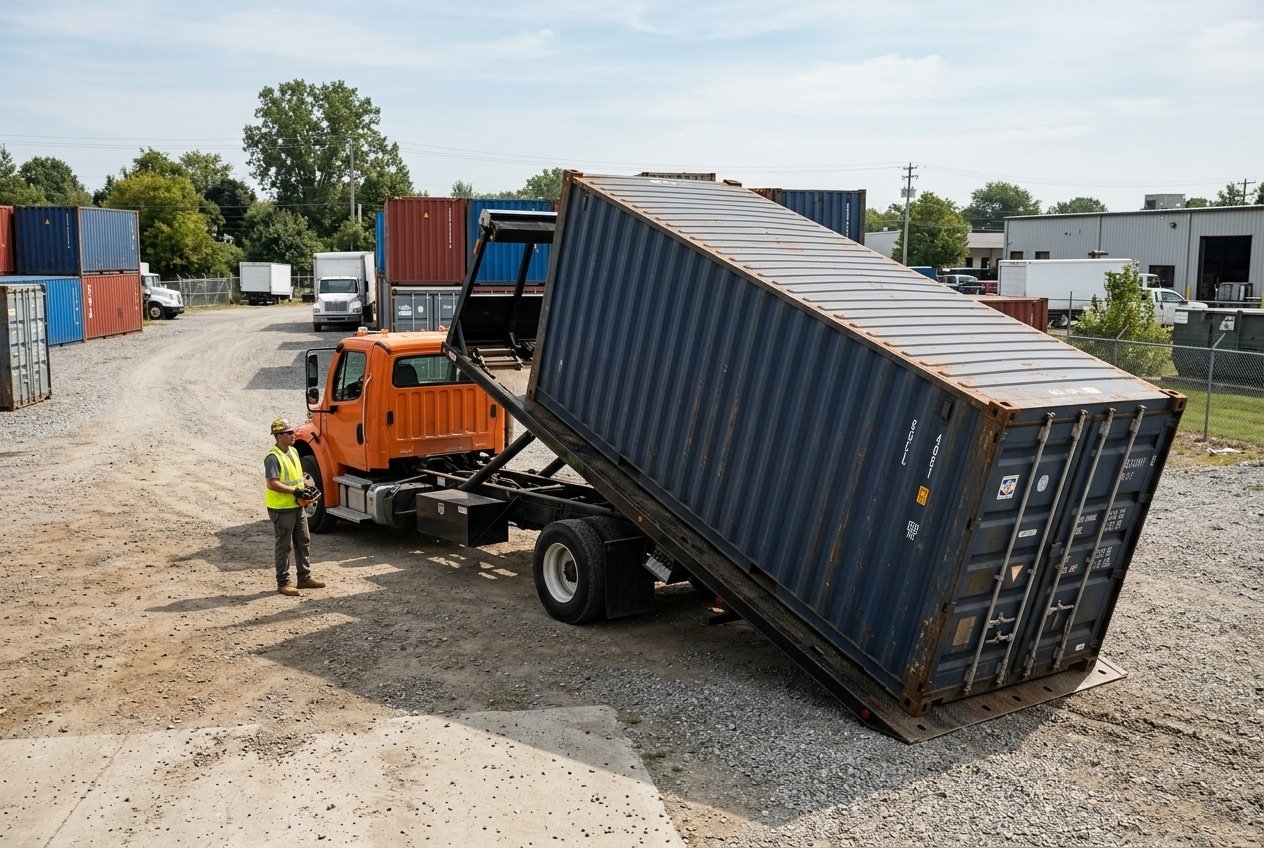
Can a Tilt Bed Deliver a Shipping Container?
Table of Contents
- Table of Contents
- Understanding Tilt Bed Trailers for Container Logistics
- How the Hydraulic Tilt Mechanism Works
- Differences Between Tilt Beds and Standard Flatbeds
- Maximum Container Sizes Compatible with Tilt Beds
- Handling 20-Foot vs. 40-Foot Units
- Site Requirements for a Successful Tilt Bed Delivery
- Calculating Necessary Clearance and Turn Radius
- Ground Surface and Leveling Considerations
- Step-by-Step Breakdown of the Unloading Process
- Advantages of Using Tilt Beds Over Cranes or Forklifts
- Cost-Effectiveness for Short-Haul Deliveries
- Potential Limitations and Safety Risks
- Weight Restrictions and Cargo Shifting Concerns
- Choosing the Right Transport Service for Your Container
- Final Checklist: Preparing for a Tilt Bed Container Delivery
Table of Contents
- Understanding Tilt Bed Trailers for Container Logistics
- Maximum Container Sizes Compatible with Tilt Beds
- Site Requirements for a Successful Tilt Bed Delivery
- Step-by-Step Breakdown of the Unloading Process
- Advantages of Using Tilt Beds Over Cranes or Forklifts
- Potential Limitations and Safety Risks
- Choosing the Right Transport Service for Your Container
One of the most common questions buyers ask before purchasing a shipping container is whether a tilt bed truck can actually deliver it. The short answer: yes, and for most residential, farm, and small business deliveries across the U.S., a tilt bed is the most practical method available. Unlike crane-assisted drops or flatbed deliveries that require heavy equipment on site, tilt bed trucks use their own hydraulic system to slide a container off the back of the trailer and onto the ground. This makes them especially popular for properties in Raleigh, rural North Carolina, and suburban lots where crane access is limited or cost-prohibitive.
But a successful delivery depends on more than just the truck. Site conditions, container size, ground surface, overhead clearance, and turning radius all play a role in whether a tilt bed can get the job done safely. If you are planning to purchase a shipping container for storage, a workspace, or a project build, understanding how this delivery method works will save you time, money, and headaches. This guide covers the mechanics, site requirements, limitations, and best practices for tilt bed container delivery so you can plan with confidence.
Understanding Tilt Bed Trailers for Container Logistics
Tilt bed trailers are purpose-built for ground-level delivery of heavy loads, and shipping containers are one of their most frequent payloads. Unlike standard flatbeds, which require a secondary piece of equipment to lift the container off the trailer, a tilt bed handles both transport and placement in a single operation. This makes them the workhorse of the container delivery industry, particularly for buyers who need a container placed on a driveway, gravel pad, or cleared lot without hiring a crane crew.
The typical tilt bed used for shipping container delivery is a commercial-grade trailer rated between 20,000 and 50,000 lbs, depending on the configuration. Most operators use trucks with a gross vehicle weight rating (GVWR) of 50,000 to 80,000 lbs when fully loaded. The trailer bed itself is usually 20 to 40 feet long, and the hydraulic tilt system is integrated directly into the trailer frame.
How the Hydraulic Tilt Mechanism Works
The hydraulic tilt system operates on a straightforward principle. A set of hydraulic cylinders, typically powered by the truck’s PTO (power take-off) system, raises the front of the trailer bed while the rear remains on or near the ground. As the bed tilts to an angle of roughly 10 to 15 degrees, the container slides backward under its own weight, guided by gravity and the steel bed surface.
Most operators use a winch cable attached to the front of the container to control the descent. The driver pays out the cable slowly, managing the speed at which the container moves down the tilted bed. Once the rear of the container contacts the ground, the driver continues to tilt the bed and release cable until the container is fully off the trailer and resting on the delivery surface. The entire unloading process typically takes 10 to 20 minutes in good conditions.
The hydraulic system generates between 3,000 and 5,000 PSI of pressure, which is more than enough to lift the front of the trailer with a loaded 20-foot container weighing around 5,000 lbs empty or up to 10,000 lbs with contents.
Differences Between Tilt Beds and Standard Flatbeds
A standard flatbed trailer is flat, fixed, and has no hydraulic mechanism. Delivering a shipping container on a flatbed requires a crane, forklift, or side-loader at the delivery site to lift the container off the trailer. This adds cost, coordination, and often a second crew.
Tilt beds eliminate that dependency. The key differences include:
- Self-unloading capability: Tilt beds handle placement without auxiliary equipment.
- Ground-level drop: Containers slide directly to the ground, while flatbeds require lifting from trailer height (approximately 4.5 to 5 feet).
- Single-operator delivery: One driver can complete a tilt bed delivery; flatbed drops typically need a crane operator plus a spotter.
- Site flexibility: Tilt beds work on driveways, gravel, and cleared lots where crane access may not be feasible.
The trade-off is that tilt beds need more linear space behind the truck for the container to slide off, while a crane can place a container in tighter spots with vertical clearance.
Maximum Container Sizes Compatible with Tilt Beds
Not every shipping container can be delivered by tilt bed. The size and weight of the container must match the trailer’s capacity and length. Most tilt bed operators in the U.S. handle 20-foot and 40-foot standard containers as their primary loads.
A standard 20-foot shipping container measures 20 ft long x 8 ft wide x 8.5 ft tall and weighs approximately 5,000 lbs empty. A 40-foot container measures 40 ft long x 8 ft wide x 8.5 ft tall and weighs around 8,500 lbs empty. High cube shipping containers, which stand 9.5 ft tall, are also compatible with tilt bed delivery, though the extra foot of height can affect overhead clearance during transport and unloading.
Handling 20-Foot vs. 40-Foot Units
Twenty-foot containers are the easiest to deliver by tilt bed. They are lighter, shorter, and require less space for the slide-off. A 20-foot delivery typically needs about 80 to 100 feet of straight, clear space behind the truck for unloading. The lighter weight also means less stress on the hydraulic system and a more controlled descent.
Forty-foot containers are a different story. They require a longer trailer, more cable management during the slide, and roughly 120 to 150 feet of clear space behind the truck. The heavier weight – especially if the container is a used shipping container with residual cargo or modifications – demands a more powerful hydraulic setup and a more experienced driver.
Some operators will not deliver 40-foot containers by tilt bed to residential properties due to space constraints. If your site has limited room, a 20-foot unit or a pair of 20-foot containers may be a more practical option. At Lease Lane Containers, our delivery planning support includes helping buyers assess whether their site can accommodate the container size they want before the truck ever leaves the yard.
Site Requirements for a Successful Tilt Bed Delivery
The truck and trailer are only half the equation. Your delivery site needs to meet specific conditions for a tilt bed drop to work. Failing to prepare the site is the single most common reason deliveries get delayed or rescheduled, and rescheduling fees can run $200 to $500 depending on the operator and distance.
Calculating Necessary Clearance and Turn Radius
A tilt bed truck with a 40-foot container is roughly 65 to 75 feet long in total. That vehicle needs to reach your placement spot, position itself in a straight line, and have enough room behind it for the container to slide off. Here are the key measurements to verify before scheduling delivery:
- Overhead clearance: Minimum 14 feet for standard containers, 15 feet for high cube shipping containers. Check for power lines, tree branches, awnings, and carport structures along the entire path from the road to the drop point.
- Width clearance: At least 10 feet of clear width along the access route. The trailer is 8.5 feet wide, and the driver needs room to maneuver.
- Turning radius: A tilt bed truck needs approximately 40 to 55 feet of turning radius, depending on the trailer length. Tight 90-degree turns from a public road into a driveway are often the biggest challenge.
- Linear unloading space: 80 to 100 feet for a 20-foot container, 120 to 150 feet for a 40-foot container, measured from where the truck will stop to the final resting position of the container.
If you are in the Raleigh area or anywhere in Wake County, local streets and subdivision layouts can create tight access points. Cul-de-sacs, narrow driveways, and HOA-controlled roads are frequent obstacles. Measure your site carefully, or better yet, take photos and share them with your delivery provider before confirming the drop.
Ground Surface and Leveling Considerations
The surface where the container will land matters more than most buyers expect. A shipping container weighs thousands of pounds concentrated on its four corner castings, each of which has a footprint of roughly 7 x 6 inches. That is a lot of weight on a small area.
Ideal surfaces for tilt bed delivery include compacted gravel pads (at least 4 inches deep), concrete slabs, and asphalt driveways. Soft ground, wet clay, and loose fill will cause the container to sink unevenly, which leads to door alignment problems and structural stress over time. If you are placing a container on bare earth, a gravel pad is the minimum recommended preparation. For permanent installations, concrete piers or railroad tie foundations offer better long-term support.
The ground also needs to be reasonably level. A slope of more than 3 to 5 degrees at the unloading point creates a safety risk during the slide-off, as the container can shift laterally or accelerate unpredictably. If your site has a grade, discuss it with the delivery operator in advance so they can plan the approach angle.
Step-by-Step Breakdown of the Unloading Process
Knowing what happens during the delivery helps you prepare your site and set realistic expectations. Here is the typical sequence for a tilt bed shipping container delivery:
- The driver arrives and surveys the site, checking overhead clearance, ground conditions, and the approach path. If conditions do not meet requirements, the driver may decline to unload.
- The truck backs into position along the desired placement line. The rear of the trailer should be aligned with where you want the container doors to face (containers slide off door-end first in most configurations).
- The driver engages the PTO system and begins tilting the trailer bed. The front of the bed rises while the rear lowers toward the ground.
- Once the bed reaches the correct angle, the driver releases the winch cable slowly, allowing the container to slide backward under controlled gravity.
- The rear corner castings of the container make contact with the ground. The driver continues paying out cable and increasing the tilt angle until the container is fully on the ground.
- The driver disconnects the winch cable, lowers the trailer bed back to level, and pulls the truck forward, clearing the container.
- A final check confirms the container is positioned correctly and sitting level on all four corners.
The entire process takes 10 to 25 minutes under normal conditions. Wet or uneven ground, tight access, or a 40-foot container can push that closer to 30 to 45 minutes. Most operators ask the buyer to be present during delivery to confirm placement and sign off on the drop.
One critical detail: the container slides off in one direction, and repositioning it after the fact requires equipment. Make sure you know exactly where you want it and which direction the doors should face before the truck arrives.
Advantages of Using Tilt Beds Over Cranes or Forklifts
For most buyers purchasing a shipping container for storage, a workshop, or a small business project, a tilt bed delivery is the most practical and affordable option. Crane deliveries cost $500 to $2,000 or more depending on the crane size and duration, and they require a separate mobilization. Forklifts large enough to move a shipping container (typically 15,000 lb capacity or higher) are rarely available on residential or small commercial sites.
Tilt beds consolidate transport and placement into one operation with one truck and one driver. There is no need to coordinate multiple vendors or rent additional equipment. The container goes from the depot to your property and onto the ground in a single trip.
Cost-Effectiveness for Short-Haul Deliveries
The cost advantage of tilt bed delivery is most pronounced on short-haul routes, typically under 100 miles. A tilt bed delivery within 50 miles of a container depot usually runs between $300 and $800, depending on the container size and local market rates. Compare that to a flatbed delivery plus crane rental, which can easily exceed $1,500 for the same distance.
For buyers in the Raleigh, North Carolina area, Lease Lane Containers provides delivery planning guidance that includes helping you understand what delivery method fits your site and budget. Knowing the total delivered cost before you commit prevents surprises on delivery day.
Tilt beds also reduce liability exposure. Crane operations require rigging, load calculations, and swing-path clearance, all of which introduce risk. A tilt bed slide-off keeps the container close to the ground throughout the process, reducing the potential for drops or swinging loads.
Potential Limitations and Safety Risks
A tilt bed is not the right tool for every delivery scenario. Understanding the limitations upfront helps you avoid costly failed delivery attempts.
The most significant limitation is space. If your property does not have enough straight-line room for the truck to back in and slide the container off, a tilt bed simply will not work. Properties with narrow driveways, sharp turns, or obstructions within the unloading zone are common disqualifiers. In those cases, a crane delivery or a chassis drop (where the container stays on a wheeled chassis) may be the only options.
Terrain is another factor. Steep grades, soft soil, and unimproved roads can make tilt bed access dangerous or impossible. Drivers have the authority to refuse a delivery if they judge the site unsafe, and they exercise that authority regularly.
Weight Restrictions and Cargo Shifting Concerns
Empty shipping containers are well within the capacity of most tilt bed trailers. A standard 20-foot container at 5,000 lbs or a 40-foot container at 8,500 lbs poses no weight issue. Problems arise when buyers want containers delivered with contents already inside.
A loaded container changes the dynamics of the tilt and slide significantly. Contents shift toward the door end as the bed tilts, creating an unbalanced load that can accelerate the slide unpredictably. Most tilt bed operators will not deliver a container with loose contents inside. If the container has been loaded for transport, the contents must be secured with load bars, straps, or blocking to prevent movement.
The maximum payload for tilt bed delivery typically caps at 10,000 to 15,000 lbs total (container plus contents), though this varies by operator and equipment. Exceeding weight limits risks hydraulic failure, cable snap, or trailer damage, all of which create serious safety hazards. Always disclose the loaded weight to your delivery provider before scheduling.
OSHA guidelines under 29 CFR 1926.251 govern rigging and material handling, and while they do not specifically address tilt bed operations, the general duty clause applies. Operators must ensure that loads are controlled at all times and that bystanders are clear of the unloading zone.
Choosing the Right Transport Service for Your Container
Selecting a delivery provider is not just about price. The driver’s experience with tilt bed container drops, the condition of their equipment, and their willingness to assess your site before delivery day all matter.
Ask potential providers these questions before booking:
- What is the maximum container size you deliver by tilt bed? Some operators only handle 20-foot units.
- Do you conduct a site assessment before delivery? Reputable providers will ask for photos, measurements, or a site visit for complex drops.
- What happens if the site is not accessible on delivery day? Understand rescheduling fees and policies upfront.
- Is the container insured during transport and unloading? Confirm liability coverage in case of property damage during the slide-off.
- What ground preparation do you recommend? A good operator will give you specific guidance based on your soil type and site conditions.
The right fit depends on your use case, your site, and the container you are purchasing. A one-trip container destined for a clean commercial site has different delivery considerations than a used shipping container headed to a rural farm property with a gravel lane.
At Lease Lane Containers, our Raleigh-based team helps buyers plan for delivery before they purchase. That includes reviewing site access, discussing turning radius and overhead clearance, and recommending the right container grade and size for the project. Whether you are a contractor setting up job site storage or a homeowner adding backyard storage, delivery planning is part of the process, not an afterthought.
Final Checklist: Preparing for a Tilt Bed Container Delivery
Before your delivery date, confirm each of these items:
- Overhead clearance verified: 14 ft minimum (15 ft for high cube shipping containers) along the entire route from road to drop point.
- Width clearance confirmed: At least 10 ft of unobstructed width on the access path.
- Turning radius measured: 40 to 55 ft depending on trailer length; photograph tight turns for the driver.
- Unloading space clear: 80 to 100 ft for 20-foot containers, 120 to 150 ft for 40-foot containers.
- Ground surface prepared: Compacted gravel, concrete, or asphalt preferred; level within 3 to 5 degrees.
- Container orientation decided: Know which direction the doors should face before the truck arrives.
- Weight disclosed: If the container has contents, provide the total loaded weight to the operator.
- Someone on site: Be present or have a designated representative available to confirm placement and sign off.
A tilt bed can deliver a shipping container to most properties across the U.S. with minimal fuss, provided the site is ready and the logistics are planned in advance. The combination of affordability, simplicity, and single-operator execution makes it the default delivery method for good reason.
If you are ready to move forward with a container purchase, browse our inventory to compare sizes, grades, and options for your project. Have questions about delivery access or site preparation? Contact us directly, and our team will help you plan a delivery that goes right the first time.