How Much Does a High Cube Container Price Cost?
Table of Contents
- Table of Contents
- Understanding High Cube Container Specifications and Value
- Standard vs. High Cube: The Extra Foot of Vertical Space
- Average Market Price Ranges for New and Used Units
- One-Trip Containers: The Premium for Pristine Condition
- Cargo Worthy and Wind-and-Watertight Used Options
- Key Factors Influencing High Cube Container Costs
- Global Steel Prices and Manufacturing Trends
- Regional Availability and Port Proximity
- Hidden Expenses Beyond the Sticker Price
- Delivery Logistics and Tilt-Bed Trailer Fees
- Permitting and Site Preparation Requirements
- Selecting the Right High Cube Size for Your Budget
- 40ft High Cube: The Industry Standard for Storage
- 20ft High Cube: Rarity and Custom Pricing
- Where to Buy and How to Secure the Best Deal
- Maximizing Your Investment in High Cube Containers
- Final Checklist
Table of Contents
- Understanding High Cube Container Specifications and Value
- Average Market Price Ranges for New and Used Units
- Key Factors Influencing High Cube Container Costs
- Hidden Expenses Beyond the Sticker Price
- Selecting the Right High Cube Size for Your Budget
- Where to Buy and How to Secure the Best Deal
- Maximizing Your Investment in High Cube Containers
Buying a shipping container is a straightforward decision until you start comparing quotes. One supplier lists a 40ft high cube at $3,200. Another wants $5,800 for what sounds like the same thing. The difference usually comes down to condition, location, and a handful of cost factors that aren’t obvious from a listing photo. If you’re a contractor setting up job-site storage, a homeowner planning a backyard workshop, or a small business owner needing inventory overflow space, you need a clear picture of what drives the high cube container price before you commit. That extra foot of height makes a real difference for shelving, equipment, and conversion projects, but only if you’re paying a fair rate for the grade and condition you actually need. This guide breaks down realistic pricing, the variables behind those numbers, and how to avoid surprise costs that inflate your total spend. Whether you’re buying locally in the Raleigh, North Carolina area or shipping nationwide, these figures and tips will help you budget with confidence.
Understanding High Cube Container Specifications and Value
A high cube shipping container is built to the same ISO standards as a standard container but with one key difference: it’s taller. That extra vertical clearance matters more than most buyers expect, especially once you start planning interior layouts for storage racks, workshop benches, or conversion buildouts.
Standard vs. High Cube: The Extra Foot of Vertical Space
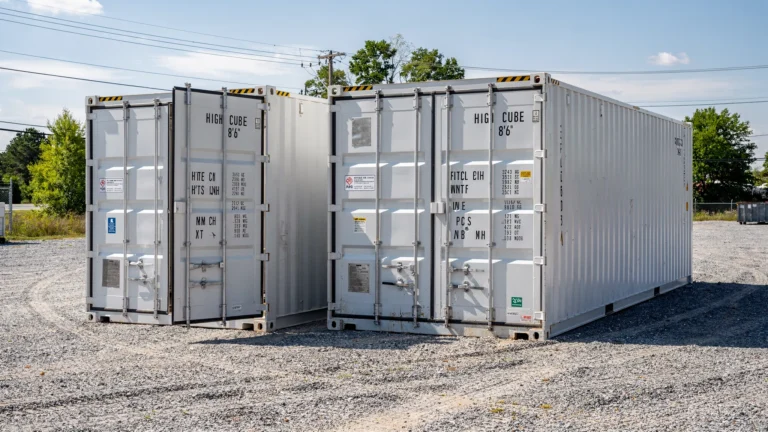
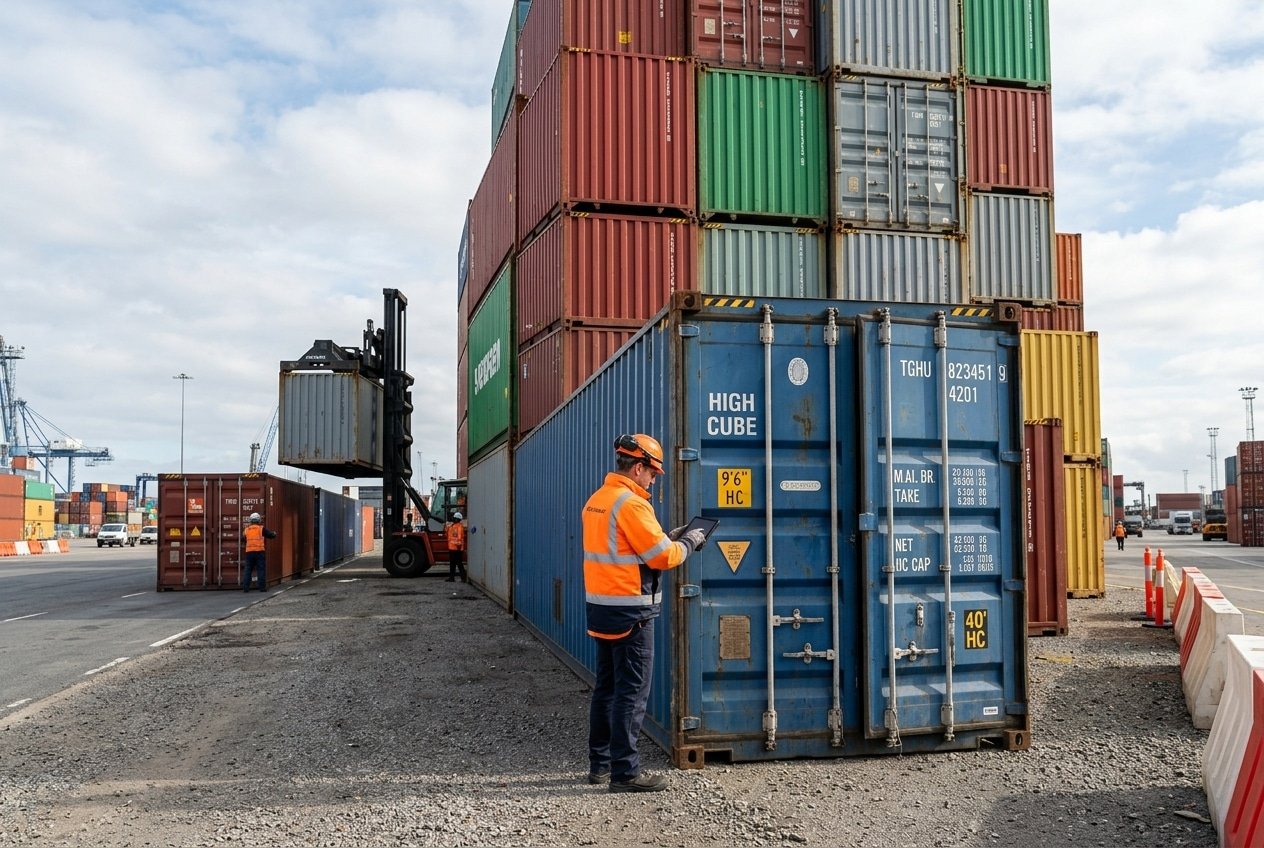
A standard shipping container stands 8 feet 6 inches tall on the exterior. A high cube adds roughly one foot, bringing the exterior height to 9 feet 6 inches. Interior height jumps from about 7 feet 10 inches to approximately 8 feet 10 inches.
That 12-inch gain changes what you can do inside. Three-tier pallet racking fits comfortably. Overhead lighting and ductwork have room without forcing you to crouch. If you’re converting a container into an office, studio, or workshop, the ceiling height feels noticeably more comfortable compared to a standard unit.
The exterior dimensions stay the same in length and width: 40 feet long by 8 feet wide for the most common size, or 20 feet long for the smaller variant. Tare weight on a 40ft high cube typically runs around 8,775 lbs, roughly 600-700 lbs heavier than its standard-height counterpart. That weight difference matters for delivery planning, foundation prep, and transport costs, which we’ll cover later.
Average Market Price Ranges for New and Used Units
Pricing on high cube shipping containers varies significantly based on condition. The gap between a brand-new unit and a well-used one can be $2,000 or more, so understanding the grading system saves you from overpaying or underestimating what you need.
One-Trip Containers: The Premium for Pristine Condition
A one-trip container has made a single ocean voyage, usually carrying goods from the manufacturing facility in Asia to a U.S. port. These units arrive in near-new condition with minimal cosmetic wear, original paint, intact factory flooring, and doors that swing smoothly.
For a 40ft high cube one-trip unit, expect to pay between $4,500 and $6,500 depending on your region and current supply levels. A 20ft high cube one-trip, which is harder to find, typically runs $4,000 to $5,500. These containers are ideal for conversion projects, retail pop-ups, or any application where appearance and structural integrity matter from day one.
Cargo Worthy and Wind-and-Watertight Used Options
Used high cube containers fall into two primary grades. Cargo worthy units have been inspected and certified as structurally sound enough for ocean transport. They may show surface rust, dents, and patched repairs, but the frame, walls, floor, and doors remain functional. Prices for a 40ft cargo worthy high cube generally range from $2,500 to $4,000.
Wind and watertight containers are a step below. They’ll keep rain and wind out, but they haven’t passed a current cargo worthiness inspection. These units often show more cosmetic wear and may have older repairs. Pricing typically falls between $1,800 and $3,200 for a 40ft high cube. For on-site storage where appearance isn’t critical, this grade offers the best value per square foot.
Key Factors Influencing High Cube Container Costs
The sticker price you see online is shaped by forces well beyond the container itself. Two identical units can carry very different price tags depending on where they’re sitting and what the steel market looked like when they were built.
Global Steel Prices and Manufacturing Trends
Shipping containers are built primarily from Corten steel, a weathering steel alloy designed to resist corrosion. When global steel prices rise, as they did sharply in 2021 and 2022, manufacturing costs follow. A 40ft high cube that cost $3,800 new in early 2020 was selling for over $7,000 by mid-2021.
Steel prices have moderated since those peaks, but they remain volatile. Tariffs on imported steel, energy costs at manufacturing plants in China, and demand from the construction sector all push prices up or down. If you’re flexible on timing, watching steel market trends can save you hundreds on a purchase.
Regional Availability and Port Proximity
Containers are cheapest near major ports: Los Angeles, Houston, Savannah, Newark. The farther you are from a port or depot, the more you’ll pay for transport to your location. Buyers in landlocked states routinely pay $500 to $1,500 more than coastal buyers for the same container, purely because of repositioning costs.
In the Southeast, proximity to the Port of Savannah and the Port of Charleston keeps supply relatively healthy. Buyers in the Raleigh, North Carolina area and along the I-40 and I-95 corridors benefit from shorter delivery distances compared to buyers in the Midwest or Mountain West. Lease Lane Containers, based in Raleigh, works with depot networks across the country to help buyers find units closer to their delivery site, reducing transport markups.
Hidden Expenses Beyond the Sticker Price
The purchase price is only part of your total cost. Two common expenses catch first-time buyers off guard: delivery fees and site preparation.
Delivery Logistics and Tilt-Bed Trailer Fees
A 40ft high cube shipping container doesn’t fit in a pickup truck. Delivery requires either a tilt-bed trailer or a roll-off truck, and the type of equipment affects both cost and site requirements.
Tilt-bed delivery is the most common method. The truck backs into your site, tilts the bed, and slides the container off. This requires a straight, level approach with at least 100 feet of clear space and no low-hanging power lines or tree branches. Overhead clearance needs to be at least 14 feet for a high cube on a tilt-bed.
Delivery fees typically range from $200 to $500 for local drops within 50 miles of a depot, and $500 to $1,500 or more for longer hauls. Some sellers include local delivery in their quoted price. Others don’t. Always ask whether delivery is included before comparing quotes. Lease Lane Containers provides delivery planning support, including guidance on turning radius, overhead clearance, and site access, so you can avoid failed delivery attempts that cost extra.
Permitting and Site Preparation Requirements
Many municipalities require a permit before you place a shipping container on your property. In Wake County and surrounding areas of North Carolina, zoning rules vary by district. Some residential zones allow containers only in backyards or behind sight lines. Commercial properties may have fewer restrictions but still require a permit application.
Permit fees typically run $50 to $300, though some jurisdictions charge more. Contact your local planning department before purchasing to confirm requirements. The Wake County Planning Division can be reached at (919) 856-6335.
Site prep is another cost to budget. At minimum, you’ll want a level surface. A compacted gravel pad, typically 4 to 6 inches deep, costs $300 to $800 depending on the area. Concrete piers or a poured slab add more but provide a longer-lasting foundation. Skipping site prep leads to water pooling, uneven settling, and doors that won’t close properly within a year or two.
Selecting the Right High Cube Size for Your Budget
Not all high cubes are the same length, and the size you choose affects both the purchase price and the practical value you get from the unit.
40ft High Cube: The Industry Standard for Storage
The 40ft high cube is the most widely available high cube size on the market. With roughly 2,700 cubic feet of interior space, it handles most storage, workspace, and conversion needs. Supply is strong because these containers make up a large share of international shipping fleets, so they’re constantly cycling into the used market.
If you need general storage for a construction site, farm equipment, or business inventory, this is the size to default to. Pricing is competitive because supply is high, and delivery logistics are well-established for this length. A rule of thumb: the 40ft high cube offers the lowest cost per cubic foot of any standard container size.
20ft High Cube: Rarity and Custom Pricing
A 20ft high cube is harder to find. Most 20ft containers produced globally are standard height, so the high cube variant commands a premium driven by scarcity rather than material cost. You might pay $3,500 to $5,500 for a 20ft high cube in one-trip condition, which is sometimes close to what a 40ft high cube costs.
This size makes sense for tight lots, residential backyards, or applications where a 40ft unit simply won’t fit. If your site can accommodate the larger container, you’ll almost always get better value from the 40ft option. But if space is limited, the 20ft high cube’s interior height still gives you that critical vertical clearance for shelving and overhead storage.
Where to Buy and How to Secure the Best Deal
Shipping containers are sold through dealers, online marketplaces, direct-from-depot listings, and auction sites. Each channel has trade-offs.
Online marketplaces like Craigslist or Facebook Marketplace occasionally list containers at low prices, but you’re buying without grade verification, delivery guarantees, or recourse if the unit doesn’t match the listing photos. Auction sites can offer deals on surplus inventory, but condition varies wildly and delivery is usually your problem.
Working with a dedicated container supplier gives you grading transparency, delivery coordination, and someone to call if something isn’t right. Ask any supplier for clear photos of the specific unit you’re buying, not stock photos. Confirm the grade in writing. Get a delivery quote that includes all fees, not just the base rate.
Timing matters too. Container prices tend to soften in late fall and winter when demand from construction and agriculture slows. If your project timeline allows, buying in the off-season can save you $200 to $500 on the same unit.
Get at least three quotes. Compare them on an apples-to-apples basis: same grade, same size, delivery included. The cheapest listing price isn’t always the cheapest total cost once delivery and condition differences are factored in.
Maximizing Your Investment in High Cube Containers
A high cube shipping container is a durable, long-term asset when you buy the right grade for your use case and prepare your site correctly. One-trip units hold their condition and resale value well, often retaining 60-70% of their purchase price after five years of use. Cargo worthy and wind and watertight units cost less upfront and serve perfectly for straightforward storage where cosmetics aren’t a priority.
Budget for the full picture: container price, delivery, site prep, and any permits your municipality requires. That total number is what you’re actually spending, and it’s the only number worth comparing across suppliers.
If you’re ready to compare options, browse available inventory at Lease Lane Containers to see current sizes, grades, and pricing. The Raleigh-based team can help you match the right container to your project and plan delivery logistics so the unit arrives without surprises.
Final Checklist
- Confirm your site can accommodate the container length and delivery vehicle clearance (14+ feet overhead for high cube tilt-bed delivery)
- Check local zoning and permit requirements before ordering
- Compare at least three quotes on the same grade and size with delivery included
- Prepare a level gravel pad or foundation before delivery day
- Verify the container grade in writing and request photos of the actual unit
- Budget $200 to $1,500 for delivery depending on distance from the nearest depot
- Contact your supplier about site access, turning radius, and placement planning