How Much Space a Shipping Container Needs to Turn
Table of Contents
- Table of Contents
- Essential Turning Radius Requirements for Delivery Trucks
- Standard Space for 20-Foot Container Delivery
- Extended Clearances for 40-Foot High Cube Units
- Factors Influencing Truck Maneuverability and Swing
- Tilt-Bed vs. Flatbed Trailer Dimensions
- The Impact of Driver Experience and Equipment Type
- Calculating Total Linear Distance for Straight-Line Entry
- Navigating Sharp Corners and Narrow Access Roads
- Width Requirements for 90-Degree Turns
- Handling Gateways and Cul-de-sacs
- Vertical Clearance and Overhead Obstruction Risks
- Ground Conditions and Surface Stability for Heavy Loads
- Site Preparation Checklist for a Successful Drop-Off
- Marking the Final Landing Zone
- Removing Temporary Obstacles and Debris
- Final Delivery Planning Checklist
Table of Contents
- Essential Turning Radius Requirements for Delivery Trucks
- Factors Influencing Truck Maneuverability and Swing
- Calculating Total Linear Distance for Straight-Line Entry
- Navigating Sharp Corners and Narrow Access Roads
- Vertical Clearance and Overhead Obstruction Risks
- Ground Conditions and Surface Stability for Heavy Loads
- Site Preparation Checklist for a Successful Drop-Off
A delivery truck hauling a 40-foot shipping container doesn’t move like a pickup truck backing into a driveway. These rigs need serious room to swing, reverse, and position the container exactly where you want it. Misjudging the space available on your property is one of the most common reasons deliveries get delayed, rescheduled, or canceled outright, and the customer still pays for the failed attempt. Understanding the shipping container turning radius for delivery before the truck arrives saves you money, time, and frustration.
Most buyers spend hours comparing container sizes and grades but only a few minutes thinking about whether the truck can actually reach the drop zone. The reality is that a fully loaded tractor-trailer carrying a shipping container weighs between 35,000 and 50,000 lbs, stretches up to 75 feet in total length, and needs a turning circle wider than most residential streets. Whether you are placing a container on a rural farm property off a county road, behind a retail building, or in a contractor’s staging yard, the access logistics matter as much as the container itself. This guide breaks down the exact clearance dimensions, surface requirements, and site prep steps that determine whether your delivery goes smoothly or turns into an expensive headache.
Essential Turning Radius Requirements for Delivery Trucks
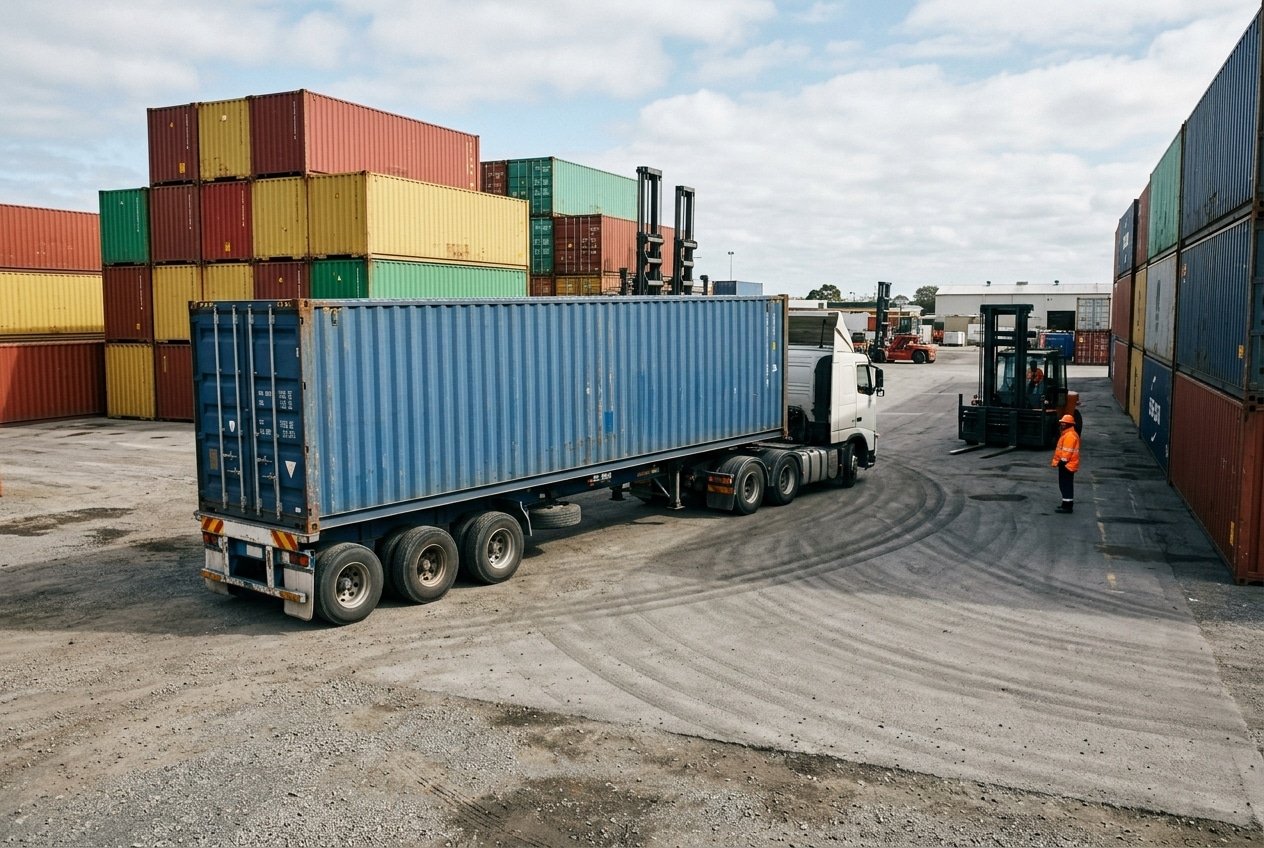
The turning radius of a shipping container delivery truck depends on two primary variables: the length of the container being hauled and the type of trailer carrying it. A standard tractor-trailer combination has a minimum turning radius of approximately 40 to 55 feet, measured from the center of the turning arc to the outermost point of the trailer. That number climbs quickly when you add a longer container or a specialized chassis.
Think of it this way: the truck’s cab pivots at the front axle, but the trailer’s rear wheels don’t steer. They drag through the turn, which means the back end swings wide on the outside while cutting tight on the inside. This “off-tracking” effect is what catches most property owners off guard. A truck that appears to have enough room at the cab can easily clip a fence, mailbox, or parked vehicle with the tail end of the trailer.
Standard Space for 20-Foot Container Delivery
A 20-foot shipping container on a standard chassis requires a minimum turning radius of roughly 40 to 45 feet. The total vehicle length, including the cab and trailer, is typically around 45 to 50 feet. This shorter combination is significantly easier to maneuver than its 40-foot counterpart, making it a practical choice for tighter residential properties and smaller commercial lots.
For a 90-degree turn into a driveway or access road, you need at least 30 feet of road width or open area for the truck to complete the swing without leaving the paved surface. A straight-line approach is always preferred, but a 20-foot container delivery can usually handle a single moderate turn without issue. Properties along standard two-lane roads in areas like Wake County or suburban Raleigh neighborhoods generally have enough frontage for this size.
The rule of thumb: if a standard fire truck can reach your property, a 20-foot container delivery truck probably can too.
Extended Clearances for 40-Foot High Cube Units
A 40-foot high cube shipping container changes the equation dramatically. The container alone measures 40 feet long, 8 feet wide, and 9 feet 6 inches tall. Mounted on a trailer behind a tractor cab, the total rig length stretches to 65 to 75 feet. The minimum turning radius jumps to 50 to 55 feet, and the off-tracking distance (how far the rear wheels cut inside the cab’s path) can exceed 8 feet.
This means you need a minimum road width of 35 to 40 feet for a 90-degree turn, and ideally more. Properties accessed by narrow rural lanes, single-track farm roads, or cul-de-sacs shorter than 80 feet in diameter frequently cannot accommodate a 40-foot delivery without modifications to the approach. Lease Lane Containers’ delivery planning support includes reviewing your site access before scheduling, which helps avoid costly failed delivery attempts.
If your property is accessed via a road narrower than 24 feet with no shoulder, a 40-foot container delivery will likely require an alternative approach strategy or a different drop point closer to the main road.
Factors Influencing Truck Maneuverability and Swing
Raw turning radius numbers only tell part of the story. The actual space a delivery truck needs depends on the equipment configuration, the driver’s skill, and the specific conditions of your site. Two deliveries to the same address can require different amounts of space depending on what type of trailer shows up.
Tilt-Bed vs. Flatbed Trailer Dimensions
The trailer type affects both the total vehicle length and the method used to offload the container. Understanding the difference helps you prepare the right amount of space.
- A tilt-bed (also called a roll-back or slide-off) trailer tilts its bed hydraulically so the container slides off the back. This method requires the truck to pull forward past the landing zone, then back up so the container slides into position. You need at least 100 feet of straight, clear space behind the truck for this maneuver, plus the full vehicle length in front.
- A flatbed trailer with a crane or forklift offload requires less linear space but needs significant lateral clearance for the lifting equipment. Expect to keep at least 15 feet clear on either side of the trailer.
- A chassis drop delivery, where the entire trailer chassis is left under the container, is the simplest method but means you need permanent clearance for the chassis to remain on site.
Tilt-bed deliveries are the most common method for residential and small commercial sites. If your site has limited straight-line distance, ask your supplier which trailer type will be used and plan accordingly.
The Impact of Driver Experience and Equipment Type
An experienced container delivery driver can work with tighter spaces than the theoretical minimums suggest. Skilled drivers use techniques like jackknifing the cab at specific angles, making multiple short reversing movements, and using spotters to thread through narrow gaps. The difference between a veteran driver and a less experienced one can be 10 to 15 feet of effective turning radius.
That said, you should never plan your site around best-case driver skill. Always prepare for the standard minimums. The truck that shows up might have a different wheelbase than expected, or the driver might be unfamiliar with your specific road configuration.
Equipment variations matter too. A day cab (no sleeper compartment) is roughly 8 feet shorter than a sleeper cab, which translates directly into a tighter turning circle. Some delivery companies use specialized short-wheelbase tractors for tight deliveries, but this isn’t standard. Confirm the equipment type with your supplier when scheduling.
Calculating Total Linear Distance for Straight-Line Entry
When a truck can approach your drop zone in a straight line without turning, the math gets simpler but the distance requirements are still substantial. A tilt-bed delivery of a 40-foot container needs approximately 120 to 150 feet of unobstructed straight-line distance. Here’s how that breaks down:
The truck pulls forward past the intended landing spot, positioning the rear of the trailer directly over the drop zone. The driver then activates the hydraulic tilt mechanism, and the container slides off the back as the truck slowly pulls forward. The container needs to clear the trailer bed completely, which means the truck travels roughly one full container length (40 feet) during the slide-off, plus it needs room to pull away afterward.
For a 20-foot container, the straight-line requirement drops to approximately 80 to 100 feet. This is measured from the point where the truck begins its approach to the point where it can safely pull away after the container is on the ground.
A practical way to measure this on your property: walk from your intended container placement spot toward the road, counting paces. Each adult pace is roughly 2.5 to 3 feet. You need at least 40 paces for a 20-foot container and 50 to 55 paces for a 40-foot container. If you run out of flat, clear ground before reaching those numbers, you have a problem that needs solving before delivery day.
Properties with circular driveways, T-shaped turnarounds, or wide parking aprons have a significant advantage. If your property doesn’t have these features, consider whether a temporary access path along the side of a building or through a field could provide the needed distance. The ground along this path needs to support the truck’s weight, which we cover in a later section.
Navigating Sharp Corners and Narrow Access Roads
Sharp turns are where most delivery failures happen. A truck that fits comfortably on a straight road can become completely stuck when the road bends.
Width Requirements for 90-Degree Turns
A 90-degree turn is the most demanding common maneuver for a container delivery truck. The required road width at the turn depends on the container length:
- 20-foot container: minimum 30 feet of combined road width at the turn, measured from the inside corner to the outside edge of the swept path
- 40-foot container: minimum 40 feet of combined road width, with 45 feet preferred
- Any container with a sleeper cab tractor: add 5 to 8 feet to the above numbers
The inside corner of the turn is the critical pinch point. The trailer’s rear wheels track inside the cab’s path by 6 to 10 feet on a 40-foot load. If there’s a curb, ditch, fence post, or utility pole within that inside swept area, the delivery cannot proceed.
One technique drivers use for tight 90-degree turns is the “swing wide” approach, where the truck drives past the turn, then reverses at an angle to set up a wider arc. This requires open space on the far side of the turn, typically 20 to 30 feet of clear area beyond the intersection.
Handling Gateways and Cul-de-sacs
Gateways present a specific challenge because they constrain both width and the angle of approach simultaneously. A standard shipping container is 8 feet wide, but the truck and trailer mirrors extend to roughly 8.5 feet. Your gate opening needs to be at least 12 feet wide to allow the truck to pass through with a margin for minor alignment corrections. A 14-foot gate is safer and accounts for slight angling during approach.
Cul-de-sacs are frequently too small for container deliveries. A standard residential cul-de-sac has a diameter of 80 to 96 feet, which is barely adequate for a 20-foot container delivery and almost always too tight for a 40-foot unit. If your property is on a cul-de-sac, the truck may need to back in from the main road rather than turning around in the circle. This requires clear line-of-sight and a straight or nearly straight path from the main road to your property.
For properties accessed through a single narrow gate, such as farm properties along rural roads outside Raleigh or in eastern North Carolina, consider temporarily removing the gate or widening the opening before delivery day. A few hours with a post-hole digger can save you a $300 to $500 failed delivery fee.
Vertical Clearance and Overhead Obstruction Risks
Overhead clearance is the factor most buyers forget entirely. A high cube shipping container on a trailer sits approximately 13 feet 6 inches above the road surface. A standard height container (8 feet 6 inches tall) sits about 12 feet 6 inches on the trailer. During a tilt-bed slide-off, the rear of the container rises as the bed tilts, adding another 2 to 3 feet temporarily. That means you need at least 16 feet of vertical clearance at the drop zone during offloading.
Common overhead obstructions that block container deliveries include:
- Power lines: residential service drops typically hang 12 to 18 feet above ground, and they sag lower in hot weather. Lines below 15 feet are a problem.
- Tree branches: anything hanging over the access road below 14 feet needs to be trimmed before delivery.
- Building overhangs, awnings, and carport roofs: these frequently sit at 10 to 12 feet and are easy to overlook.
- Bridge underpasses and tunnel clearances: posted heights are measured at the center; the edges are lower.
Contact your local utility provider if power lines cross your access path. In North Carolina, Duke Energy will sometimes temporarily raise or disconnect lines for deliveries, but this requires advance scheduling, often two to four weeks. Don’t assume you can handle this on delivery day.
A quick way to check clearance: tie a weight to a string, hold it at the highest point of the obstruction, and measure the string length to the ground. If it’s under 14 feet anywhere along the truck’s path, you need to address it before the delivery is scheduled.
Ground Conditions and Surface Stability for Heavy Loads
A loaded shipping container delivery truck exerts enormous ground pressure. The total vehicle weight ranges from 35,000 lbs for an empty 20-foot container on a tilt-bed to over 50,000 lbs for a loaded 40-foot unit. That weight concentrates on the axles, with the rear tandem axles carrying the heaviest load, typically 34,000 to 40,000 lbs distributed across eight tires.
Paved surfaces (asphalt or concrete) handle this weight without issue in most cases, though aging asphalt over soft subgrade can crack or rut. Gravel driveways and compacted stone pads work well if they are at least 6 inches deep and properly graded. The problems start with soft ground.
Bare soil, grass, and clay are risky, especially after rain. In the Piedmont region around Raleigh, the red clay soil becomes extremely soft when saturated. A delivery truck sinking even 4 to 6 inches into soft ground can become stuck, and extracting a 50,000 lb truck requires a heavy wrecker at significant cost. The general rule: if you can push a half-inch rebar into the ground easily by hand, the soil is too soft for a delivery truck.
If your placement site is on unpaved ground, consider laying a temporary access path using steel plates, heavy plywood sheets (3/4-inch minimum), or a 6-inch gravel pad along the truck’s path. The access path needs to be at least 12 feet wide and extend the full length of the truck’s travel on your property. This preparation costs far less than a stuck truck.
Site Preparation Checklist for a Successful Drop-Off
Getting the site ready before the truck arrives is the single most controllable factor in a successful delivery. Every failed delivery Lease Lane Containers has seen traces back to a site issue that could have been resolved with a few hours of preparation.
Marking the Final Landing Zone
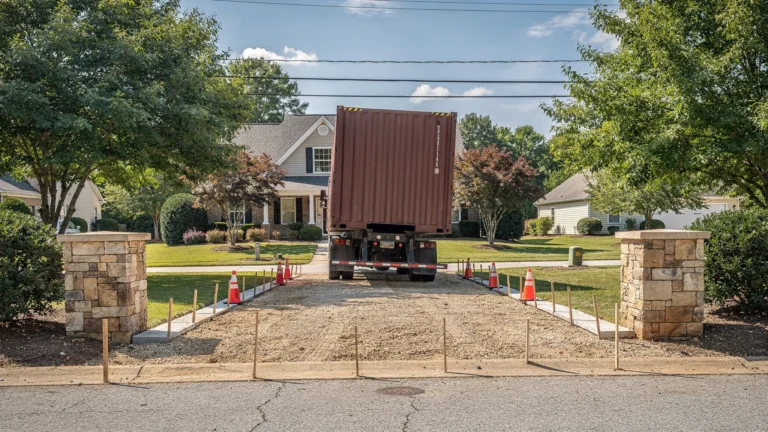
Mark the exact spot where you want the container placed using stakes, spray paint, or cones. The landing zone needs to be level within 3 inches across the container’s footprint. For a 20-foot container, that’s an 8-by-20-foot rectangle. For a 40-foot unit, it’s 8 by 40 feet.
Place your markers at all four corners and confirm the orientation you want: which end should the doors face? This sounds obvious, but a container placed with doors facing a wall or fence becomes useless until it’s repositioned, and repositioning requires calling the truck back.
Check the ground level with a simple 4-foot carpenter’s level or a smartphone level app placed on a long, straight board. If the ground slopes more than 3 inches across the container’s width, the doors may not open and close properly, and water will pool on one side. Grade the site with fill dirt or gravel before delivery, not after.
Removing Temporary Obstacles and Debris
Walk the entire route from the road to the landing zone and remove anything that could interfere with the truck’s path. This includes:
- Parked vehicles, trailers, and equipment: move them at least 15 feet from the truck’s path on both sides
- Trash cans, planters, decorative rocks, and mailboxes: relocate anything within the truck’s swept turning area
- Temporary fencing, construction barriers, and signage: take them down the morning of delivery
- Low-hanging branches: trim anything below 14 feet along the access route
- Garden hoses, extension cords, and irrigation lines crossing the path: remove or bury them
Take photos of the cleared route and landing zone and send them to your delivery coordinator. This gives the driver a preview of the site and allows the logistics team to flag any remaining concerns before the truck rolls out. Lease Lane Containers offers delivery planning guidance that includes reviewing your site photos and access conditions ahead of time.
A final walk-through the evening before delivery catches last-minute issues. Neighbors sometimes park in new spots, wind blows debris into access paths, and overnight rain can change ground conditions. Fifteen minutes of checking the night before can prevent a morning of problems.
Final Delivery Planning Checklist
Use this quick reference to confirm your site is ready:
- Measure the road width at every turn between the main road and your property: minimum 30 feet for 20-foot containers, 40 feet for 40-foot containers.
- Confirm straight-line distance at the drop zone: 100 feet minimum for 20-foot, 150 feet for 40-foot tilt-bed deliveries.
- Check vertical clearance along the entire route: 14 feet minimum, 16 feet at the offloading point.
- Test ground firmness: if rebar pushes in easily by hand, add gravel or lay steel plates.
- Mark the landing zone corners and confirm door orientation.
- Remove all obstacles within 15 feet of the truck’s path.
- Photograph the route and send images to your delivery team.
Planning the turning radius and access for a shipping container delivery is not complicated, but it does require specific measurements and honest assessment of your property’s limitations. The numbers in this guide represent real-world minimums from thousands of deliveries across residential, commercial, and rural sites. Err on the side of more space, not less.
If you are comparing container options for an upcoming project, browse our inventory to see available sizes, grades, and pricing. For site-specific questions about access, placement, or delivery logistics, contact us and the Raleigh-based team can help you plan a delivery that goes right the first time.