How to Check Used Shipping Container Conditions
Table of Contents
- Table of Contents
- Understanding Container Grading Systems
- One-Trip vs. Cargo Worthy Standards
- The Wind and Watertight (WWT) Classification
- Inspecting the Exterior Structure and Roof
- Identifying Structural Rust and Corrosion
- Checking for Roof Dents and Standing Water
- Evaluating Door Functionality and Seals
- Testing Locking Bars and Hinges
- Inspecting Gaskets for Weatherproofing
- Assessing Interior Floor and Wall Integrity
- The Light Test for Pinholes and Cracks
- Checking Marine-Grade Plywood for Delamination
- Detecting Chemical Contamination and Odors
- Verifying CSC Plates and Certification
- Final Checklist for On-Site Inspections
Table of Contents
- Understanding Container Grading Systems
- One-Trip vs. Cargo Worthy Standards
- The Wind and Watertight (WWT) Classification
- Inspecting the Exterior Structure and Roof
- Identifying Structural Rust and Corrosion
- Checking for Roof Dents and Standing Water
- Evaluating Door Functionality and Seals
- Testing Locking Bars and Hinges
- Inspecting Gaskets for Weatherproofing
- Assessing Interior Floor and Wall Integrity
- The Light Test for Pinholes and Cracks
- Checking Marine-Grade Plywood for Delamination
- Detecting Chemical Contamination and Odors
- Verifying CSC Plates and Certification
- Final Checklist for On-Site Inspections
Buying a used shipping container without inspecting it properly is one of the fastest ways to waste money. A container that looks fine in photos can show up with rusted-out floor panels, seized door hinges, or a roof that pools water after the first rain. The difference between a solid purchase and an expensive headache often comes down to knowing exactly what to look for before you commit.
This used shipping container condition guide covers the specific inspection steps that separate experienced buyers from first-timers. Whether you’re a contractor setting up job-site storage, a homeowner planning a backyard workshop, or a small business owner in need of inventory overflow space, these checks apply universally. The grading system, the structural red flags, the interior tests, and the certification requirements all follow the same logic: verify the condition yourself, or pay the price later. Each section below breaks down a specific area of the container so you can walk onto a lot or review a listing with confidence and clarity.
Understanding Container Grading Systems
Shipping containers are graded based on their structural condition, cosmetic appearance, and intended use after retirement from ocean freight. These grades aren’t regulated by a single government body, which means terminology can vary slightly between sellers. That said, the industry has settled on three primary classifications that most reputable suppliers use consistently: One-Trip, Cargo Worthy, and Wind and Watertight.
Knowing these grades before you shop prevents the most common buyer mistake: paying a Cargo Worthy price for a container that’s really Wind and Watertight, or expecting One-Trip quality from a unit that’s been in service for 12 years. The grade directly affects the price, the expected lifespan, and what you can realistically do with the container.
One-Trip vs. Cargo Worthy Standards
A one-trip container is manufactured overseas (typically in China), loaded with cargo for a single voyage to the United States, and then sold domestically. These units are essentially new. They’ll have minimal cosmetic wear, factory-fresh paint, intact flooring, and fully functional hardware. Expect to pay a premium: a 20ft one-trip container typically runs 20-40% more than its Cargo Worthy equivalent. For buyers planning a container office conversion, a living space, or a project where appearance matters, one-trip is the standard to target.
Cargo Worthy (CW) is the grade assigned to containers that have passed inspection and are still certified for international ocean transport. A CW container might be 8-15 years old, with surface rust, minor dents, and cosmetic wear, but the structural steel, floor, doors, and seals all meet the threshold for safe cargo shipping. This is the sweet spot for most storage and commercial buyers. The container functions well, protects contents from weather, and costs significantly less than a one-trip unit. When a seller says “Cargo Worthy,” they should be able to back it up with a current CSC plate and inspection record.
The Wind and Watertight (WWT) Classification
Wind and Watertight is the most common grade for budget-conscious buyers, and it’s also where the most misunderstandings happen. A WWT container keeps rain and wind out, but it no longer qualifies for ocean freight. It may have heavier surface rust, patched panels, older gaskets, or minor floor wear. The container is still functional for ground-level storage, but it won’t carry a Cargo Worthy certification.
The critical distinction: WWT is a seller’s assessment, not a third-party certification. There’s no standardized WWT inspection the way there is for Cargo Worthy containers. This means the quality within the WWT category varies widely. Some WWT units are barely a step below Cargo Worthy. Others are nearing the end of their useful life. Your on-site inspection matters most with this grade. If you’re buying WWT, every check in this guide becomes non-negotiable.
Inspecting the Exterior Structure and Roof
The exterior tells you roughly 60% of what you need to know about a used shipping container’s remaining life. Corten steel (the weathering steel used in container construction) is designed to form a protective rust layer, but that protection has limits. Once corrosion penetrates past the surface patina, structural integrity degrades quickly.
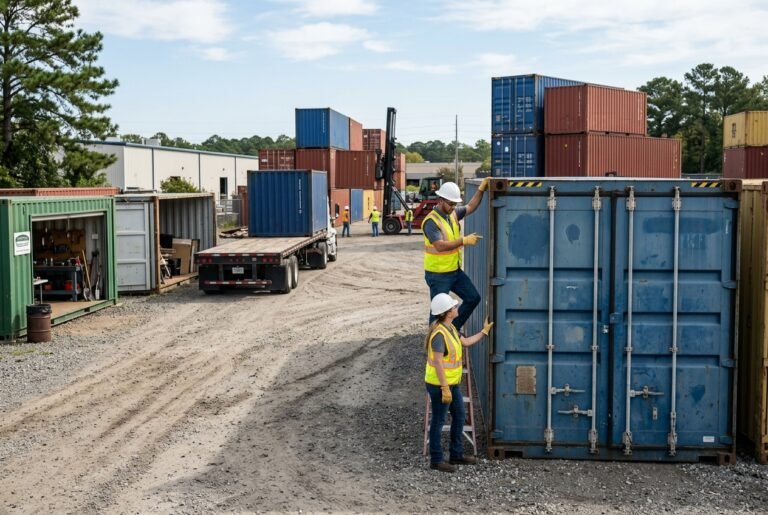
Walk the full perimeter of the container before opening the doors. You’re looking for panel warping, deep dents that have cracked the paint, weld failures at corner castings, and any signs of previous collision damage. Pay special attention to the bottom rails: these 6-inch steel beams run the length of the container and bear the full load. If the bottom rails are compromised, the container is compromised.
Identifying Structural Rust and Corrosion
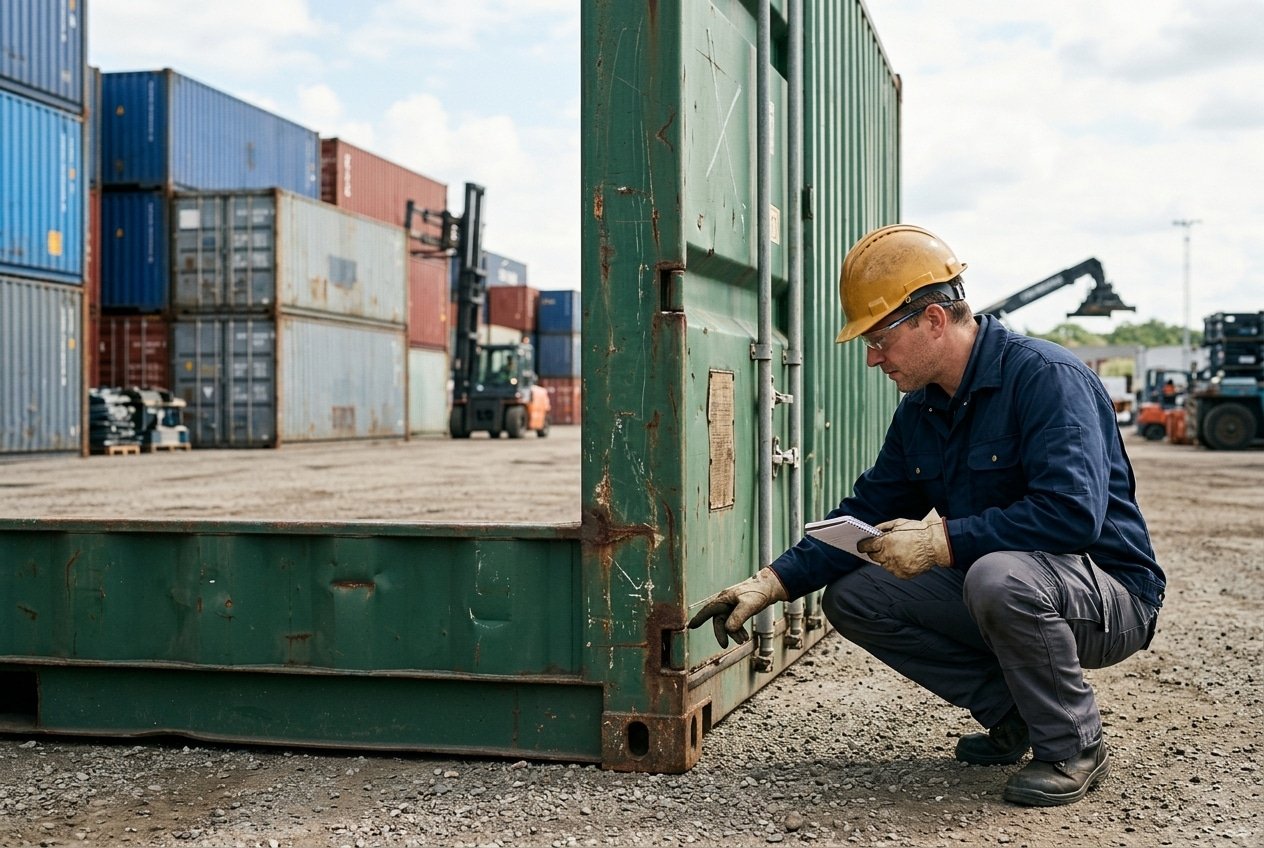
Surface rust on a used shipping container is normal and expected. The orange-brown patina on Corten steel is actually a feature, not a defect: it forms a barrier that slows further corrosion. What you’re watching for is deep, flaking rust that has eaten through the steel or created holes. Press a screwdriver or key against any suspect spots. If the metal flakes away or the tool pushes through, you’ve found structural corrosion.
Focus on these high-risk areas: the bottom 12 inches of side panels (where water splashes up from the ground), the underside of the container frame, any areas where paint has been scratched or chipped, and the corners where panels meet. Containers that sat on bare earth or in coastal environments tend to corrode faster. A container stored on a gravel pad or concrete blocks in Raleigh, North Carolina will generally fare better than one that spent years on a salt marsh in Galveston.
Checking for Roof Dents and Standing Water
The roof is the most neglected part of a container inspection because most buyers never climb up to look at it. That’s a mistake. Container roofs are made from thinner steel than the walls (typically 1.6mm versus 2.0mm for side panels), making them more vulnerable to dents and punctures.
Use a ladder to inspect the roof surface. You’re looking for dents deeper than about 2 inches, which can create low spots where water pools. Standing water accelerates rust and eventually causes leaks. Run your hand across any dented areas to feel for soft spots or pinhole corrosion. If you’re inspecting after rain, pooled water on the roof is an immediate red flag. A properly functioning container roof should shed water completely. Any container with active roof leaks should be priced accordingly or avoided entirely.
Evaluating Door Functionality and Seals
Container doors take more abuse than any other component. They’re opened and closed thousands of times during a container’s shipping life, exposed to salt spray, and subjected to the stress of cargo shifting during ocean transport. A container with a solid body but failed doors is a container that won’t protect your contents.
Open and close both doors fully during your inspection. They should swing smoothly through their full 270-degree range (or 180 degrees on standard configurations). If the doors bind, stick, or require excessive force, the container may have frame distortion from stacking damage or impact. This is a structural issue, not just an inconvenience.
Testing Locking Bars and Hinges
The locking mechanism on a shipping container consists of vertical lock rods, cam keepers, and handle assemblies on each door. Turn the handles and watch the lock rods move up and down. They should travel smoothly and seat firmly into the cam keepers at the top and bottom of the door frame. Stiff or seized lock rods are common on older containers but can often be restored with penetrating oil and manual working.
Hinges are harder to fix. Each door hangs on three or four blade hinges welded to the container frame. Check for cracks at the weld points, excessive play in the hinge pins, and any signs that hinges have been re-welded (visible grinding marks or mismatched weld beads). A door that sags when opened indicates worn hinge pins, and while replacement pins are available, the labor isn’t trivial. Budget $200-$500 for professional hinge repair if needed.
Inspecting Gaskets for Weatherproofing
The rubber gaskets (also called door seals) run along the full perimeter of both doors and create the weather barrier when the container is closed. On a one-trip container, these gaskets are supple and compress evenly. On older units, they harden, crack, and shrink away from the door frame.
Close the doors and look for daylight around the seal edges. Any visible light means moisture will find its way in. Press the gasket with your thumb: it should compress and spring back. If it feels hard like plastic or shows visible cracking, plan on replacing it. Replacement gasket kits for a standard 20ft container run $150-$300 for parts, and installation is a reasonable DIY project. Don’t skip this check. A container with perfect steel but failed gaskets will still develop interior moisture problems, mold, and condensation damage within months.
Assessing Interior Floor and Wall Integrity
Step inside the container and close the doors behind you. This is where you’ll discover problems that exterior inspections miss entirely. The interior floor of a standard shipping container is 28mm (roughly 1-1/8 inch) marine-grade plywood, supported by steel cross-members spaced approximately 12 inches apart. The walls are corrugated steel panels welded to the frame.
Walk the entire floor slowly. Feel for soft spots, bounce, or flex underfoot. A solid floor feels firm and uniform. A compromised floor will give noticeably under your weight, particularly near the edges where moisture migrates from the steel frame into the plywood.
The Light Test for Pinholes and Cracks
This is the single most effective test for container integrity, and it requires nothing more than a dark interior and daylight outside. Close both doors completely and let your eyes adjust for 30-60 seconds. Then scan every surface: walls, ceiling, floor edges, and especially the areas around corner posts and panel joints.
Any pinpoint of light means there’s a hole in the steel. Even tiny pinholes will admit water over time, and where there’s one, there are usually more nearby. Mark any light spots with chalk or tape so you can assess them from the outside. Small pinholes (under 3mm) can be patched with weld or marine-grade sealant. Larger holes or clusters of pinholes in the roof or upper walls suggest advanced corrosion that may not be worth repairing. Lease Lane Containers provides transparent grading guidance on their used inventory, so buyers know exactly what condition to expect before scheduling delivery.
Checking Marine-Grade Plywood for Delamination
Marine-grade plywood is specified for container floors because it resists moisture better than standard plywood. But “resists” doesn’t mean “immune.” After years of exposure to humidity, cargo spills, and condensation, the plywood layers can separate: a condition called delamination. Delaminated flooring looks wavy or bubbled, feels spongy underfoot, and may show dark staining from trapped moisture.
Check the floor edges along both side walls, where water tends to collect. Probe any suspect areas with a screwdriver. Solid marine plywood resists penetration. Delaminated plywood will crumble or separate easily. A full floor replacement on a 20ft container costs $800-$1,500 depending on your region and whether you do the labor yourself. On a 40ft unit, double that estimate. Factor this cost into your purchase decision if you find significant floor damage.
Detecting Chemical Contamination and Odors
Used shipping containers have carried everything from electronics and clothing to industrial chemicals and agricultural products. While most containers are cleaned between uses, chemical residue can persist in the wood flooring, in rust pockets, and in the porous surfaces of older containers. This matters significantly if you’re planning to store food products, use the container as a workspace, or convert it for habitable use.
Open the doors and stand at the threshold before entering. Take a deliberate breath. You’re checking for chemical odors: solvents, pesticides, fumigants, or any sharp, acrid smell that doesn’t belong. Methyl bromide, a fumigant historically used to treat cargo for pest control, is a particular concern. While its use has been restricted under the Montreal Protocol, older containers may still carry residual traces. Containers treated with methyl bromide should be stamped with “MB” on the CSC plate or a separate treatment plate near the doors.
If you detect strong chemical odors, walk away unless you’re prepared for professional remediation. For mild odors, ventilation and floor replacement can often resolve the issue. Containers intended for agricultural storage on farms in the Southeast, for example, should be odor-free and free of any fumigant markings. When in doubt, request the container’s cargo history from the seller. Reputable suppliers like Lease Lane Containers can provide guidance on which units are appropriate for sensitive storage applications.
Verifying CSC Plates and Certification
Every shipping container built for international transport carries a CSC (Convention for Safe Containers) plate, typically riveted to the left door. This metal plate is the container’s birth certificate and inspection record rolled into one. It contains the manufacturer, the date of manufacture, the maximum gross weight, the maximum stacking weight, and the dates of any periodic inspections.
Read the CSC plate carefully. The manufacturing date tells you the container’s age, which is one of the strongest predictors of remaining useful life. A container built in 2015 has a fundamentally different condition profile than one from 2005. The maximum gross weight (typically 30,480 kg or 67,200 lbs for a standard 20ft unit) confirms the container’s rated capacity. The stacking weight rating (usually 216,000 kg or 476,000 lbs) confirms the corner castings and frame can handle being stacked during transport.
For Cargo Worthy containers, the CSC plate should show a current inspection date. CSC inspections are valid for 30 months after the initial 5-year period from manufacture. If the inspection has lapsed, the container may still be perfectly functional for ground storage, but it won’t qualify for ocean freight and shouldn’t be sold as Cargo Worthy. Containers without a CSC plate, or with a plate that’s been tampered with, should raise immediate questions. The plate’s absence doesn’t necessarily mean the container is unsafe for storage, but it does mean you can’t verify its specifications or history through official channels.
Final Checklist for On-Site Inspections
Use this checklist every time you inspect a used shipping container, whether you’re visiting a depot in person or reviewing a unit before accepting delivery. Print it, save it on your phone, or write it on a clipboard. Consistency matters more than memory.
- Confirm the container grade (One-Trip, Cargo Worthy, or Wind and Watertight) matches what the seller advertised
- Walk the full exterior perimeter checking for deep rust, panel cracks, and bottom rail damage
- Inspect the roof from above for dents deeper than 2 inches and any signs of standing water
- Open and close both doors fully, testing lock rods, handles, and hinge movement
- Compress door gaskets with your thumb to check for hardness, cracking, or gaps
- Perform the light test with doors closed, scanning all interior surfaces for pinholes
- Walk the entire floor feeling for soft spots, bounce, or delamination
- Smell for chemical odors or fumigant residue before entering
- Read the CSC plate to confirm manufacture date, weight ratings, and inspection history
- Check for an “MB” fumigant treatment marking near the doors
- Photograph every defect you find for reference during price negotiation
A good rule of thumb: budget 30-45 minutes per container for a thorough inspection. Rushing this process is how buyers end up with units that need $2,000 in repairs on a $3,000 purchase.
The condition of a used shipping container determines everything: what you can store in it, how long it will last, and whether your investment holds up over 5, 10, or 15 years. Every minute you spend inspecting before purchase saves hours of repair and frustration after delivery. If you’re buying for a job site, a farm, or a small business, matching the right grade to your actual needs is just as important as the inspection itself.
Ready to find the right container for your project? Browse available inventory at Lease Lane Containers to compare sizes, grades, and conditions, then reach out to the Raleigh-based team at (984) 313-6158 for help with delivery planning and site logistics.