Requirements for a Shipping Container Delivery
Table of Contents
- Table of Contents
- Essential Site Preparation and Ground Conditions
- Space and Clearance Specifications for Delivery Trucks
- Choosing the Right Delivery Method
- Container Orientation and Door Direction Planning
- Permits and Legal Compliance for Placement
- Safety Protocols and On-Site Coordination
- Final Inspection and Post-Delivery Checklist
Table of Contents
- Essential Site Preparation and Ground Conditions
- Space and Clearance Specifications for Delivery Trucks
- Choosing the Right Delivery Method
- Container Orientation and Door Direction Planning
- Permits and Legal Compliance for Placement
- Safety Protocols and On-Site Coordination
- Final Inspection and Post-Delivery Checklist
A 20-foot shipping container weighs roughly 5,000 lbs empty. A 40-foot high cube tips the scales at over 8,500 lbs. When a truck rolls onto your property to drop one of these steel structures, every inch of ground, every overhead wire, and every tight corner matters. Failing to prepare your site properly is the single most common reason deliveries go sideways, and rescheduling a failed delivery can cost $300 to $800 or more depending on the carrier and distance. Understanding what's required before the truck arrives saves money, protects your property, and ensures the container lands exactly where you need it. Whether you're a contractor setting up a job site storage solution, a homeowner adding backyard space, or a farm operation expanding equipment storage, the delivery requirements for a shipping container follow the same core principles. This guide covers every detail: ground conditions, truck clearance, delivery methods, orientation planning, permits, and safety coordination. If you're still deciding on the right container size or grade, Lease Lane Containers offers practical buying guidance to help you compare options before scheduling delivery. Getting the container choice right is step one. Getting the site ready is step two, and it's where most people underestimate the work involved.
Essential Site Preparation and Ground Conditions
The ground beneath your shipping container determines its lifespan, structural integrity, and usability. A container sitting on poorly prepared ground will shift, develop drainage problems, and corrode faster along its bottom rails. Site prep isn't optional: it's the foundation of a successful placement.
Shipping containers are engineered to bear weight at their four corner castings and along their bottom side rails. The flat corrugated steel floor panels between those rails aren't designed to support the full load from below, which means your foundation needs to support the container at specific structural points. Ignoring this leads to warping, door misalignment, and pooling water underneath the unit.
Surface Leveling and Stability Requirements
Your placement area needs to be level within 3 inches across the full length of the container. For a 40-foot unit, that's a tolerance of 3 inches over 40 feet, which is achievable with basic grading equipment but nearly impossible to eyeball accurately. Use a laser level or a long spirit level to verify grade before delivery day.
Soft or organic soil is a problem. Containers placed directly on grass, topsoil, or clay will sink unevenly over time, especially in areas with heavy rainfall like central North Carolina where annual precipitation averages around 46 inches. The corner castings concentrate thousands of pounds of force into small contact patches. Without stable ground, those corners dig in at different rates, and within a few months your doors won't open or close properly.
Remove all vegetation, roots, and organic material from the placement area. Compact the exposed subgrade using a plate compactor or roller. A minimum compacted depth of 6 inches is the standard rule of thumb for residential and light commercial placements. For heavier loads or containers that will be stacked, consult a geotechnical assessment.
Foundation Options: Concrete Pads vs. Gravel Beds
Concrete pads provide the most stable, long-term foundation. A full slab poured at 4 inches thick with rebar or wire mesh reinforcement works well for permanent installations. For a 20-foot container footprint (roughly 8 ft x 20 ft), expect to pour about 160 square feet of concrete. At typical rates, this runs $1,500 to $3,000 depending on your region and site access.
Concrete pier blocks are a more economical alternative. Place them at each corner casting and at 10-foot intervals along the side rails. This approach costs significantly less than a full slab and still provides excellent load distribution.
Gravel beds are the most common foundation for semi-permanent and temporary placements. A 6-inch compacted bed of 3/4-inch crushed stone provides good drainage, prevents moisture from pooling beneath the container, and allows for minor leveling adjustments. Extend the gravel pad 2 feet beyond the container footprint on all sides to manage water runoff. For a 40-foot container, that means a gravel area of approximately 12 ft x 44 ft.
Railroad ties or treated timber beams placed perpendicular to the container's length offer another practical option, particularly on rural properties and farms where gravel delivery may be difficult. Space them at 10-foot intervals and ensure each beam sits on compacted ground.
Space and Clearance Specifications for Delivery Trucks
The delivery truck needs far more space than the container itself. This is where many first-time buyers get caught off guard: the container is 40 feet long, but the truck and trailer combination delivering it can stretch 65 to 75 feet.
Vertical Clearance for Tilt-Bed and Crane Operations
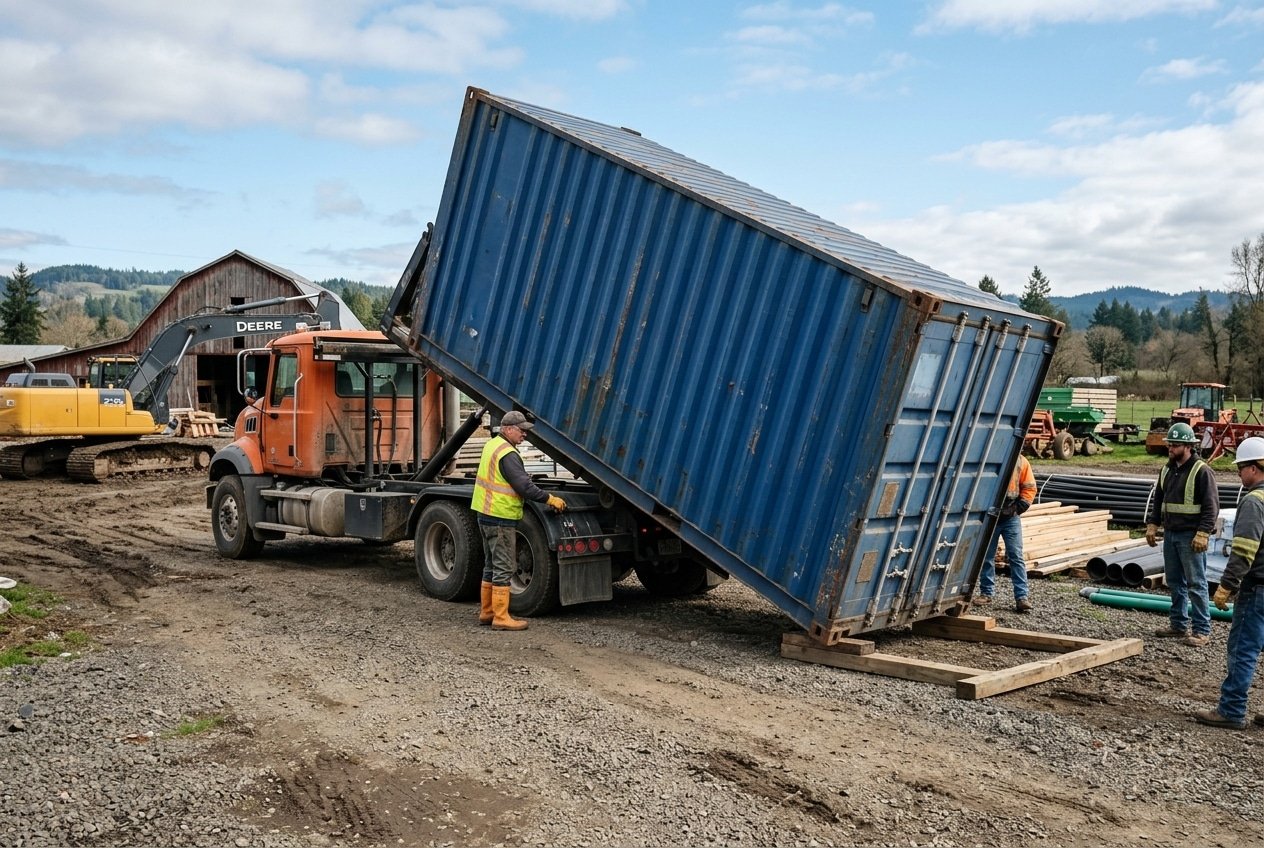
A tilt-bed trailer raises its bed to an angle of approximately 15 to 20 degrees during offloading. At full tilt, the rear of the container rises to about 14 to 16 feet above ground level, and the hydraulic arm at the front of the trailer may reach 18 feet or higher. Standard high cube shipping containers already stand 9 feet 6 inches tall on the trailer deck, so any overhead obstruction below 18 feet is a potential problem.
Measure every overhead element along the delivery path and at the placement site: power lines, tree branches, building eaves, carport structures, and cable or telephone lines. Utility lines in residential areas typically hang between 15 and 25 feet, but sagging lines in rural areas can dip well below that. If overhead power lines cross your delivery path at less than 20 feet, contact your utility provider at least two weeks before delivery to discuss temporary line raising or de-energizing.
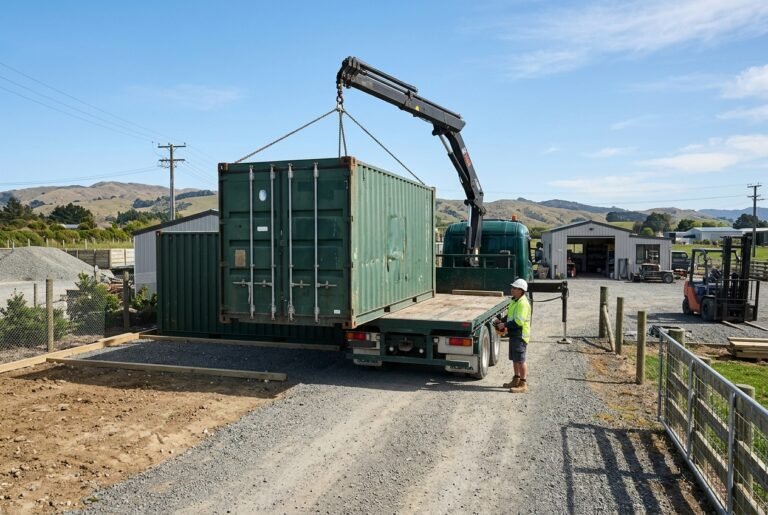
Crane-assisted deliveries require even more vertical clearance. A typical mobile crane used for container placement extends its boom 30 to 50 feet overhead. The crane itself needs a firm, level staging area of at least 20 ft x 20 ft with ground capable of supporting 40,000 to 60,000 lbs of equipment weight.
Turning Radius and Linear Path Requirements
A standard tilt-bed truck with a 40-foot container needs a minimum turning radius of 30 to 40 feet. That means if the truck has to turn from a public road onto your driveway, the driveway entrance needs to be at least 12 feet wide, and the turn itself requires 30+ feet of unobstructed arc.
The delivery path from the road to the placement area should be straight whenever possible. Every turn adds complexity and risk. If a straight path isn't feasible, map out the route in advance and confirm that each turn point has adequate clearance on both sides: at least 3 feet beyond the truck's swept path.
Driveway surfaces matter too. Asphalt and concrete handle the weight of a loaded delivery truck (up to 80,000 lbs gross vehicle weight for a tractor-trailer combination). Gravel driveways work if properly compacted, but soft gravel or loose stone can cause the truck to lose traction or sink. Dirt paths and unpaved roads should be assessed for load-bearing capacity, especially after rain. If you're on a rural property with a long unpaved approach, consider having gravel laid along the delivery route.
Gate openings must accommodate the truck width of 8.5 feet at minimum, though 10 to 12 feet provides a safer margin. Measure every gate, fence opening, and narrow passage along the route.
Choosing the Right Delivery Method
The delivery method you choose affects cost, site requirements, and placement precision. Not every method works for every property, and the right choice depends on your access conditions, budget, and how precisely you need the container positioned.
Tilt-Bed Trailers vs. Flatbed Chassis
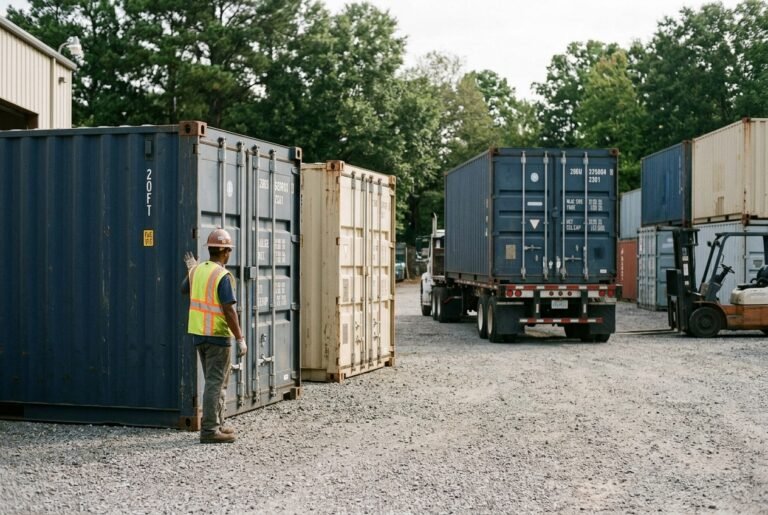
Tilt-bed trailers are the most common delivery method for ground-level placement. The truck backs into position, and the trailer bed tilts hydraulically while the container slides off the rear onto the ground. This method is cost-effective and works well on flat, open sites with a clear straight-line approach of at least 100 feet behind the desired placement spot.
The limitation of tilt-bed delivery is that the container can only be placed in line with the truck's approach angle. You cannot rotate the container during offloading. The container slides off in the direction the truck is facing, so your truck approach path determines your container orientation. Plan accordingly.
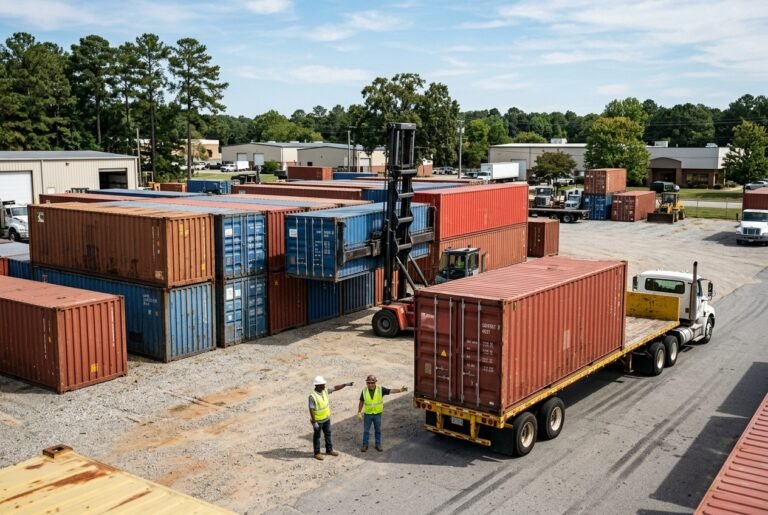
Flatbed chassis delivery is different: the container arrives on a standard flatbed trailer and must be lifted off by a separate crane, forklift, or side-loader. This method is common for commercial sites and locations where a tilt-bed can't maneuver. The container stays on the chassis until lifting equipment removes it, giving you more flexibility in placement positioning.
Side-Loader and Crane-Assisted Offloading
Side-loaders are specialized trucks with built-in hydraulic arms that lift the container off the side of the trailer and place it on the ground. They offer excellent placement precision: typically within 6 inches of your target position. Side-loaders can also rotate the container during placement, which solves the orientation limitations of tilt-bed delivery.
The trade-off is cost. Side-loader delivery typically runs $200 to $500 more than tilt-bed delivery, and availability varies by region. In the Raleigh, North Carolina area and along the I-40 and I-95 corridors, side-loader service is generally accessible through major container carriers. In more remote areas, you may need to coordinate further in advance.
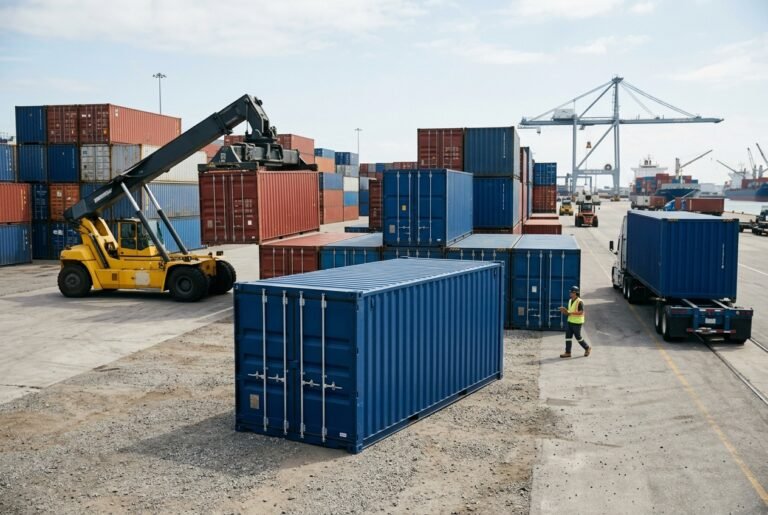
Crane-assisted delivery is reserved for situations where no other method works: tight urban lots, rooftop placements, locations behind buildings, or sites with no truck access to the final position. Mobile crane rental adds $500 to $2,000+ to the delivery cost depending on crane size and duration. The crane operator and the container delivery driver need to coordinate timing precisely, so schedule both well in advance. Lease Lane Containers' delivery planning guidance can help you determine which method fits your site conditions.
Container Orientation and Door Direction Planning
This is the detail that experienced buyers plan for and first-time buyers forget. Every standard shipping container has double doors on one end. Once that container is on the ground, moving it to change the door direction costs real money and requires heavy equipment. Get the orientation right the first time.
Think about how you'll use the container daily. If it's storing lawn equipment on a residential property, you probably want the doors facing your house or driveway for easy access. If it's holding construction materials on a job site, the doors should face the work area, not a fence or wall. If you're placing the container against a building or property line, you need at least 8 to 10 feet of clearance in front of the doors for them to swing fully open. Standard container doors swing outward approximately 270 degrees, but you need at least 90 degrees of swing to access the full interior width.
For properties where the container will sit parallel to a driveway or road, decide whether you want the doors facing the road (for frequent loading and unloading) or facing away (for security and aesthetics). On farm properties, door orientation often depends on equipment access: a tractor with a front loader needs a straight approach path to the container opening.
Sketch your placement area on paper before delivery day. Mark the container footprint, the door end, the approach path for the delivery truck, and any obstacles. Share this sketch with your delivery driver. A 5-minute conversation about orientation before the truck backs in prevents a costly repositioning later. If you're ordering from Lease Lane Containers, the Raleigh-based team can walk you through placement planning to make sure the container lands where and how you need it.
Permits and Legal Compliance for Placement
Permit requirements for shipping container placement vary dramatically by jurisdiction. What's perfectly legal on a rural 10-acre parcel in Johnston County may require multiple permits on a half-acre lot inside Raleigh city limits. Never assume you're exempt: always verify with your local planning or zoning office before delivery.
Most municipalities classify shipping containers as accessory structures. In Wake County, North Carolina, accessory structures typically require a zoning permit, and some areas require a building permit if the container will be modified with electrical, plumbing, or structural changes. Call the Wake County Planning Department or check your municipality's online portal to confirm requirements for your specific address.
Some jurisdictions limit where containers can be placed on a lot: setback requirements from property lines, maximum lot coverage percentages, and restrictions on placement in front yards are common. In many suburban areas, containers must be placed behind the front building line of the primary structure.
Zoning Laws and Homeowners Association Rules
Zoning codes dictate whether a shipping container is permitted on your property at all. Agricultural and industrial zones are generally the most permissive. Residential zones vary widely: some allow containers as temporary storage during construction (typically 6 to 12 months with a permit), while others prohibit them entirely.
HOA restrictions are separate from municipal zoning and often stricter. Many HOAs ban shipping containers outright, regardless of what the city or county allows. Review your HOA covenants, conditions, and restrictions (CC&Rs) before purchasing a container. Violations can result in daily fines ranging from $25 to $200 until the container is removed.
If your property falls under both municipal zoning and an HOA, you need approval from both. Start the permit process at least 4 to 6 weeks before your planned delivery date. Some jurisdictions require a site plan showing the container's exact placement, dimensions, and distance from property lines. Having this documentation ready speeds up the approval process significantly.
Safety Protocols and On-Site Coordination
Delivery day involves heavy equipment, large vehicles, and a multi-ton steel structure being maneuvered into position. Treating it casually invites property damage and personal injury.
Clear all people, pets, vehicles, and loose items from the delivery path and placement area at least one hour before the scheduled delivery window. Establish a safety perimeter of 25 feet around the offloading zone: no one enters this area during active delivery operations. OSHA standard 29 CFR 1926.251 covers rigging equipment used in construction, and its principles apply to any crane or lifting operation involved in container placement.
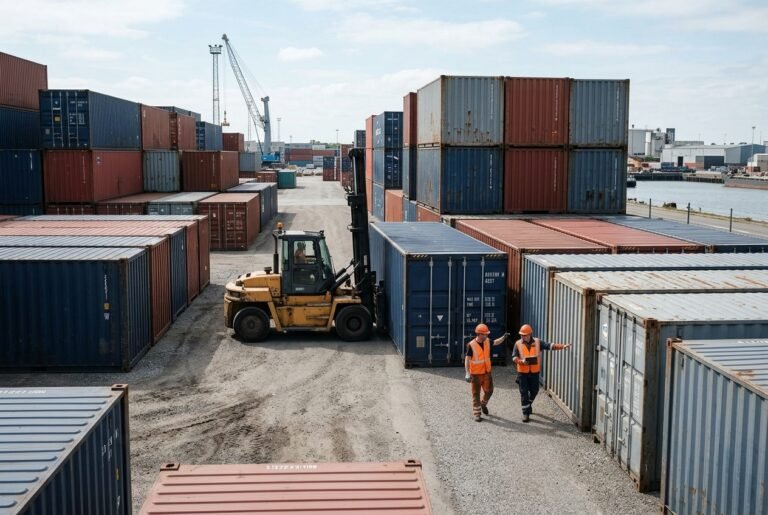
Designate one person on site as the point of contact for the delivery driver. This person should know the exact placement location, the desired door orientation, and any site-specific concerns. Conflicting instructions from multiple people on site cause delays and mistakes.
Identifying Overhead Obstructions and Hazards
Walk the entire delivery route the day before delivery. Look up, not just ahead. Overhead hazards include power lines, telephone cables, tree limbs, building overhangs, satellite dishes, and light fixtures. Mark any hazard with flagging tape or cones so the driver can see them from the truck cab.
Underground utilities are equally critical. Call 811 (the national "Call Before You Dig" line) at least 3 business days before delivery to have underground utility lines marked. A heavy delivery truck rolling over a shallow gas line or water main creates a dangerous and expensive situation. The 811 service is free and legally required in most states before any excavation, but it's smart practice even for surface-level delivery operations where truck weight could compress soil over buried lines.
If your property has a septic system, know exactly where the tank and drain field are located. Delivery trucks can crush septic lines and collapse tank lids. Mark these areas clearly and route the truck around them.
Final Inspection and Post-Delivery Checklist
Once the container is on the ground, resist the urge to sign off and let the driver leave immediately. A 10-minute inspection now prevents disputes and headaches later.
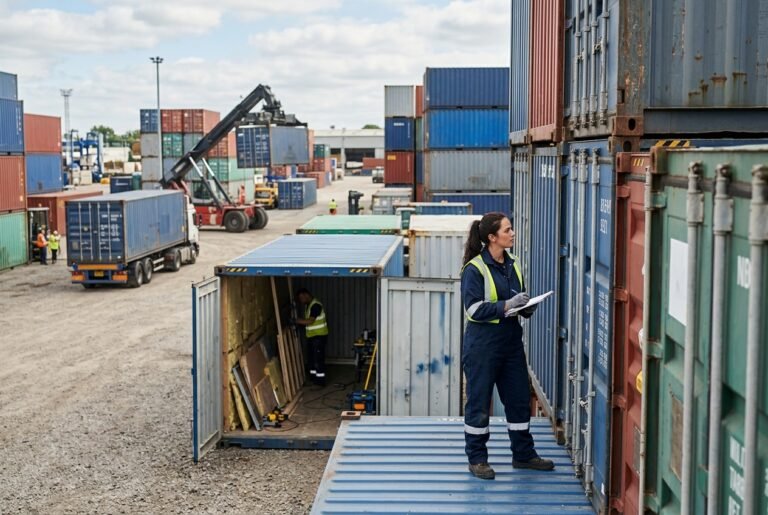
Walk around the entire container. Check all four sides, the roof, and the undercarriage for damage that may have occurred during transport. Look for fresh dents, scratches through the paint to bare metal, bent corner castings, and any structural deformation. Open and close both doors fully: they should swing smoothly without binding or scraping. Test the locking bars and handles. Check the door gaskets for tears or compression damage that could compromise the container's weather seal.
Verify the container is level using a 4-foot spirit level placed on the floor inside the container near each end. If the container is more than 2 inches off level, the doors will become increasingly difficult to operate over time, and water may pool on the roof rather than sheeting off.
Confirm the container's orientation matches your plan. Verify the door end faces the correct direction and that you have adequate clearance for door operation. Check that the container is positioned at the correct distance from property lines, buildings, and other structures per your permit requirements.
Use this checklist before the driver departs:
- Container is level within 2 inches across its full length
- Doors open, close, and lock smoothly on both sides
- No fresh transport damage on walls, roof, or corner castings
- Door gaskets are intact with no visible tears
- Container orientation and door direction match the planned layout
- Foundation or ground surface is stable with no visible settling
- Minimum 8-foot clearance exists in front of doors for full swing
- Container serial number and condition match your purchase documentation
- Delivery path and property show no truck-caused damage to note
Document everything with photos: timestamped images of all four sides, the roof (if accessible), the interior, the door hardware, and the foundation. If you notice damage, photograph it and note it on the delivery receipt before signing.
Getting your shipping container delivery requirements right the first time means less stress, lower costs, and a container that performs exactly as intended for years. If you're ready to move forward, browse our inventory to compare container sizes, grades, and conditions for your specific project. Have questions about site prep, delivery access, or placement planning? Contact us directly: the Lease Lane Containers team is here to help you plan a delivery that goes right the first time.