The Average Cost of a New 20ft Shipping Container
Table of Contents
- Table of Contents
- Current Market Rates for New 20ft Shipping Containers
- The Difference Between One-Trip and Brand New Units
- Global Price Benchmarks for 2024
- Key Factors Influencing Container Pricing
- Steel Market Fluctuations and Manufacturing Costs
- Geographic Location and Port Proximity
- Standard Features and Specifications of 20ft Units
- Additional Costs Beyond the Purchase Price
- Delivery Fees and Tilt-Bed Transport
- Site Preparation and Foundation Requirements
- Comparing New vs. Used 20ft Container Value
- Long-Term ROI and Resale Value
- Customization and Modification Surcharges
- How to Secure the Best Price from Suppliers
- Bulk Purchase Discounts and Seasonal Trends
- Final Checklist Before You Buy
Table of Contents
- Current Market Rates for New 20ft Shipping Containers
- The Difference Between One-Trip and Brand New Units
- Global Price Benchmarks for 2024
- Key Factors Influencing Container Pricing
- Steel Market Fluctuations and Manufacturing Costs
- Geographic Location and Port Proximity
- Standard Features and Specifications of 20ft Units
- Additional Costs Beyond the Purchase Price
- Delivery Fees and Tilt-Bed Transport
- Site Preparation and Foundation Requirements
- Comparing New vs. Used 20ft Container Value
- Long-Term ROI and Resale Value
- Customization and Modification Surcharges
- How to Secure the Best Price from Suppliers
- Bulk Purchase Discounts and Seasonal Trends
- Final Checklist Before You Buy
Buying a shipping container sounds straightforward until you start comparing quotes. Prices swing by thousands of dollars depending on the grade, your location, the supplier, and even the time of year. If you’re a contractor setting up a job site near Raleigh, a homeowner adding backyard storage, or a small business owner handling inventory overflow, understanding what drives the cost of a new 20ft shipping container is the difference between a smart purchase and an expensive surprise.
This guide breaks down real pricing data, hidden fees, and practical ways to get the best deal. Whether you’re buying your first container or your tenth, you’ll find specific numbers and actionable advice below. The goal is simple: help you budget accurately and buy confidently.
Current Market Rates for New 20ft Shipping Containers
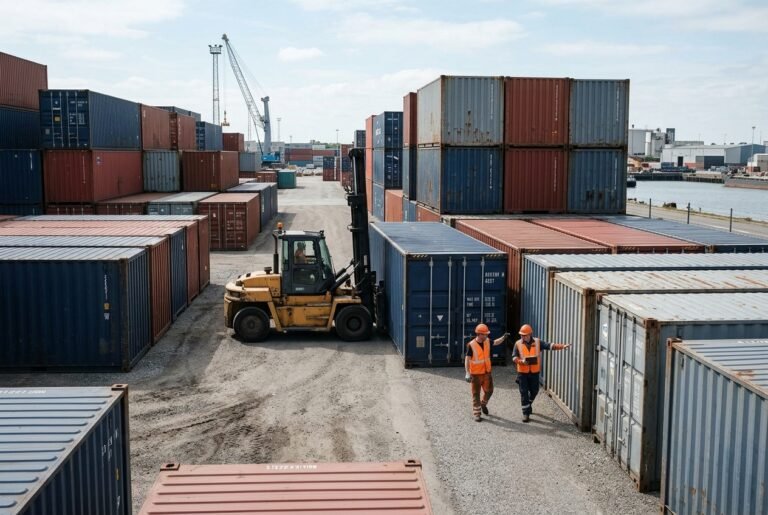
A new 20ft shipping container typically costs between $3,500 and $6,500 in the United States as of late 2024. That range is wide for good reason. The term “new” covers more than one category, and where you buy matters almost as much as what you buy.
Most buyers shopping for a new 20ft container are actually looking at one-trip units, which represent the bulk of the market. True factory-fresh containers exist, but they’re rarely sold directly to end users in the U.S. because almost all shipping containers are manufactured in China. Understanding this distinction will save you from overpaying or expecting the wrong product.
The Difference Between One-Trip and Brand New Units
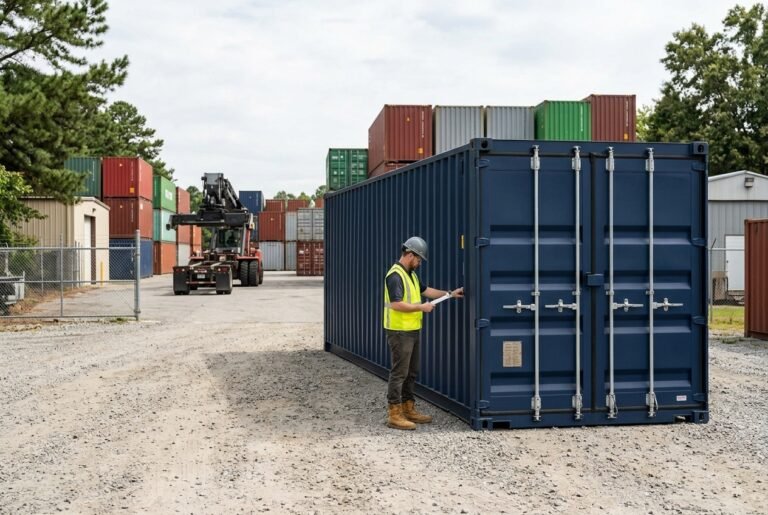
A one-trip container has made exactly one ocean voyage, typically loaded with cargo from a Chinese manufacturing facility to a U.S. port. It arrives in near-perfect condition with minimal cosmetic wear, intact factory paint, and no dents or rust. For all practical purposes, it’s the closest thing to “brand new” available on the domestic market.
A true brand-new container, by contrast, has never been loaded or shipped. These units are available at the factory gate in China and occasionally through specialty importers. They cost roughly 10-15% more than one-trip units but offer almost no functional advantage for storage, workspace, or modification projects. Most buyers in the Southeast and across the U.S. are well served by one-trip grade containers.
Global Price Benchmarks for 2024
Container prices have stabilized since the extreme highs of 2021-2022, when supply chain disruptions pushed one-trip 20ft units past $8,000 in some markets. Here’s where pricing stands for late 2024:
- One-trip 20ft standard height: $3,500 to $5,500 depending on location
- One-trip 20ft high cube: $4,200 to $6,500, reflecting the added 1 foot of interior height
- Factory-direct (FOB China): $1,800 to $2,500, though ocean freight and customs add $1,500 to $3,000
Prices tend to be lower near major ports like Houston, Savannah, and Los Angeles. Buyers in landlocked states or rural areas should expect to pay $500 to $1,500 more due to inland transport costs.
Key Factors Influencing Container Pricing
No single factor determines what you’ll pay. Pricing is a product of global manufacturing economics, raw material costs, and local supply-demand dynamics. Knowing which variables matter most helps you time your purchase and negotiate from a stronger position.
Steel Market Fluctuations and Manufacturing Costs
Shipping containers are built primarily from Corten steel (also called weathering steel), and the price of that raw material directly affects what you pay. When hot-rolled steel prices spike, container manufacturing costs follow within 60 to 90 days. A $100-per-ton increase in steel prices can add $300 to $500 to the cost of a single 20ft unit.
Labor costs at Chinese manufacturing plants and the exchange rate between the U.S. dollar and Chinese yuan also play a role. A stronger dollar generally means lower container prices for American buyers, while a weaker dollar pushes costs up.
Geographic Location and Port Proximity
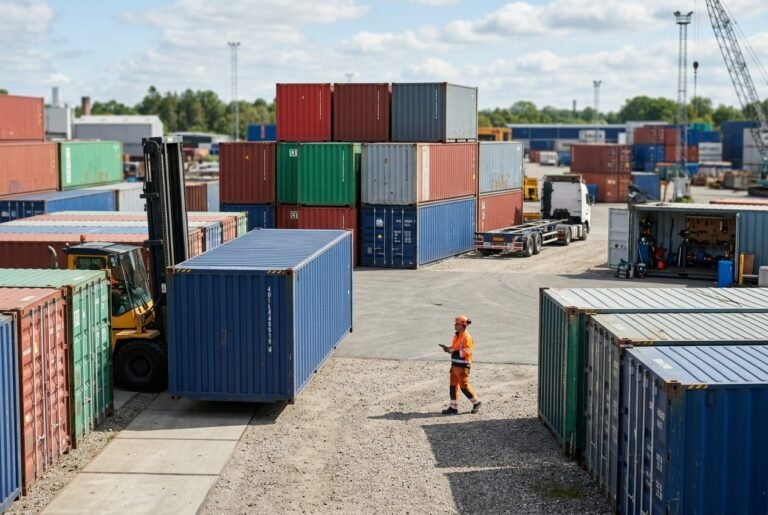
If you’re buying near a major port city, you’ll almost always find lower prices and more inventory. Containers naturally accumulate at import-heavy ports, creating surplus stock that drives competition among sellers.
Buyers in the Raleigh, North Carolina area benefit from relative proximity to the Port of Wilmington and the Port of Virginia in Norfolk. Both are within a day’s trucking distance, which keeps inland delivery surcharges reasonable compared to buyers in the Midwest or Mountain West. A container delivered to a site along the I-40 or I-95 corridor typically costs $400 to $800 for transport, while deliveries to remote locations in Montana or Wyoming can run $1,500 or more.
Standard Features and Specifications of 20ft Units
A standard 20ft shipping container measures 20 feet long, 8 feet wide, and 8 feet 6 inches tall on the exterior. Interior dimensions come in slightly smaller at roughly 19 feet 4 inches long, 7 feet 8 inches wide, and 7 feet 10 inches tall, giving you approximately 1,170 cubic feet of usable space.
Every new or one-trip 20ft container includes:
- Marine-grade Corten steel walls and roof panels (14-gauge)
- Bamboo or marine plywood flooring rated for forklift traffic
- Double cargo doors with lock rods and rubber gaskets
- Four corner castings rated for stacking and crane lifting
- A tare weight of approximately 5,070 lbs (2,300 kg)
- Maximum payload capacity of roughly 61,000 lbs (27,600 kg)
High cube variants add one foot of height, bringing the exterior to 9 feet 6 inches. This extra clearance matters for container office conversions, workshops, or any project where headroom affects comfort. If you’re planning modifications, the high cube option is usually worth the $500 to $1,000 premium.
Additional Costs Beyond the Purchase Price
The sticker price on a container is only part of your total investment. Delivery, site work, and permitting can add $1,000 to $5,000 depending on your situation. Budgeting for these costs upfront prevents delays and frustration.
Delivery Fees and Tilt-Bed Transport
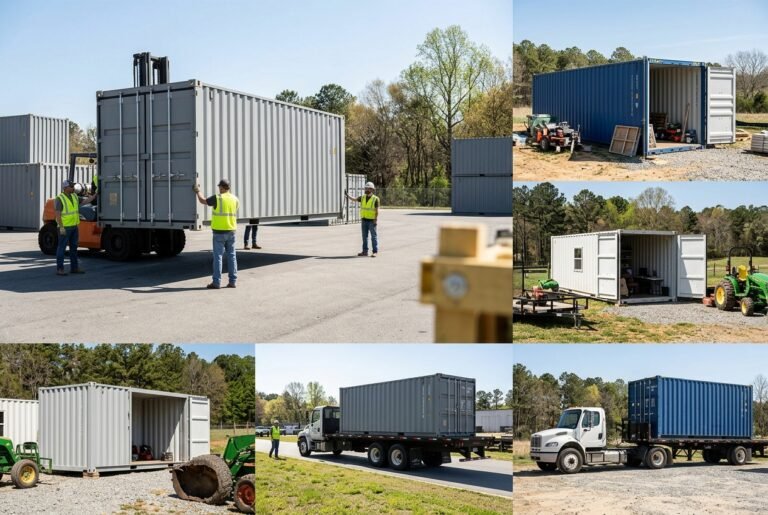
Most 20ft containers are delivered on a tilt-bed truck, which hydraulically tilts the trailer and slides the container off at ground level. This method requires roughly 100 feet of straight, level space in front of the placement spot. If your site has tight turns, overhead power lines, or soft ground, you may need a crane or side-loader instead, which adds $300 to $800 to the delivery cost.
Typical delivery fees within 50 miles of a depot or port run $250 to $600. Beyond that, expect to pay $3 to $5 per mile. For buyers in the Raleigh area, Lease Lane Containers provides delivery planning support that covers site access, turning radius, overhead clearance, and placement logistics so the container arrives and gets positioned correctly the first time.
Site Preparation and Foundation Requirements
You don’t need a concrete slab for most storage applications, but you do need a level surface. Uneven ground causes doors to bind and creates pooling water that accelerates corrosion at the base. Common foundation options include:
- Compacted gravel pad (4-6 inches deep): $300 to $800 for a 20ft footprint
- Concrete piers at the four corners: $500 to $1,200 installed
- Railroad ties or treated timber beams: $100 to $300 for materials
- Full concrete slab: $2,000 to $4,000 depending on local rates
A rule of thumb: spend at least 10% of your container’s purchase price on proper site preparation. It protects your investment and makes future modifications or resale significantly easier.
Comparing New vs. Used 20ft Container Value
A used 20ft shipping container in Cargo Worthy condition typically sells for $1,800 to $3,200, roughly half the cost of a one-trip unit. Wind and Watertight grade containers, which may have cosmetic damage but still keep weather out, run $1,200 to $2,500. The savings are real, but so are the trade-offs.
Used containers often have dents, surface rust, faded paint, and worn door gaskets. None of these issues necessarily affect function for basic storage, but they matter if you’re planning visible placement on a commercial property or a residential lot where appearance counts.
Long-Term ROI and Resale Value
One-trip containers hold their value better than used units. A one-trip 20ft container purchased for $4,500 today might resell for $3,000 to $3,500 after five years of use, retaining roughly 65-75% of its value. A used container bought for $2,500 might only fetch $1,200 to $1,500 at resale, a retention rate closer to 50%.
If you’re buying for a 10-year-plus application like permanent storage, a workshop, or a container conversion project, the one-trip premium pays for itself through longer service life and lower maintenance costs. For short-term job site storage lasting 6 to 18 months, a used container in Cargo Worthy condition often makes more financial sense.
Customization and Modification Surcharges
Modifications can quickly double the cost of your container. Basic additions like a lockbox ($75 to $150) or ventilation openings ($200 to $400 each) are affordable. Larger projects get expensive fast.
Common modification costs for 20ft containers:
- Roll-up door installation: $1,200 to $2,500
- Personnel door with frame: $800 to $1,500
- Window cutout with security bars: $500 to $1,000
- Electrical panel and wiring: $1,500 to $3,500
- Spray foam insulation (walls and ceiling): $2,000 to $4,000
- Full container office buildout: $8,000 to $25,000+
If you know you’ll need modifications, discuss them with your supplier before purchase. Some sellers offer pre-modified units at lower cost than custom work, and buying a high cube from the start avoids the headroom regret that plagues many conversion projects.
How to Secure the Best Price from Suppliers
Getting the best price on a new 20ft shipping container requires a combination of timing, comparison shopping, and understanding how suppliers structure their pricing. Don’t assume the first quote you receive reflects the market rate.
Start by requesting quotes from at least three suppliers. Ask each one to break out the container price, delivery fee, and any applicable taxes or surcharges separately. This makes comparison straightforward and reveals hidden markups. Suppliers like Lease Lane Containers provide transparent grading guidance and clear pricing, which simplifies the process for first-time buyers.
Bulk Purchase Discounts and Seasonal Trends
Buying two or more containers at once typically earns a 5-10% discount per unit. Some suppliers extend better pricing for five or more units, which benefits contractors outfitting multiple job sites or businesses setting up modular storage compounds.
Seasonal trends also affect pricing. Container prices tend to dip slightly in late fall and winter when construction activity slows and demand drops. Spring and early summer bring higher prices as contractors and homeowners ramp up projects. If your timeline is flexible, placing an order in November or December can save $200 to $500 per unit compared to peak season pricing.
Final Checklist Before You Buy
Use this checklist to confirm you’ve covered every cost and consideration before placing your order:
- Confirm the container grade: one-trip, Cargo Worthy, or Wind and Watertight
- Verify exterior and interior dimensions, especially if you need high cube height
- Get delivery fees in writing, including mileage charges beyond the base radius
- Assess your site for level ground, overhead clearance (minimum 14 feet for tilt-bed), and access width (at least 12 feet)
- Budget for foundation materials and installation
- Check local zoning and permit requirements with your county planning department (Wake County residents can call 919-856-6335)
- Factor in any planned modifications and get quotes before purchasing the container
- Compare at least three supplier quotes with line-item breakdowns
The cost of a new 20ft shipping container is predictable once you understand what drives the price. Steel markets, port proximity, delivery logistics, and site conditions all play a part, but none of them are mysteries. Armed with the numbers in this guide, you’re in a strong position to budget accurately and avoid surprises.
If you’re ready to compare options, browse available inventory at Lease Lane Containers to see current 20ft container choices, grades, and pricing. The Raleigh-based team can help you match the right container to your project and plan delivery logistics before you commit.