The Best Vertical Blinds for a Jackleg Cabin
Table of Contents
- Table of Contents
- Why Vertical Blinds are the Ideal Choice for Jackleg Cabins
- Maximizing Space in Portable Cabin Environments
- Light Control for Productive Office Container Workspaces
- Top Materials for Durability in Portable Structures
- Easy-Clean PVC for High-Traffic Jackleg Cabins
- Fire-Retardant Fabrics for On-Site Safety Compliance
- Optimizing Office Container Window Coverings for Privacy
- Measuring and Installing Blinds in Prefabricated Cabins
- No-Drill Mounting Solutions for Metal Window Frames
- Essential Jackleg Cabin Accessories for Window Maintenance
- Thermal Efficiency and Insulation Benefits
- Reducing Heat Gain in Portable Cabin Blinds
- Selecting the Best Aesthetics for Professional Portable Offices
- Final Checklist for Jackleg Cabin Vertical Blind Selection
Table of Contents
- Why Vertical Blinds are the Ideal Choice for Jackleg Cabins
- Maximizing Space in Portable Cabin Environments
- Light Control for Productive Office Container Workspaces
- Top Materials for Durability in Portable Structures
- Easy-Clean PVC for High-Traffic Jackleg Cabins
- Fire-Retardant Fabrics for On-Site Safety Compliance
- Optimizing Office Container Window Coverings for Privacy
- Measuring and Installing Blinds in Prefabricated Cabins
- No-Drill Mounting Solutions for Metal Window Frames
- Essential Jackleg Cabin Accessories for Window Maintenance
- Thermal Efficiency and Insulation Benefits
- Reducing Heat Gain in Portable Cabin Blinds
- Selecting the Best Aesthetics for Professional Portable Offices
Jackleg cabins serve as temporary offices, welfare units, and site management hubs on construction sites, farms, and commercial properties across the United States. These portable steel-framed structures sit on adjustable legs, and while they’re built for function, the window treatments inside them rarely get the attention they deserve. The right vertical window blind for a jackleg cabin does more than block sunlight: it controls temperature, protects privacy during sensitive meetings, and gives a prefab workspace the professional appearance that clients and inspectors expect. With the global vertical window blinds market projected to reach approximately $5.5 billion by 2025 and growing at a compound annual growth rate of around 6.2% through 2033, manufacturers are producing more options suited to non-traditional structures than ever before. Whether you’re outfitting a single site cabin or planning a fleet of portable offices, choosing the correct blind saves money on energy costs and replacement cycles. If you’re also considering container-based office setups, Lease Lane Containers provides practical guidance on container office configurations that pair well with the same window treatment strategies covered here.
Why Vertical Blinds are the Ideal Choice for Jackleg Cabins
Standard horizontal blinds and roller shades have their place in residential settings, but jackleg cabins present a specific set of challenges that vertical blinds handle better than any alternative. The windows in these structures tend to be wider than they are tall, often spanning 1200mm to 1800mm across, which matches the natural orientation of vertical louvres. Vertical blinds also tolerate the vibrations and minor structural shifts that occur when a jackleg cabin is transported between sites or repositioned on uneven ground.
Another practical advantage is airflow management. On a warm site in North Carolina or anywhere in the southeastern U.S., you can angle vertical louvres to direct a cross-breeze without fully exposing the interior. Horizontal slats don’t offer this same directional control. The vertical orientation also sheds dust more readily, a genuine concern on active construction sites where particulate matter settles on every surface daily.
Maximizing Space in Portable Cabin Environments
Floor space inside a jackleg cabin is limited. A standard unit measures roughly 6m x 2.7m (approximately 20ft x 9ft), and every square inch matters when you’re fitting desks, filing cabinets, and welfare facilities into that footprint. Vertical blinds stack neatly to one side of the window when open, consuming virtually zero usable wall or floor space. Compare that to curtains, which billow inward and eat into desk placement zones, or venetian blinds that protrude several inches when tilted open.
The headrail for a vertical blind system typically mounts within 75mm of the window frame’s top edge. This compact profile means you can position shelving or notice boards directly above or beside the window without interference. For site managers working in cramped conditions, that recovered space translates directly into a more functional office.
Light Control for Productive Office Container Workspaces
Glare on a computer screen kills productivity. In a container office or jackleg cabin, the sun’s angle changes dramatically throughout the day, and the metal walls amplify heat and reflection. Vertical blinds allow precise 180-degree rotation of individual louvres, so you can block direct sunlight from one angle while still admitting diffused natural light from another.
This matters for video calls, plan reviews on monitors, and any task requiring sustained screen time. A 2022 workplace study found that employees in spaces with adjustable daylight control reported 15% fewer eye-strain complaints than those in fixed-shade environments. For portable cabin blinds, the vertical configuration gives occupants real-time control without standing up: a quick twist of the wand adjusts the entire bank of louvres in seconds.
Top Materials for Durability in Portable Structures
Material selection determines whether your blinds last six months or six years. Jackleg cabins endure temperature swings, moisture, dust, and the occasional rough handling during relocation. The blind material needs to survive all of it without warping, discolouring, or becoming a fire hazard.
Two material categories dominate the portable structure market: PVC and fire-retardant fabric. Each has distinct advantages depending on your site conditions, regulatory requirements, and budget. Understanding the trade-offs before purchasing prevents costly replacements mid-project.
Easy-Clean PVC for High-Traffic Jackleg Cabins
PVC vertical louvres weigh approximately 80-120 grams per slat (89mm width, 1500mm drop) and resist moisture, grease, and most chemical splashes. On sites where workers enter the cabin with dirty hands or where catering facilities share the same unit, PVC is the obvious choice. A damp cloth and mild detergent restore the slats to near-new condition in minutes.
PVC also resists UV degradation better than untreated fabrics. Quality PVC louvres rated for commercial use maintain their colour for 5-7 years under direct sunlight exposure, compared to 2-3 years for budget fabric alternatives. The cost difference is minimal: expect to pay $35-$60 for a complete PVC vertical blind set covering a standard jackleg cabin window of 1200mm x 900mm, compared to $30-$50 for basic fabric.
Fire-Retardant Fabrics for On-Site Safety Compliance
OSHA 29 CFR 1926.51 and general site safety protocols require that materials inside welfare and office units meet fire-resistance standards. In the UK, BS 5867 Part 2 Type B certification is the benchmark for flame-retardant fabrics in commercial premises, and many U.S. contractors working with international firms adopt equivalent standards.
Fire-retardant fabric louvres pass vertical flame tests, meaning they self-extinguish within seconds of the ignition source being removed. These fabrics cost roughly 20-30% more than standard PVC, but the compliance benefit is non-negotiable on regulated sites. Always request the fire-test certificate from your blind supplier and keep a copy in the cabin’s safety file. Site inspectors in Wake County and across North Carolina routinely check welfare unit compliance during scheduled audits.
Optimizing Office Container Window Coverings for Privacy
Privacy in a portable office isn’t a luxury: it’s a practical requirement. Payroll processing, HR meetings, disciplinary hearings, and client negotiations all happen inside jackleg cabins. Without adequate window coverings, anyone walking past can see documents, screens, and conversations they shouldn’t.
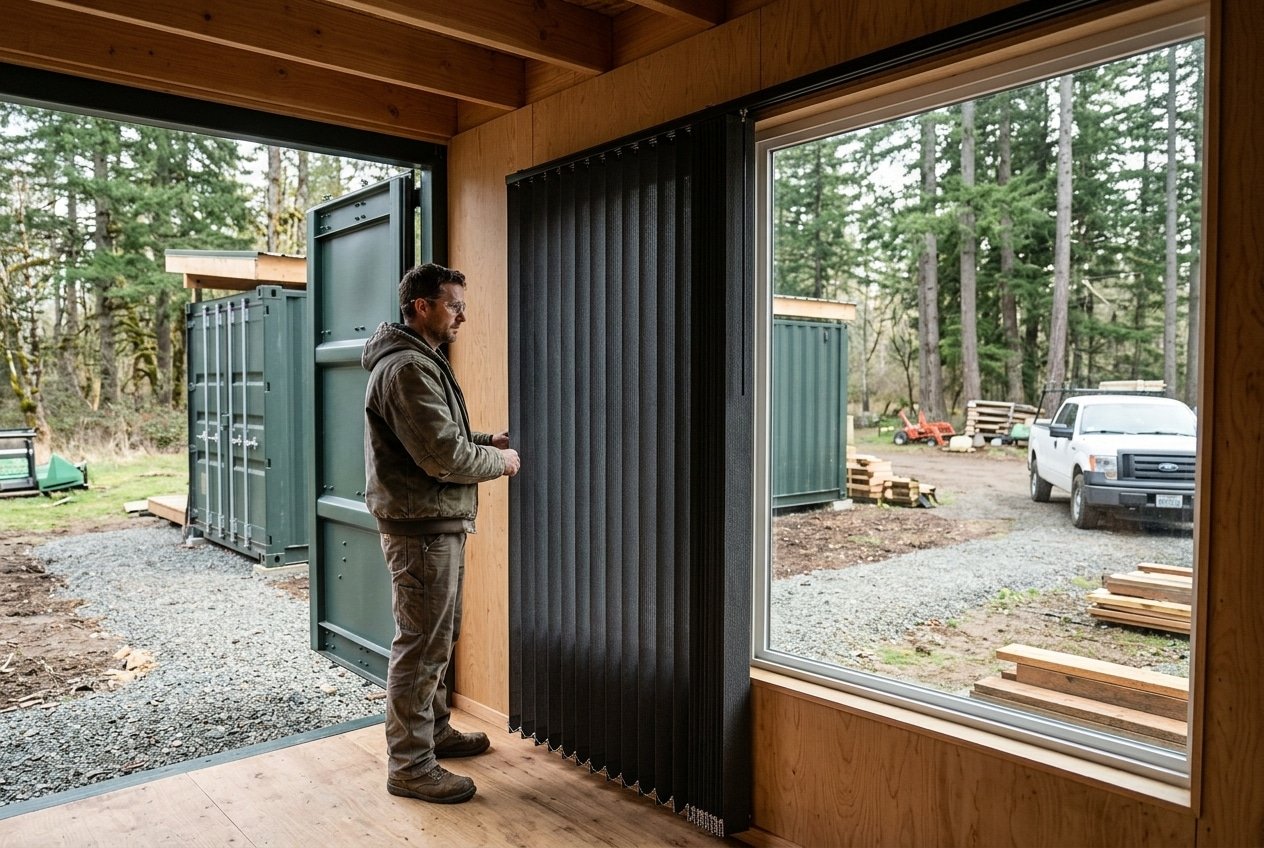
Vertical blinds offer a privacy advantage that few other office container window coverings match. When fully closed, the overlapping louvres create a near-complete visual barrier. The standard 89mm louvre width provides approximately 15mm of overlap between adjacent slats, eliminating sightline gaps that plague thinner 60mm alternatives.
For cabins positioned near public footpaths, site perimeters, or adjacent to other units, consider blackout-grade vertical louvres. These use a denser weave or opaque PVC that blocks 99% of light transmission, making it impossible to see interior activity even when backlit. The trade-off is reduced natural light when closed, but the louvre rotation feature means you can switch between full privacy and partial daylight in seconds. Pairing vertical blinds with a frosted window film on the lower third of the glass gives you a permanent privacy base with adjustable control above: a configuration that works well in both jackleg cabins and shipping container offices.
Measuring and Installing Blinds in Prefabricated Cabins
Accurate measurement is the difference between a professional installation and a blind that gaps, jams, or falls. Jackleg cabin windows aren’t always perfectly square, especially in older units that have been transported multiple times. Always measure width and drop at three points: left, centre, and right for width; left, centre, and right for drop. Use the smallest measurement in each dimension and subtract 10mm for clearance.
A standard jackleg cabin window recess measures between 1000mm and 1800mm wide and 800mm to 1200mm in drop. Record measurements in millimetres, not centimetres, to avoid rounding errors that compound across multiple windows. If you’re ordering blinds for a fleet of cabins, measure each unit individually: manufacturing tolerances mean no two cabins have identical window openings.
No-Drill Mounting Solutions for Metal Window Frames
Drilling into the metal frame of a jackleg cabin creates rust points and can void the unit’s warranty or lease agreement. No-drill mounting brackets solve this problem cleanly. Tension-fit brackets grip the inside of the window recess using spring pressure, supporting headrails up to 3kg without any permanent modification.
For heavier blind assemblies, magnetic mounting brackets rated for steel surfaces hold up to 5kg per bracket. Place one bracket every 400mm along the headrail for secure support. These magnets grip the steel window surround firmly, and the blind can be removed in under 60 seconds for transport or cleaning. If your cabin has aluminium window frames rather than steel, tension-fit brackets are your only no-drill option since magnets won’t adhere.
Essential Jackleg Cabin Accessories for Window Maintenance
Blinds are only one part of the window system. A few inexpensive accessories extend the life of your vertical blinds and keep them functioning properly between site moves.
- Replacement louvre hangers (the small plastic clips that connect each slat to the headrail carrier) should be stocked at a ratio of one spare for every five installed. These clips are the most common failure point, cracking under UV exposure or rough handling. A pack of 20 costs under $5.
- A headrail lubricant spray, applied every 6 months, keeps the carrier hooks sliding smoothly. Silicone-based sprays work best and won’t attract dust the way petroleum-based products do.
- Bottom chain weights (approximately 25-35 grams each) keep louvres hanging straight in cabins exposed to wind through open doors. Missing weights cause louvres to twist and tangle.
- A blind wand extension (available in 600mm and 900mm lengths) makes operation easier in cabins where desks or equipment block direct access to the window.
Keeping these jackleg cabin accessories on hand means a broken slat or sticky headrail gets fixed the same day, not after a week-long wait for parts.
Thermal Efficiency and Insulation Benefits
Jackleg cabins lose heat fast. The steel walls, single-glazed windows, and minimal insulation in older units mean that heating costs spike during winter months. A well-chosen vertical blind adds a measurable insulation layer that reduces both heat loss and heat gain.
Closed vertical blinds create a trapped air pocket between the louvres and the glass. This dead-air space acts as an insulating buffer, reducing thermal transfer by approximately 15-20% compared to an uncovered window. For a jackleg cabin running a 2kW electric heater during a North Carolina winter, that insulation effect can save $8-$12 per week in electricity costs: a meaningful figure across a 6-month project.
Reducing Heat Gain in Portable Cabin Blinds
Summer heat gain is the bigger problem for portable cabin blinds in the southeastern United States. A south-facing window in a jackleg cabin can push interior temperatures above 35°C (95°F) by midday without any shading. White or light-coloured PVC louvres reflect up to 70% of incoming solar radiation, compared to just 30-40% for dark fabric alternatives.
Solar-reflective coatings applied to PVC louvres during manufacturing add another 10-15% reflectivity. These coatings cost roughly $10-$15 extra per blind but pay for themselves within a single summer through reduced air conditioning load. If your cabin uses a portable AC unit rated at 2.5kW, reducing solar heat gain by even 20% extends the unit’s effective cooling range and cuts fuel consumption by approximately 0.3-0.5 litres per hour. For contractors managing site energy budgets, that saving compounds quickly across multiple units. Lease Lane Containers’ team often advises on container delivery planning and site orientation to minimize solar exposure: the same principles apply to jackleg cabin placement.
Selecting the Best Aesthetics for Professional Portable Offices
A jackleg cabin that looks professional inside earns trust from clients, inspectors, and visiting stakeholders. The vertical window blind you choose communicates whether this is a serious operation or a thrown-together site office.
Neutral tones: white, light grey, and cream work best for most professional settings. These colours reflect light effectively, make small spaces feel larger, and don’t clash with branded signage or safety posters on the walls. Avoid dark colours in small cabins unless privacy is the absolute priority, because dark louvres absorb light and make an already compact space feel cramped.
Textured fabric louvres in a linen weave or subtle pattern add visual interest without looking out of place. For client-facing portable offices where first impressions matter, these fabric options bridge the gap between industrial function and professional appearance. Match the louvre colour to the cabin’s interior wall colour for a cohesive look, or choose a complementary neutral that ties the space together. The cost difference between plain and textured louvres is typically under $10 per window, making it one of the most affordable upgrades available.
Final Checklist for Jackleg Cabin Vertical Blind Selection
Before ordering, run through these steps:
- Measure each window at three points for both width and drop; use the smallest figures.
- Confirm whether your window frames are steel or aluminium to determine mounting bracket type.
- Check site fire-safety requirements and request flame-test certificates for fabric louvres.
- Choose PVC for high-traffic or dusty environments; choose fire-retardant fabric for regulated sites.
- Stock replacement hangers, bottom weights, and silicone lubricant before installation day.
- Select light-coloured or solar-reflective louvres if the cabin faces south or west.
- Verify that no-drill brackets are permitted under your cabin lease or rental agreement.
Getting the right jackleg cabin vertical window blind installed correctly saves you replacement costs, keeps your team comfortable, and presents a professional image to everyone who walks through the door. If you’re planning a container-based workspace alongside your cabin setup, browse available inventory at Lease Lane Containers to compare shipping container sizes, grades, and configurations. Have questions about site prep, delivery clearance, or which container fits your project? Contact us for straightforward guidance from our Raleigh-based team.