Essential Steps for a Shipping Container Delivery
Table of Contents
- Table of Contents
- Site Selection and Ground Preparation
- Evaluating Surface Leveling and Stability
- Choosing Between Gravel, Concrete, or Paving Stones
- Measuring Clearance and Accessibility Requirements
- Calculating Vertical and Lateral Space for the Truck
- Accounting for Turning Radii and Entry Points
- Selecting the Right Delivery Method
- Tilt-Bed Trailers vs. Flatbed Deliveries
- Crane and Side-Loader Options for Tight Spaces
- Determining Container Orientation Before Arrival
- Permits and Local Zoning Compliance
- Navigating Homeowners Association (HOA) Rules
- Securing Temporary Placement Permits
- Safety Protocols and On-Site Coordination
- Post-Delivery Inspection and Leveling Adjustments
- Final Delivery Checklist
Table of Contents
- Site Selection and Ground Preparation
- Measuring Clearance and Accessibility Requirements
- Selecting the Right Delivery Method
- Determining Container Orientation Before Arrival
- Permits and Local Zoning Compliance
- Safety Protocols and On-Site Coordination
- Post-Delivery Inspection and Leveling Adjustments
A 40-foot shipping container weighs roughly 8,000 lbs empty and arrives on a truck that can stretch 65 feet or longer. If the ground isn’t ready, the access path isn’t clear, or the placement angle is off by even a few degrees, you’re looking at a costly rescheduling, potential property damage, or a container sitting somewhere you never intended. Most delivery problems aren’t caused by the trucking company: they’re caused by inadequate site preparation on the buyer’s end. Having a solid shipping container delivery checklist before the truck rolls onto your property is the single most effective way to avoid surprises. Whether you’re a contractor staging equipment storage on a job site, a homeowner adding backyard storage, or a farm operator placing a container on rural acreage, the preparation steps are largely the same. The differences come down to terrain, local regulations, and the specific delivery method your site requires. This guide walks through every critical step, from grading your ground to inspecting the container after it’s placed, so you can get the delivery right the first time. Lease Lane Containers’ Raleigh-based team works with buyers across the country on delivery planning and site access questions daily, and the issues covered here represent the most common points of failure we see.
Site Selection and Ground Preparation
Picking the right spot for your container is a decision that affects everything downstream: drainage, accessibility, structural integrity, and even whether the delivery truck can reach the location at all. A poorly chosen site leads to pooling water, uneven settling, and doors that won’t open or close properly within months. Start by identifying a location that sits on relatively high ground compared to the surrounding area. Low spots collect water, and even a container rated as wind and watertight will develop condensation and floor damage if it’s sitting in standing water for extended periods.
Think about how you’ll actually use the container. If you need frequent access, placing it 200 feet from your driveway across uneven terrain is going to create daily frustration. If it’s long-term storage, proximity matters less, but drainage still does.
Evaluating Surface Leveling and Stability
A shipping container needs to sit on a surface that is level within 3 inches across its full length. For a 40-foot container, that’s a tolerance of about 3 inches over 480 inches of steel frame. Anything beyond that and you’ll see door alignment issues, structural stress on the corner castings, and uneven weight distribution that accelerates corrosion at contact points.
Use a long builder’s level or a laser level to check the grade of your intended site. If the ground slopes more than a few inches, you’ll need to either excavate the high side or build up the low side before delivery day. Compaction matters as much as leveling. Loose fill dirt will compress unevenly under 8,000 to 10,000 lbs of container weight, especially after rain. A plate compactor run over the area in multiple passes gives you a stable base.
For rural properties and farms, check for underground utilities, septic lines, and irrigation pipes before committing to a location. A quick call to 811 (the national “Call Before You Dig” line) is free and can save you thousands in damaged infrastructure.
Choosing Between Gravel, Concrete, or Paving Stones
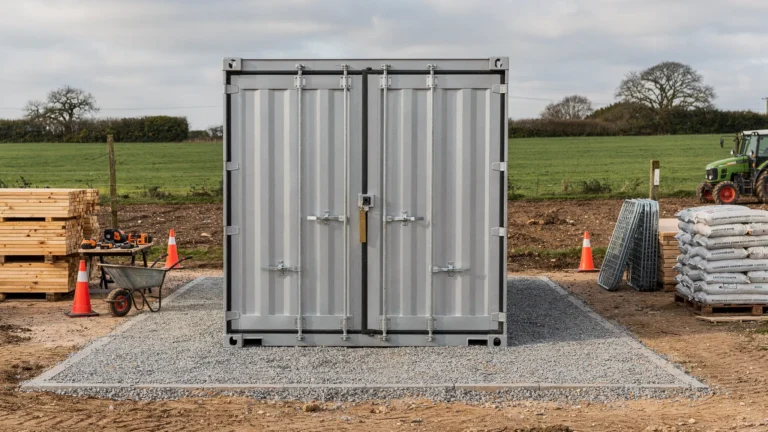
Gravel pads are the most common foundation for shipping containers, and for good reason. A 6-inch deep gravel pad using compacted 3/4-inch crushed stone provides excellent drainage, resists settling, and costs a fraction of poured concrete. For a 20-foot container, you’re looking at a pad roughly 10 feet by 22 feet. For a 40-foot unit, plan for at least 10 feet by 42 feet to allow some clearance on all sides.
Concrete piers or a full slab make sense for permanent installations, container offices, or locations where the container will support heavy internal loads. A 4-inch reinforced concrete slab with proper rebar runs $5 to $8 per square foot in most markets. Concrete piers placed at each corner casting and at midpoints along the frame cost less and still provide solid support.
Paving stones work for lighter-duty applications, but they can shift under the concentrated weight at the container’s corner points. If you go this route, use interlocking pavers over a compacted gravel base, and place steel plates or concrete blocks directly under the corner castings to spread the load.
Measuring Clearance and Accessibility Requirements
This is where most first-time buyers underestimate the challenge. The container itself might be 8 feet wide and 8.5 feet tall (or 9.5 feet for a high cube shipping container), but the truck delivering it needs dramatically more space. Measuring your access route is just as important as preparing the placement site.
Calculating Vertical and Lateral Space for the Truck
A standard shipping container on a tilt-bed trailer sits approximately 10 to 11 feet off the ground at its highest point. High cube containers add another foot, pushing the total height to nearly 12 feet. Any overhead obstruction below that height – power lines, tree branches, building eaves, carport structures – will block the delivery.
Measure every overhead obstacle along the entire route from the street to the placement site. Power lines are the most commonly overlooked hazard. Standard residential power lines hang between 15 and 18 feet above the road, but service drops to individual properties can sag as low as 12 feet, especially in hot weather when the cables expand. If your service drop is too low, contact your utility company at least two weeks before delivery to request a temporary lift or disconnect.
Lateral clearance needs to be at least 12 feet wide for the truck to pass safely, and 14 feet is better. Account for mailboxes, fence posts, parked vehicles, landscaping features, and anything else within that corridor. The delivery driver needs to see the path clearly and have enough room to maneuver without risking damage to your property or the truck.
Accounting for Turning Radii and Entry Points
A tilt-bed truck carrying a 40-foot container needs a turning radius of approximately 40 to 50 feet. That means if your driveway meets the road at a 90-degree angle and the road is only 24 feet wide, the truck likely cannot make the turn without crossing into the opposite lane or running over your lawn.
Walk the route yourself and identify every turn the truck will need to make. If your driveway curves, measure the inside radius of each curve. For properties accessed via private roads or shared driveways, check for narrow gates, tight bends, and soft shoulders that could give way under the truck’s weight (loaded delivery trucks can exceed 50,000 lbs).
If access looks tight, take photos and share them with your container supplier before scheduling delivery. The delivery planning support team at Lease Lane Containers regularly reviews site photos and satellite imagery with customers to identify potential access problems before the truck is dispatched.
Selecting the Right Delivery Method
The delivery method determines how much space you need, how precise the placement can be, and what the delivery will cost. Not every site works with every method, so matching the right approach to your specific conditions is a critical part of your container delivery checklist.
Tilt-Bed Trailers vs. Flatbed Deliveries
Tilt-bed (also called roll-off) trailers are the most common delivery method for residential and small commercial sites. The trailer hydraulically tilts to a steep angle, and the container slides off the back onto the ground. This method requires a straight, flat stretch of ground behind the truck equal to about 1.5 times the container’s length. For a 40-foot container, that means roughly 60 feet of clear, level space behind the truck.
The advantage of tilt-bed delivery is simplicity and cost. No additional equipment is needed, and the entire process takes 15 to 30 minutes. The limitation is precision: the container lands where gravity and momentum take it, with limited ability to fine-tune the final position. You can shift it a few inches with a pry bar, but major repositioning requires equipment.
Flatbed deliveries require a crane, forklift, or other lifting equipment to remove the container from the trailer. This method is more expensive but allows precise placement. If you need the container positioned within a few inches of a specific spot, or if the placement site is not directly accessible by truck, flatbed delivery with a crane is the right choice.
Crane and Side-Loader Options for Tight Spaces
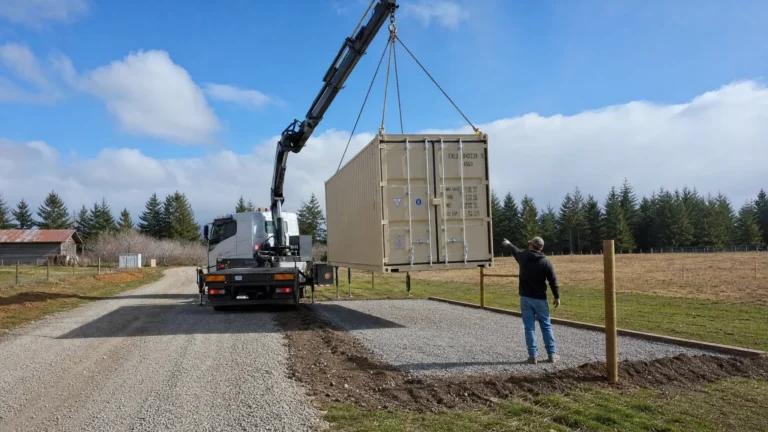
Crane placement is the go-to solution for sites with limited access, obstacles between the truck’s parking position and the final placement location, or situations where the container needs to clear a fence, wall, or other structure. A standard mobile crane can lift a 20-foot container (roughly 5,000 lbs empty) with ease and place it with precision measured in inches.
For a 40-foot container, you’ll need a crane rated for at least 10,000 lbs at the required boom radius. Crane rental costs vary by region but typically run $500 to $1,500 for a half-day, plus mobilization fees. In the Raleigh, North Carolina area and along the I-40 and I-95 corridors, crane operators are generally available with one to two weeks’ notice.
Side-loader trucks carry their own hydraulic lifting arms and can pick up and place containers without a separate crane. They’re less common than tilt-bed trucks but offer a good middle ground between cost and placement precision. Side-loaders need about 15 feet of clearance on one side of the truck to swing the container into position.
Determining Container Orientation Before Arrival
This step gets skipped more often than any other, and it causes real headaches. A shipping container’s doors are on one end. Once the container is on the ground, rotating it 180 degrees requires heavy equipment. If the doors end up facing a wall, a fence, or a hillside, you’ve just created an expensive problem.
Before delivery day, stand at your placement site and decide exactly which direction the doors should face. Consider your workflow: will you be loading and unloading from a driveway, a parking area, or an open yard? The door end needs at least 8 feet of clear space in front of it for the doors to swing fully open, and more if you’ll be moving large items in and out.
Communicate the desired orientation clearly to your delivery driver. Use compass directions or reference landmarks (“doors facing the house” or “doors facing east toward the driveway”). Mark the ground with spray paint or stakes showing the container’s footprint and door position. Some buyers even create a simple sketch showing the site layout, truck approach direction, and desired container orientation. That five-minute drawing can prevent a 30-minute argument on delivery day.
For buyers comparing container sizes and dimensions, keep in mind that a 20-foot container gives you more flexibility in orientation since it’s easier to reposition with a skid steer or forklift if needed. A 40-foot container, once placed, is staying put unless you bring in equipment.
Permits and Local Zoning Compliance
Zoning rules for shipping containers vary dramatically by jurisdiction. Some rural counties have almost no restrictions. Some municipalities treat containers as temporary structures with minimal permitting. Others classify them as accessory buildings requiring full building permits, setback compliance, and inspections.
Navigating Homeowners Association (HOA) Rules
If your property falls within an HOA, check the covenants, conditions, and restrictions (CC&Rs) before you order a container. Many HOAs prohibit shipping containers outright, while others allow them with conditions: screening requirements, time limits, or placement restrictions. Violating HOA rules can result in daily fines that accumulate quickly, forced removal at your expense, and legal action.
Request the specific section of your CC&Rs that addresses temporary structures, storage buildings, or accessory structures. If the language is ambiguous, submit a written request to the HOA board for clarification before committing to a purchase. Getting verbal approval from a neighbor who sits on the board is not the same as getting written authorization from the HOA.
Even in neighborhoods without HOAs, check with your municipality. In Wake County, North Carolina, for example, shipping containers used for storage on residential property may require a zoning compliance permit. The Wake County Planning Department (919-856-6335) can confirm current requirements for your specific zoning district.
Securing Temporary Placement Permits
Many jurisdictions offer temporary placement permits for shipping containers, typically valid for 30 to 180 days. These are common for construction sites, renovation projects, and seasonal storage needs. The application process usually involves submitting a site plan showing the container’s location relative to property lines, buildings, and easements.
Setback requirements are the most common compliance issue. Most residential zones require structures to be placed at least 5 to 15 feet from property lines, depending on the jurisdiction. Measure your intended placement location against your property survey to confirm compliance before applying.
If you plan to keep the container permanently, some jurisdictions require it to be placed on a permanent foundation and may classify it as an accessory building subject to building code requirements. This can include electrical permits if you plan to add lighting or outlets, and foundation inspections for concrete pads or piers.
Safety Protocols and On-Site Coordination
Delivery day should be organized, not chaotic. Having clear safety protocols protects your property, the delivery crew, and anyone else on site. OSHA standard 29 CFR 1926.251 covers rigging equipment used in material handling, and while residential deliveries aren’t typically OSHA-regulated job sites, the principles apply to anyone managing a heavy lift.
Clear the delivery path and placement area of all people, pets, vehicles, and loose objects at least 30 minutes before the truck arrives. Establish a safety perimeter of at least 25 feet around the placement zone. No one should stand behind the truck during a tilt-bed delivery or under a container being lifted by crane.
Designate one person as the ground guide who communicates directly with the driver or crane operator. Conflicting instructions from multiple people cause mistakes. The ground guide should have a clear line of sight to both the truck and the placement site, and should use agreed-upon hand signals or radio communication.
Check the weather forecast. High winds (above 20 mph) make crane lifts dangerous and can cause a container to swing unpredictably. Wet ground reduces traction for the delivery truck and can cause the container to slide during tilt-bed unloading. If conditions are marginal, reschedule. A delayed delivery is always better than a damaged container, a stuck truck, or an injury.
Post-Delivery Inspection and Leveling Adjustments
Once the container is on the ground, your job isn’t done. A thorough inspection immediately after delivery protects you from accepting a container with pre-existing damage and ensures the placement is correct before the truck leaves.
Start with the exterior. Walk all four sides and check for dents, holes, excessive rust, and damage to the corrugated panels. Pay close attention to the bottom rails and corner castings, which bear the full weight of the container and its contents. For buyers who ordered a specific container grade such as one-trip, cargo worthy, or wind and watertight, verify that the container’s actual condition matches what was described.
Open and close both doors. They should swing freely without binding or scraping. If a door sticks, it may indicate the container is not level. Check the door gaskets for tears or compression damage that could allow water intrusion. Step inside and look at the ceiling for light leaks, which indicate holes in the roof panels. Check the floor for soft spots, water stains, or delamination of the marine-grade plywood.
Use a 4-foot level on the container’s floor in multiple locations and directions. If the container is more than 1 inch out of level over its width (8 feet) or more than 2 inches over its length, adjust the foundation. Shimming with steel plates, hardwood blocks, or concrete pavers under the corner castings is the standard correction method. Avoid using cinder blocks, which can crack under concentrated loads.
Document everything with photos and timestamps. If you identify damage that wasn’t disclosed before purchase, contact your supplier immediately with your documentation. Reputable suppliers will work with you to resolve legitimate claims quickly.
Final Delivery Checklist
Before your container arrives, confirm every item on this list:
- Site graded and compacted to within 3 inches of level across the full container length
- Foundation material in place (gravel pad, concrete piers, or slab)
- Overhead clearance verified at 12+ feet along the entire access route
- Lateral clearance confirmed at 12 to 14 feet wide from street to placement site
- Turning radius checked at every curve and intersection along the route
- Container orientation decided and communicated to the driver
- Permits secured and HOA approval obtained if applicable
- Utility lines identified and marked (call 811)
- Safety perimeter established with one designated ground guide
- Weather forecast checked for wind and rain on delivery day
- Inspection plan ready with camera, level, and a list of items to verify
Getting your site and access route right before the truck shows up is the difference between a 20-minute delivery and a frustrating, expensive ordeal. If you’re still comparing options or figuring out which container size and grade fits your project, browse our inventory to see what’s currently available. And if you have questions about site access, placement planning, or delivery logistics for your specific property, contact us directly: our team helps buyers work through these details every day.