

How to Measure Shipping Container Overhead Clearance
Table of Contents
- Table of Contents
- Understanding Standard Container Heights and Vertical Clearances
- Standard vs. High Cube Container Dimensions
- Accounting for Tilt-Bed and Roll-Off Delivery Height
- Essential Tools for Accurate Vertical Measurement
- Step-by-Step Guide to Measuring Site Overhead Space
- Identifying the Lowest Point of Obstruction
- Calculating Ground Level Variance and Slope
- Identifying Common Overhead Obstacles
- Navigating Power Lines and Utility Cables
- Managing Tree Canopies and Structural Overhangs
- Safety Buffers and Operational Clearance Margins
- Measuring for Specialized Placement Equipment
- Crane Lift Vertical Arc Requirements
- Forklift Mast Height and Extension Limits
- Final Inspection Checklist Before Delivery
Table of Contents
- Understanding Standard Container Heights and Vertical Clearances
- Standard vs. High Cube Container Dimensions
- Accounting for Tilt-Bed and Roll-Off Delivery Height
- Essential Tools for Accurate Vertical Measurement
- Step-by-Step Guide to Measuring Site Overhead Space
- Identifying the Lowest Point of Obstruction
- Calculating Ground Level Variance and Slope
- Identifying Common Overhead Obstacles
- Navigating Power Lines and Utility Cables
- Managing Tree Canopies and Structural Overhangs
- Safety Buffers and Operational Clearance Margins
- Measuring for Specialized Placement Equipment
- Crane Lift Vertical Arc Requirements
- Forklift Mast Height and Extension Limits
- Final Inspection Checklist Before Delivery
A single miscalculation of a few inches can turn a routine container delivery into a costly disaster. Downed power lines, damaged roof overhangs, and stuck delivery trucks are all consequences of failing to properly assess the vertical space at your site. Whether you are placing a container on a rural property outside Raleigh or at a commercial lot in another state, understanding shipping container overhead clearance is one of the most critical steps in delivery planning. The delivery truck itself, not just the container, determines how much height you actually need. Most people focus on the container dimensions alone and forget that the vehicle carrying it adds significant height during transit and placement. Getting this right the first time saves money, prevents property damage, and keeps your delivery on schedule. This guide breaks down every measurement you need to take, the tools that make it accurate, and the common mistakes that catch even experienced contractors off guard. If you are still deciding on the right container for your project, Lease Lane Containers offers practical buying guidance to help you compare sizes, grades, and delivery requirements before you commit.
Understanding Standard Container Heights and Vertical Clearances
The height of the container itself is only one variable in the clearance equation. The real number that matters is the total height of the container while it sits on the delivery vehicle, because that is the measurement that must clear every obstacle between the street and your placement spot. Too many buyers look up the spec sheet for a 20-foot or 40-foot container, see the exterior height, and assume that is what they need to plan around. The delivery vehicle adds anywhere from 4 to 6 feet depending on the truck type, which changes the math dramatically.
Standard vs. High Cube Container Dimensions
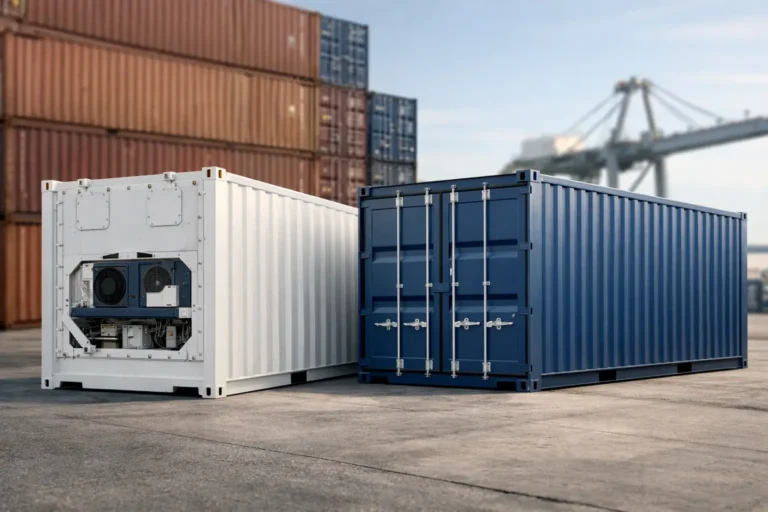
A standard shipping container (20 ft or 40 ft) has an exterior height of 8 feet 6 inches (2.59 m). A high cube shipping container stands 9 feet 6 inches (2.89 m) tall, giving you that extra foot of interior headroom that makes a real difference for workshop builds, container offices, and storage of taller items. The width for both types is 8 feet (2.44 m), and the length varies between 20 feet (6.06 m) and 40 feet (12.19 m).
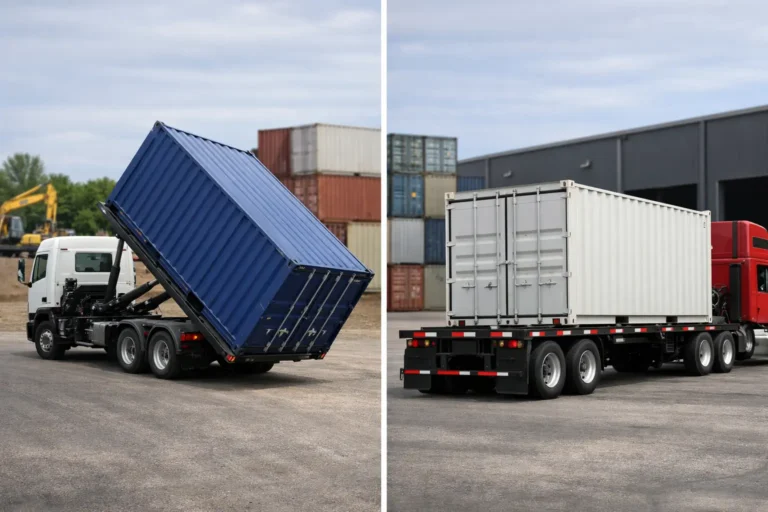
Here is the critical distinction: that 8 ft 6 in or 9 ft 6 in measurement is the container alone, sitting flat on the ground. During delivery, the container rides on top of a truck chassis, flatbed, or tilt-bed trailer. A standard container on a tilt-bed truck reaches a combined height of roughly 12 ft 6 in to 13 ft 6 in. A high cube on the same truck pushes that to approximately 13 ft 6 in to 14 ft 6 in. These numbers are what you need to measure against every overhead obstacle on your property.
Accounting for Tilt-Bed and Roll-Off Delivery Height
Tilt-bed trailers are the most common delivery method for shipping containers. The truck tilts its bed to a steep angle, then slides the container off the back using gravity and hydraulics. At the peak of the tilt, the front edge of the container can reach 16 to 18 feet above the ground. This is the maximum clearance you need at the placement point, not just along the driveway.
Roll-off trucks work differently. They use a hook-lift system that raises the container at a shallower angle, typically peaking around 14 to 15 feet. The trade-off is that roll-off trucks require more horizontal space behind the placement area. When planning your site, ask your delivery provider which truck type they will use. At Lease Lane Containers, our delivery planning support covers these specifics so you can prepare your site with the correct clearance dimensions for the exact truck being dispatched.
Essential Tools for Accurate Vertical Measurement
You do not need expensive surveying equipment to measure overhead clearance accurately, but a tape measure alone will not cut it for heights above 10 feet. The right combination of tools makes the difference between a reliable measurement and a guess.
A laser distance measurer is the single most useful tool for this job. Models from Bosch, Leica, or DeWalt in the $50 to $150 range can measure vertical distances up to 165 feet with accuracy within 1/16 of an inch. Point the laser straight up from ground level to the underside of any obstruction, and you get a precise reading in seconds. This eliminates the wobble and estimation errors that come with extending a tape measure overhead.
For power lines and utility cables where you cannot physically reach the obstruction, a clinometer or inclinometer app on your smartphone paired with basic trigonometry gives you a workable estimate. Stand a known distance from the base of the pole, measure the angle to the cable’s lowest point, and calculate the height. Alternatively, contact your utility provider for the exact cable height, which they are required to have on file.
A builder’s level or a long spirit level (4 ft minimum) is essential for checking ground slope across the delivery path. Even a 2-degree slope across 50 feet of driveway changes your effective clearance by several inches at different points along the route. A surveyor’s rod or a simple measuring pole made from PVC pipe marked in 1-foot increments helps you do quick visual checks along the entire delivery path without repositioning a ladder repeatedly.
Keep a clipboard, graph paper, and a camera or smartphone for documentation. Photograph every potential obstruction with the measuring pole held next to it for reference. This visual record is invaluable when communicating with your delivery driver or container supplier.
Step-by-Step Guide to Measuring Site Overhead Space
Accurate measurement is a process, not a single reading. You need to survey the entire path the delivery truck will travel, from the street entrance to the final placement spot, and record every potential pinch point.
Identifying the Lowest Point of Obstruction
Start at the street where the delivery truck will enter your property. Walk the entire route the truck will take, looking up the entire time. Mark every overhead feature: tree branches, power lines, building eaves, carport roofs, light fixtures, signs, and any cables spanning the driveway or access road.
Measure the height of each obstruction from ground level directly beneath it. The lowest single point along the entire route determines your maximum allowable delivery height. A driveway might have 20 feet of clearance for 90% of its length, but if one tree branch hangs at 12 feet near the entrance, that 12-foot reading is your constraint.
Record each measurement on a simple site sketch showing the approximate location of every obstruction. Note the distance from the street entrance to each point. This sketch becomes your delivery route map, and any professional delivery team will appreciate having it in advance.
Calculating Ground Level Variance and Slope
Flat ground is rare. Most residential and rural properties have some grade change between the street and the container placement area. A slope that rises toward the placement spot effectively reduces your overhead clearance because the truck gains elevation while the overhead obstruction stays at the same absolute height.
Use a builder’s level and a measuring rod to check the elevation change at 10-foot intervals along the delivery path. If the ground rises 6 inches over 30 feet, subtract those 6 inches from your overhead clearance measurement at the higher point. Conversely, if the ground dips, you gain clearance but may face drainage or stability issues for the container pad itself.
Pay special attention to driveway transitions: the point where a flat street meets a sloped driveway. Tilt-bed trucks have limited ground clearance under the rear bumper, and a sharp grade transition can cause the truck frame to scrape or the container to shift during the tilt operation. A grade change of more than 8% at the transition point is a red flag that requires discussion with your delivery team.
Identifying Common Overhead Obstacles
Every property has its own set of vertical challenges. Knowing what to look for prevents surprises on delivery day.
Navigating Power Lines and Utility Cables
Power lines are the most dangerous overhead obstacle, and they deserve the most careful attention. The National Electrical Safety Code (NESC) specifies minimum heights for power lines over driveways: 15.5 feet for standard residential service drops and 18.5 feet for lines carrying over 750 volts. But minimum does not mean actual. Lines sag over time due to heat, ice loading, and age, and many residential service drops installed decades ago sit well below current standards.
Contact your utility provider (in the Raleigh area, that is Duke Energy at 800-769-3766) and request the measured height of any lines crossing your delivery path. If lines are too low, the utility company can temporarily raise or disconnect them, though this typically requires 2 to 4 weeks of lead time and may involve a fee ranging from $200 to $1,500 depending on the complexity.
Never assume you can squeeze under a power line with a few inches to spare. OSHA standard 29 CFR 1926.1408 requires a minimum 10-foot clearance between any equipment and power lines carrying up to 50 kV. Delivery drivers will refuse to proceed if they judge the clearance to be unsafe, and they are right to do so.
Managing Tree Canopies and Structural Overhangs
Tree branches are the most common cause of delivery delays. Unlike power lines, you can handle tree trimming yourself or hire an arborist before delivery day. Walk the route and identify any branches below 16 feet. Trim them back at least 2 feet beyond the width of the delivery truck (approximately 8.5 feet wide) to allow for minor sway and mirror clearance.
Structural overhangs present a different challenge because they are fixed. Carport roofs, building awnings, porch overhangs, and even basketball backboards can block the delivery path. Measure each one carefully and compare against the total delivery height for your container type. If a structural overhang is too low, you may need to reroute the delivery path or consider alternative placement equipment like a crane.
Satellite dishes, exterior light fixtures, and flag poles mounted on buildings along the delivery path are easy to overlook. Check for anything protruding from walls or rooflines within 5 feet on either side of the truck’s path.
Safety Buffers and Operational Clearance Margins
Raw clearance measurements are not enough. You need buffers built into every number to account for real-world variables that your tape measure cannot predict.
The industry standard rule of thumb is the 20% buffer rule: add 20% to the maximum delivery height to establish your minimum required clearance. For a standard container on a tilt-bed truck peaking at 17 feet, your minimum overhead clearance should be 20.4 feet at the placement point. This buffer accounts for truck suspension bounce on uneven ground, slight miscalculations in ground slope, and the dynamic movement of the container during the tilt or lift operation.
For the transit path (driveway, access road), a minimum buffer of 12 inches above the truck’s travel height is the absolute floor. If the truck and container measure 13 ft 6 in in transit mode, you need 14 ft 6 in of clearance at every point along the route. Experienced drivers may work with tighter margins on straight, flat approaches, but curves, slopes, and soft ground all introduce variables that eat into your buffer.
Wind is a factor that most people ignore. A container suspended from a crane or elevated on a tilting bed acts like a sail. Even moderate wind gusts of 15 to 20 mph can cause a container to sway 6 to 12 inches laterally and shift vertically. Delivery teams will postpone placement in winds exceeding 25 mph, but lighter winds still require extra clearance margin.
Document your raw measurements and your buffered measurements separately. Share both sets of numbers with your delivery provider so they can make an informed decision about truck type and approach angle.
Measuring for Specialized Placement Equipment
Sometimes a standard tilt-bed delivery is not possible due to tight access, low overhead clearance along the driveway, or precise placement requirements. Specialized equipment changes the clearance math significantly.
Crane Lift Vertical Arc Requirements
Crane placement is the go-to solution when the delivery path has obstructions but the placement area itself has open sky above it. The crane parks on the street or in an accessible area, lifts the container over the obstacles, and sets it down at the target location.
A typical mobile crane used for shipping container delivery lifts the container to a peak height of 30 to 60 feet depending on the boom length and the horizontal distance to the placement spot. The vertical arc of the lift, from pickup to set-down, must clear every obstacle in the swing path. This includes not just overhead wires and branches but also building rooflines, fences, and any structures between the crane and the target.
Crane placement adds $500 to $3,000 to your delivery cost depending on the crane size, duration of the lift, and your location. You will also need to verify that the street or staging area can support the crane’s weight, which ranges from 20 to 60 tons for the models typically used in container placement. Soft ground, narrow streets, and local permit requirements (check with your municipality or county, such as Wake County Planning at 919-856-6335) can all affect crane feasibility.
Forklift Mast Height and Extension Limits
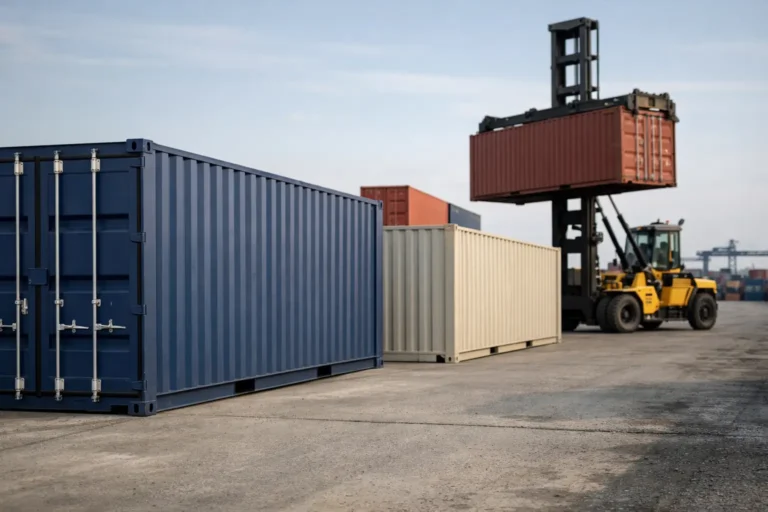
Large forklifts with 8,000 to 15,000 lb capacity can move and position shipping containers on-site, but they require careful clearance planning. A forklift carrying a standard container raises the total height to approximately 12 to 14 feet, depending on the forklift model and how high the forks need to be raised for placement.
The mast on a full-extension forklift can reach 15 to 20 feet, which means the top of a container being placed on an elevated pad or stacked on another container could peak at 20 to 28 feet. If you are stacking containers or placing one on a raised foundation, measure the clearance from the top of the final container position to the nearest overhead obstruction, not from the ground.
Forklifts also need firm, level ground to operate safely. Soft soil, gravel deeper than 4 inches, or slopes greater than 5% can cause tipping risks. The forklift approach path needs the same overhead clearance survey as a truck delivery path.
Final Inspection Checklist Before Delivery
Run through this checklist 48 hours before your scheduled delivery to confirm everything is ready:
- Measure and record the height of every overhead obstruction along the delivery path from street to placement spot
- Confirm the delivery truck type (tilt-bed, roll-off, or flatbed) and its maximum height in transit and during placement
- Verify that the lowest overhead clearance exceeds the truck’s maximum height by at least 12 inches in transit and 20% at the placement point
- Contact your utility provider if any power lines are within 15 feet of the delivery path, and schedule temporary raising or disconnection if needed
- Trim all tree branches below 16 feet and within 5 feet on either side of the truck path
- Check ground slope at 10-foot intervals and adjust clearance calculations for elevation changes
- Photograph every obstruction with a measuring reference and share images with your delivery driver
- Confirm the placement area has adequate clearance for the tilt, lift, or roll-off operation (minimum 18 feet for tilt-bed, 15 feet for roll-off)
- Verify ground conditions at the placement spot: firm, level, and capable of supporting the container weight (a 40 ft container weighs approximately 8,200 lbs empty)
- Have a backup plan if conditions change: identify an alternative placement spot or confirm crane availability with your delivery provider
Getting overhead clearance right is a matter of preparation, not guesswork. Every measurement you take before delivery day reduces the risk of delays, damage, and added cost. The difference between a smooth delivery and an expensive problem often comes down to whether someone walked the route with a laser measurer and a notepad.
If you are still selecting the right container for your project, browse our inventory to compare sizes, grades, and options for both standard and high cube shipping containers. Have questions about delivery access or site preparation? Contact us and our Raleigh-based team can help you plan the details before your container ships.

2 Comments