The 12 x 7.5ft Towable Welfare Unit with a Generator
Table of Contents
- Table of Contents
- The Evolution of Site Facilities: The 12 x 7.5ft Towable Welfare Unit
- Detailed Mobile Welfare Unit Specifications
- Integrated Power Solutions and Generator Performance
- Essential On-Site Amenities for Workforce Comfort
- Key Considerations When You Buy a Welfare Unit
- Finding a Towable Welfare Unit for Sale
- Maximizing ROI Through Mobility and Low Maintenance
Table of Contents
- The Evolution of Site Facilities: The 12 x 7.5ft Towable Welfare Unit
- Detailed Mobile Welfare Unit Specifications
- Interior Layout and Space Management
- Chassis and Towing Durability
- Integrated Power Solutions and Generator Performance
- Fuel Efficiency and Silent Run Features
- Essential On-Site Amenities for Workforce Comfort
- Kitchenette and Canteen Facilities
- Sanitation and Drying Room Capabilities
- Key Considerations When You Buy a Welfare Unit
- Compliance with HSE Health and Safety Regulations
- Finding a Towable Welfare Unit for Sale
- Evaluating New vs. Used Inventory
- Maximizing ROI Through Mobility and Low Maintenance
Remote job sites demand more than just hard hats and heavy equipment. Your crew needs somewhere to eat, warm up, dry off, and use proper sanitation, and that requirement doesn't disappear just because the site is miles from the nearest building. A 12 x 7.5ft towable mobile welfare unit with generator solves that problem in a single, road-ready package. These self-contained units deliver hot water, heating, toilet facilities, a canteen area, and reliable electricity to locations where none of those things exist. Whether you're running a highway construction crew, managing a pipeline project, or overseeing utility work in a rural area, this size of welfare unit hits a practical sweet spot: large enough to support a six-person team, compact enough to tow behind a standard pickup truck or van. If you're weighing your options for portable site welfare, this guide covers the specifications, power systems, amenities, compliance requirements, and buying considerations that matter most.
The Evolution of Site Facilities: The 12 x 7.5ft Towable Welfare Unit
Site welfare has come a long way from the days of a cold shipping container with a folding chair and a thermos. Regulatory pressure, worker retention challenges, and genuine concern for crew wellbeing have pushed the industry toward purpose-built solutions. The 12 x 7.5ft towable welfare unit represents the current standard for small-to-mid-sized crews working in locations without permanent infrastructure.
These units evolved from basic site huts into fully integrated mobile facilities. Early versions offered little more than a roof and a bench. Modern versions pack a drying room, flushing toilet, hot running water, microwave, kettle, heating, and a built-in generator into a footprint that fits on a single-axle or twin-axle trailer. The shift wasn't just about comfort. It was driven by health and safety regulations that now require employers to provide specific welfare provisions on construction sites.
What makes the 12 x 7.5ft format so popular is its balance between capacity and portability. It's large enough to seat six workers comfortably in the canteen area, yet compact enough to tow on public roads without special permits in most jurisdictions. The integrated generator means you don't need a separate power source or site connection, which is critical for greenfield projects, roadside work, and remote agricultural sites.
For contractors who manage multiple sites or move between projects frequently, this size class avoids the logistical headaches of larger static welfare cabins. You hitch it, tow it, unhitch it, and your crew has a fully functioning welfare facility within minutes.
Detailed Mobile Welfare Unit Specifications
The spec sheet on a welfare unit tells you a lot about how it'll perform on your site. Exterior dimensions of 12ft by 7.5ft (roughly 3.66m x 2.29m) give you approximately 90 square feet of usable interior space. That's after accounting for wall thickness and insulation. Every square foot is allocated with purpose.
Most units in this class feature a steel outer skin with insulated composite panels. Wall insulation thickness typically ranges from 40mm to 60mm, which keeps the interior warm in winter and cool in summer without overworking the heating system. The roof is usually slightly pitched or crowned to prevent water pooling, and all joints are sealed against weather ingress.
Interior Layout and Space Management
Inside, the layout is divided into distinct zones. You'll typically find the canteen and seating area at one end, with bench seating for six people arranged around a fold-down or fixed table. The kitchenette occupies a section of wall space near the canteen, housing a sink with hot and cold water, a microwave, and a kettle.
The opposite end of the unit contains the toilet compartment, which is fully enclosed with its own door and ventilation. Adjacent to the toilet, most manufacturers include a drying room or drying area with hooks and sometimes a small heated rail. This layout keeps wet gear away from the eating area, which is both a hygiene requirement and a practical comfort issue.
Storage is built into every available gap. Overhead lockers, under-bench compartments, and wall-mounted first aid cabinets are standard. Some models include a small fire extinguisher bracket and a notice board for site safety information.
Chassis and Towing Durability
The chassis is where build quality really shows. A 12 x 7.5ft towable welfare unit typically weighs between 1,700 and 1,980 kg when dry, according to manufacturer listings. That weight climbs once you add a full water tank, fuel, and supplies, so your towing vehicle needs to be rated accordingly.
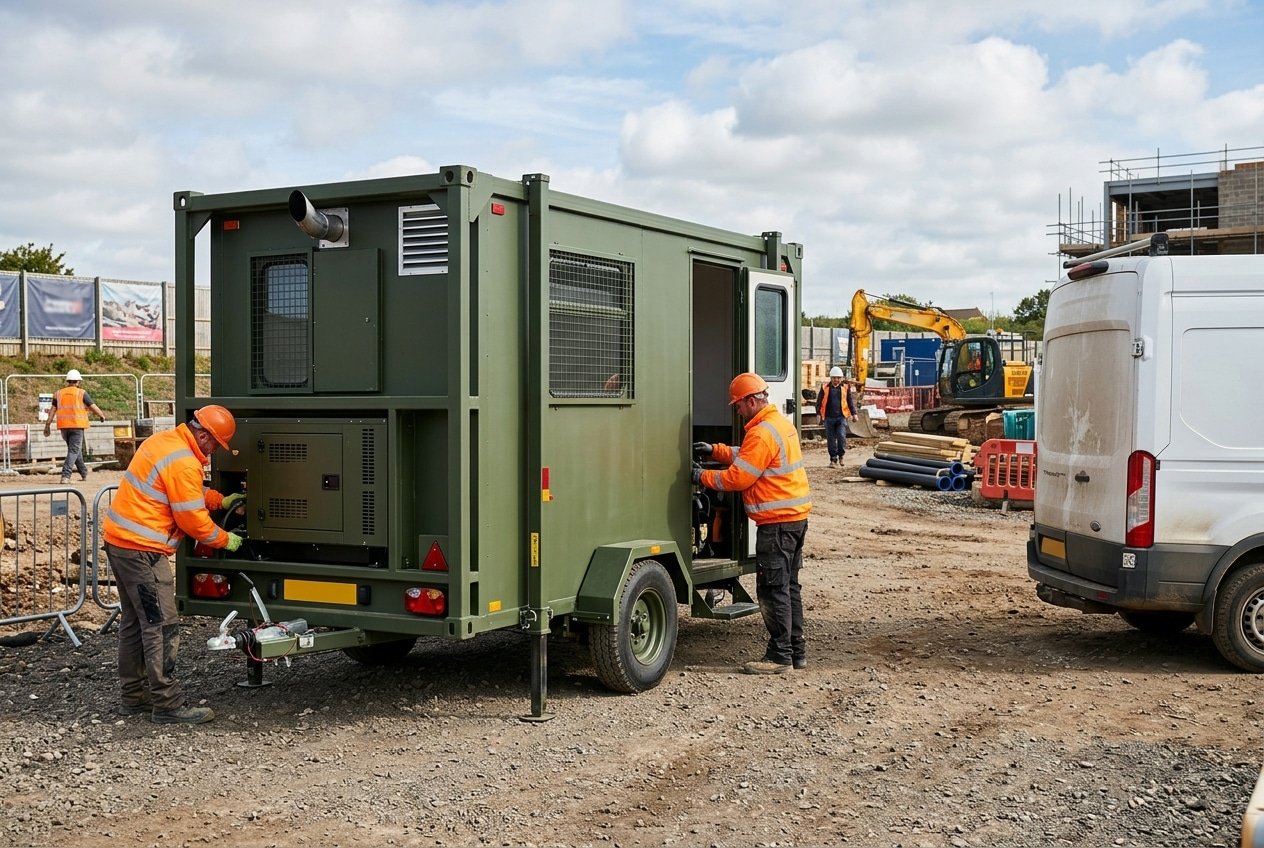
Most units sit on a galvanized steel chassis with a twin-axle configuration for stability. Braked axles are standard at this weight class, and you'll find either 50mm ball couplings or NATO-style hitch points depending on the manufacturer. Jockey wheels and corner steadies allow for quick leveling on uneven ground.
Check the chassis for hot-dip galvanizing rather than just paint. A galvanized chassis resists corrosion from mud, salt, and standing water far better than a painted one, and it'll hold its resale value longer.
Integrated Power Solutions and Generator Performance
The built-in generator is what separates a towable welfare unit from a static cabin that needs external power. These units typically house a diesel generator in a dedicated compartment, usually mounted underneath or at one end of the chassis, with sound-dampening enclosures to reduce noise.
Generator output for this size of unit generally falls between 6 kW and 10 kW. A 7.5 kW generator is common and provides enough power to run all onboard systems simultaneously: lighting, water heater, heating, microwave, kettle, and charging sockets. Can a 7.5 kW generator run a house? In theory, yes, it can handle essential household circuits, but welfare units are designed for a more controlled load. The fixed appliance list means the generator is sized precisely for its task.
How many appliances can you run on a 7,500-watt generator? In a welfare unit context, you can run the water heater, space heater, microwave, kettle (not simultaneously with the microwave on some models), interior lighting, extractor fan, and multiple USB or 240V charging points. The generator handles this comfortably because the load is predictable and managed.
The weight of the generator itself typically falls between 90 kg and 180 kg depending on the model and output rating. That weight is factored into the overall unit weight, so it doesn't change your towing calculations.
Fuel Efficiency and Silent Run Features
Fuel consumption is a real operating cost concern. Most diesel generators in this class consume between 0.8 and 1.5 liters per hour under typical load. Over a 10-hour workday, that's 8 to 15 liters of diesel. If you're wondering about longer runtimes: how much does it cost to run a Generac generator for 24 hours? At average diesel prices and a consumption rate of roughly 1 liter per hour, you're looking at approximately $25 to $40 per day, though actual costs depend on fuel prices in your area and load levels.
The 20-20-20 rule for generators is a useful guideline: run the generator for 20 minutes at no load, then 20 minutes at half load, then 20 minutes at full load during the break-in period. This helps seat the piston rings and extends engine life. After break-in, the 80% rule for generators applies: don't consistently run your generator above 80% of its rated capacity. A 7.5 kW unit should ideally sustain loads below 6 kW for maximum longevity. Running at full capacity constantly accelerates wear on the engine, alternator, and voltage regulator.
Many modern welfare units feature "silent run" or "eco mode" generators that reduce engine speed when demand drops. This cuts fuel consumption and keeps noise levels below 65 dB at 7 meters, which matters on residential-adjacent sites or in noise-restricted zones.
Essential On-Site Amenities for Workforce Comfort
A welfare unit isn't just a box with a heater. It's a functioning workspace where your crew recharges, both literally and physically. The amenities inside determine whether workers actually use the facility or just keep sitting in their trucks.
Good welfare provision has a direct impact on productivity and morale. Cold, uncomfortable break areas lead to shorter breaks, which sounds efficient until you realize that fatigued workers make more mistakes and have more accidents. A properly equipped welfare unit gives your team a genuine rest environment.
Kitchenette and Canteen Facilities
The canteen area in a standard 12 x 7.5ft unit includes bench seating for six people, a table surface, and the kitchenette. The kitchenette features a stainless steel sink with hot and cold running water supplied by an onboard water tank (typically 100 to 150 liters) and heated by a gas or electric water heater.
Standard appliance provisions include:
- Microwave oven (typically 800W to 1,000W)
- Electric kettle
- 240V power sockets for charging phones and power tools
- Overhead lighting (LED in most current models)
- Paper towel dispenser and waste bin
Some units include a small fridge, though this varies by manufacturer. The canteen area is typically finished with wipe-clean surfaces for easy hygiene maintenance.
Sanitation and Drying Room Capabilities
The toilet compartment is self-contained with a flushing toilet connected to an onboard waste tank. Tank capacity varies, but 100 to 200 liters is typical, and most units include a waste level indicator so you know when it needs emptying. Hand washing facilities with hot water and soap dispensers are standard, and many units now include hand sanitizer stations as well.
The drying room sits between the toilet and the canteen, acting as a buffer zone. It's equipped with hooks, a small heated towel rail or radiant heater, and ventilation to manage moisture. On wet days, this room earns its space many times over. Wet coats and boots dry between shifts instead of staying damp, which reduces the risk of hypothermia and keeps the canteen area comfortable.
Key Considerations When You Buy a Welfare Unit
Purchasing a welfare unit is a capital investment, and the wrong choice costs you in downtime, compliance issues, and resale value. Before you buy a welfare unit, establish your primary use case. Are you towing it daily between sites, or will it sit in one location for months? Daily towing demands a stronger chassis and better road lighting. Static placement puts more emphasis on insulation and amenity quality.
Think about crew size. A 12 x 7.5ft unit comfortably serves six workers. If your typical crew is eight or more, you'll need a larger unit or a second welfare facility to stay compliant. Overcrowding a welfare unit isn't just uncomfortable: it's a regulatory violation.
Compliance with HSE Health and Safety Regulations
In the UK, the Construction (Design and Management) Regulations 2015 (CDM 2015) require welfare facilities including toilets, washing stations, drinking water, a place to rest and eat, and somewhere to change and dry clothing. In the US, OSHA standard 29 CFR 1926.51 sets similar requirements for sanitation and welfare on construction sites. Both frameworks mandate that these facilities be available before work begins on site.
A properly specified towable welfare unit meets these requirements out of the box. That said, you need to verify that the specific model you're purchasing includes all mandated provisions. Some budget units cut corners on hot water or drying facilities, which can leave you non-compliant. Ask for a full specification sheet and cross-reference it against your applicable regulations before signing a purchase order.
Finding a Towable Welfare Unit for Sale
The market for towable welfare units includes both new-build manufacturers and a healthy used market. New units offer the latest specifications, warranty coverage, and the ability to customize layout and branding. Used units can save you 30% to 50% off the new price, but they require more careful inspection.
When searching for a towable welfare unit for sale, start with manufacturers and authorized dealers who can provide full service histories and compliance documentation. Online marketplaces list plenty of options, but buying sight-unseen carries risk. Inspect the chassis for corrosion, check the generator hours, test all plumbing and electrical systems, and verify that the gas system has a current safety certificate.
Evaluating New vs. Used Inventory
New welfare units typically cost between $15,000 and $35,000 depending on specification and manufacturer. Used units with low generator hours and good chassis condition sell for $8,000 to $20,000. The key variables are generator hours (think of it like mileage on a truck), chassis condition, and the state of the plumbing and electrical systems.
A used unit with under 3,000 generator hours and a galvanized chassis in good condition can represent excellent value. Units with over 8,000 hours may need a generator rebuild or replacement within the first year, which can cost $2,000 to $5,000. Factor that into your purchase price comparison.
If you're already sourcing shipping containers for site storage or modified workspaces, companies like Lease Lane Containers can help you think through the logistics of site setup, including delivery access, placement planning, and how a welfare unit fits alongside your container-based storage or office solutions. Their Raleigh-based team offers practical guidance on site prep and delivery requirements that applies whether you're placing a shipping container, a welfare unit, or both.
Maximizing ROI Through Mobility and Low Maintenance
The financial case for owning a towable welfare unit rather than renting one becomes clear after about 12 to 18 months of regular use. Rental costs for this size of unit typically run $250 to $500 per week. If you're using a welfare unit for 40 or more weeks per year, ownership pays for itself quickly.
Maintenance costs are modest. Budget approximately $1,500 to $2,500 per year for generator servicing, gas safety checks, plumbing maintenance, and chassis inspections. Diesel fuel is your primary ongoing expense, but at 1 liter per hour, it's predictable and manageable.
Resale values hold well for maintained units. A five-year-old welfare unit in good condition with documented service history typically retains 40% to 55% of its original purchase price. That's a better depreciation curve than most commercial vehicles.
The mobility factor is the real multiplier. One unit serves every project you run, moving from site to site as your work shifts. You don't need to arrange separate welfare provisions for each location, and you're never waiting on a rental company to deliver or collect.
If you're planning a site that needs both storage and welfare facilities, it's worth looking at your full equipment list together. Lease Lane Containers can help you compare shipping container sizes, grades, and delivery options for your storage and workspace needs. Browse their current inventory to see what's available and get a clear picture of pricing before you request a quote. Pairing the right shipping container with a well-specified welfare unit gives your crew everything they need from day one.