Efficient Delivery: How to Plan Access for a Container Drop
A shipping container delivery looks simple until it isn’t. The most common causes of failed or delayed drops are not “container issues,” they are access issues: a tight turn off a Raleigh cul-de-sac, soft shoulders after a Carolina thunderstorm, low branches, or a drop zone that is not level enough for the driver to safely unload.
If your goal is efficient delivery, the best time to plan is before you buy, not when the truck calls “ETA 30 minutes.” This guide breaks down how to plan access for a container drop (driveway, turning, clearances, and ground prep) so your 20ft or 40ft container lands exactly where you need it, the first time.
Before you schedule delivery, it also helps to review our shipping container buying guide so you understand which unit type and size best fit your site.
Start with the container details (size, height, and grade)
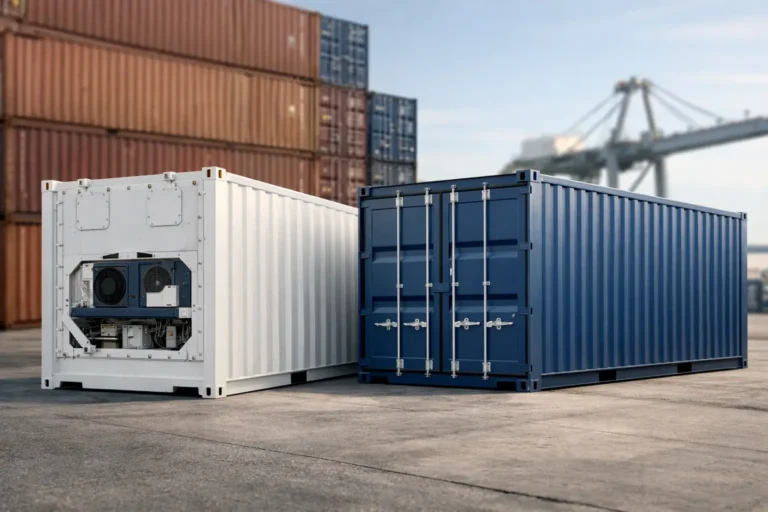
Access planning begins with understanding what is being delivered. In the container industry, ISO standard dry containers are typically 8 feet wide, with common lengths of 20ft and 40ft. Height depends on the model:
-
Standard: typically 8'6" tall
-
High Cube: typically 9'6" tall (an extra foot of interior headroom)
If you are comparing heights and access limits, review our guide to 40ft High Cube containers before finalizing your delivery plan.
That extra height matters for overhead clearance (trees, service drops, carports), especially on residential properties around Raleigh where mature canopies are common.
Container grades (and why they still matter for delivery planning)
Even though “grade” is mainly about condition and usability, it influences how you should plan placement and protection once it’s set.
-
One-Trip (new): A near-new container that has made a single loaded voyage. Usually the best choice for customer-facing projects, clean storage, and long lifespan expectations.
-
Cargo Worthy (CW): A used container that is structurally fit for transport and typically suitable for international shipping use cases. Expect dents and cosmetic wear, but doors should seal and the frame should be sound.
-
Wind & Watertight (WWT): A used storage-grade container intended to keep out wind and water for storage. Often ideal for jobsite storage or farm use when cosmetic condition is less important.
All three are typically built from Corten steel (weathering steel) designed to resist corrosion better than standard carbon steel, but site conditions (standing water, constant wet soil contact) can still accelerate rust over time if you do not prep the pad.
If you’re still choosing a size, start with the container buying guide and then confirm site constraints before finalizing.
If you need a broader breakdown of condition, lifespan, and use case, see our full guide on new vs used shipping containers.
Match your access plan to the unloading method
Most site-access problems happen because the customer plans for “a truck,” but not for how the container comes off the truck.
| Delivery method | What it is | When it’s used most | What access planning must cover |
|---|---|---|---|
| Tilt-bed (roll-off) | Truck tilts the bed and slides the container to the ground | Common for residential drops and many job sites | Approach angle, overhead clearance during the slide, firm ground where the container will “land” |
| Flatbed with unload assist | Container arrives on a flatbed and is offloaded with equipment | Sites with forklifts, cranes, or telehandlers | Space for equipment positioning, lift points, safe working radius |
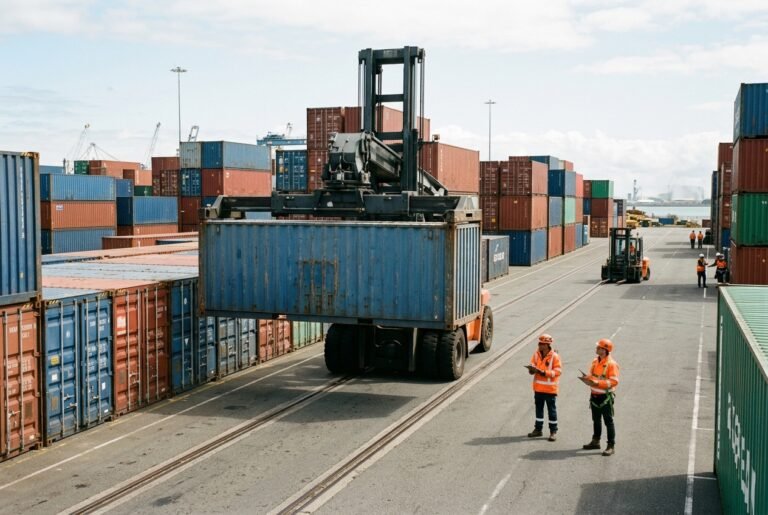
| Crane delivery | Crane lifts container off the truck and places precisely | Tight sites, over obstacles, exact placement needs | Crane access, overhead obstructions, ground bearing for crane outriggers |
If you are unsure whether your site needs a tilt-bed, flatbed unload, or crane placement, review our full shipping container delivery requirements checklist before booking.
If you are unsure which method your site requires, compare your plan against the checklist in shipping container delivery requirements and send photos to your supplier for confirmation.
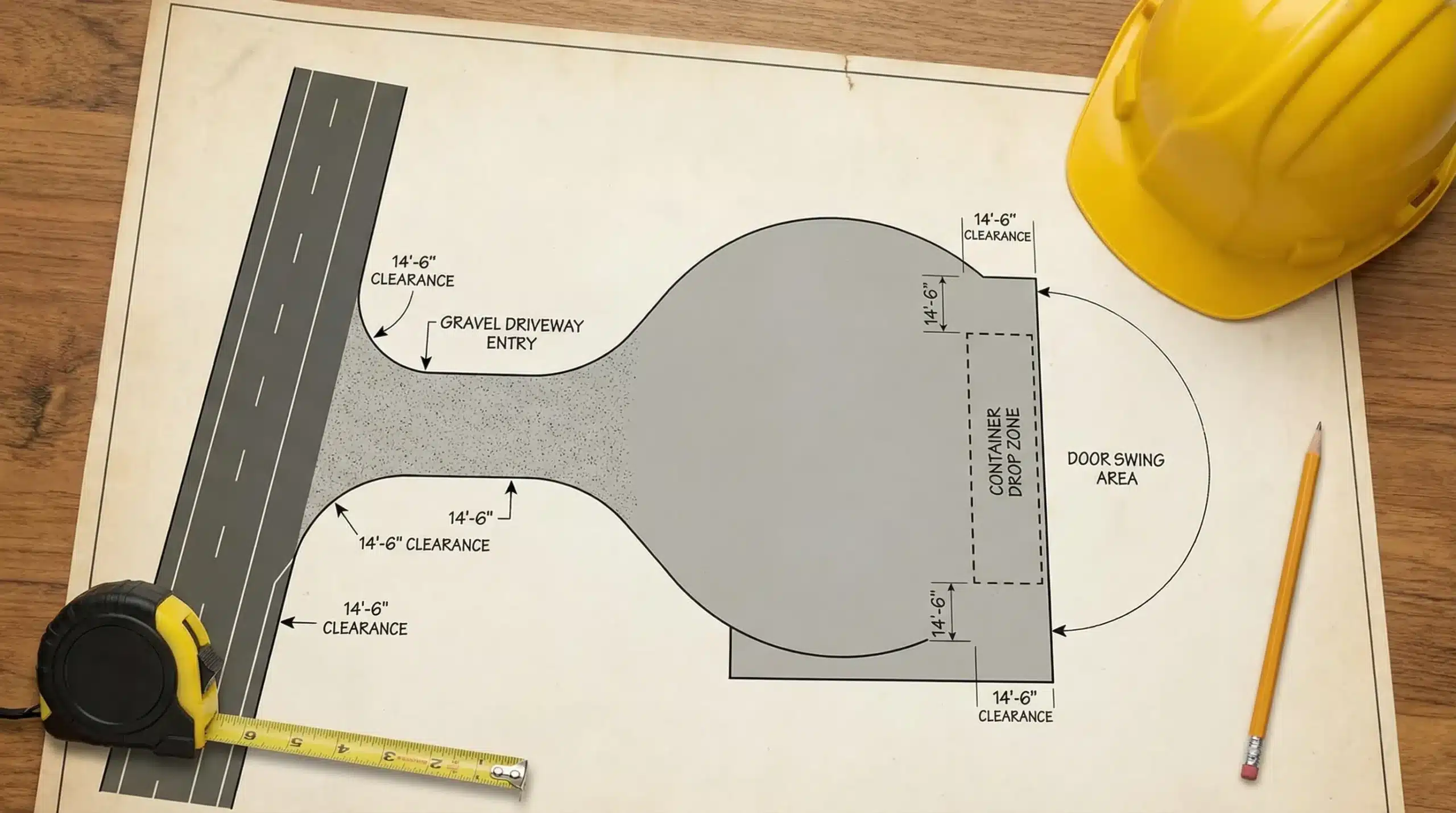
Plan access in three zones: street, route, and drop zone
Think of access like a mini logistics project. For customers across Raleigh, Wake County, and the broader Southeast, these three zones cover almost every avoidable delivery problem.
Buyers still deciding between sizes should start with how to choose shipping container size so access limits and usable space are weighed together.
Zone 1: Street approach and turn-in
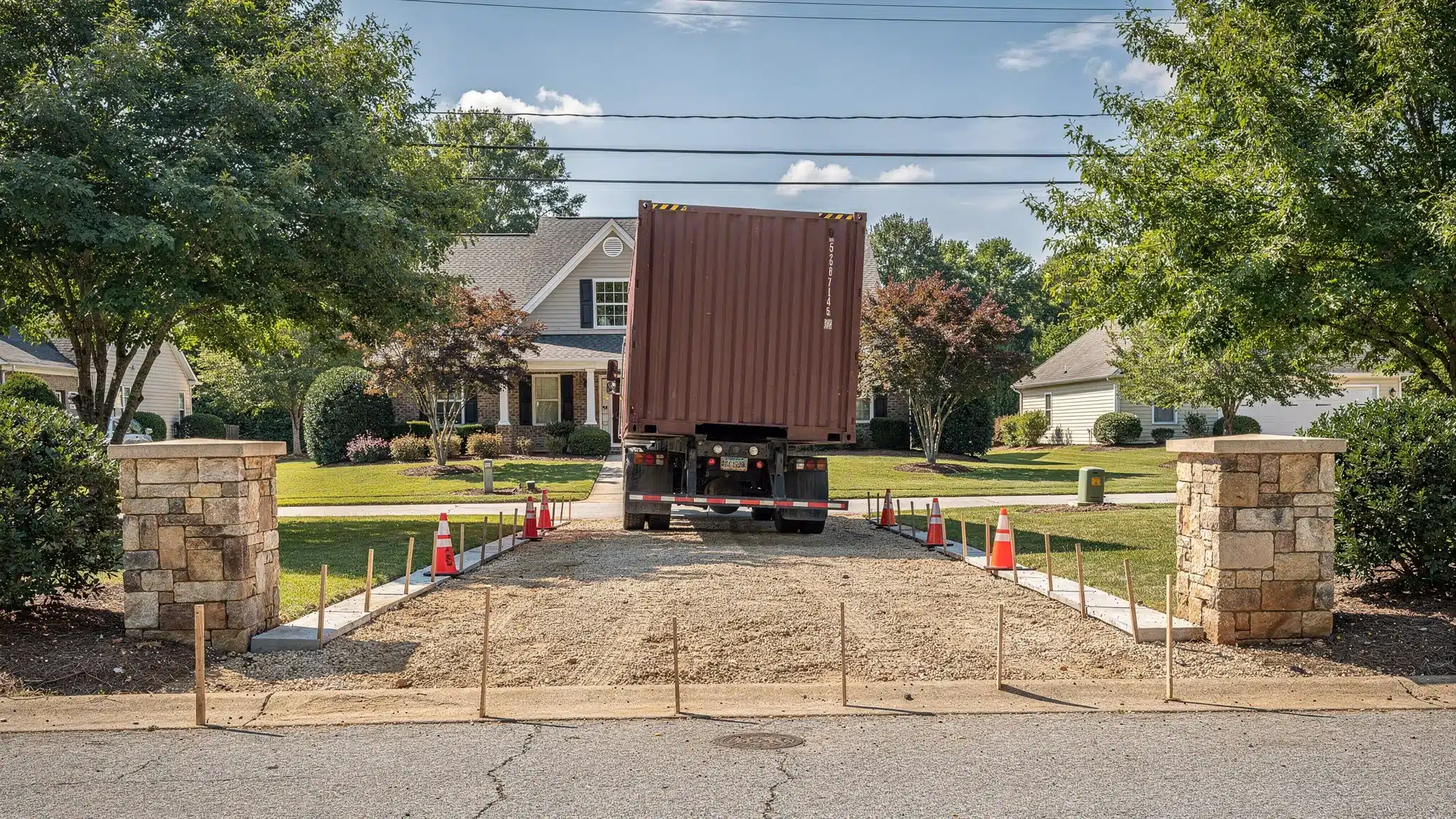
Drivers need room to line up, turn, and keep tires on stable pavement. Problems show up fast in:
-
Narrow neighborhood streets with parked cars
-
Soft shoulders (especially after rain)
-
Tight gates or stone columns
-
Sharp turns immediately after the entrance
What to do: stand at your entrance and imagine a long truck needing a wide arc to turn. If the driver has to “cheat” onto a shoulder, that shoulder must be firm enough to support heavy loads.
Raleigh-specific note: in many suburban areas, the shoulder may be landscaped or saturated clay after storms. If it is soft, plan a different approach or clear temporary parking restrictions so the truck can swing wider without leaving pavement.
Zone 2: The route from entrance to drop
This is where most “we didn’t think of that” issues happen.
Overhead clearance
You need vertical clearance not only where the container ends up, but along the entire path the truck travels. Watch for:
-
Tree limbs
-
Power and service lines
-
Roof overhangs and carports
-
Low bridges (for longer private drives)
If overhead clearance is tight, browse our 20ft containers first, since shorter units are often easier to place on residential and narrow-access properties.
High Cube containers (often requested for conversions and extra storage volume) add height, so confirm the container type early if you are considering a 40ft High Cube.
Width and pinch points
Measure any narrow points (gate openings, fence lines, between buildings). Remember you need clearance for the truck, not just the container.
Slope and traction
A steep gravel drive can be fine when it is dry and a problem when it is wet. In the Southeast, plan for rain, not for best-case conditions. If the driver cannot safely stop, reverse, or stabilize the truck, delivery may be postponed.
Zone 3: The drop zone (final placement area)
The drop zone must be:
-
Level enough for doors to operate and seal
-
Firm enough to prevent settling and twisting
-
Large enough for placement and future access
If your site will use the unit for tools, equipment, or long-term on-site storage, compare options in our used shipping containers inventory.
Door access is often overlooked. If you want regular walk-in access, do not place the container tight against a wall, berm, or fence. Also consider where water flows during heavy rain. A “perfectly flat” low spot can become a pond.
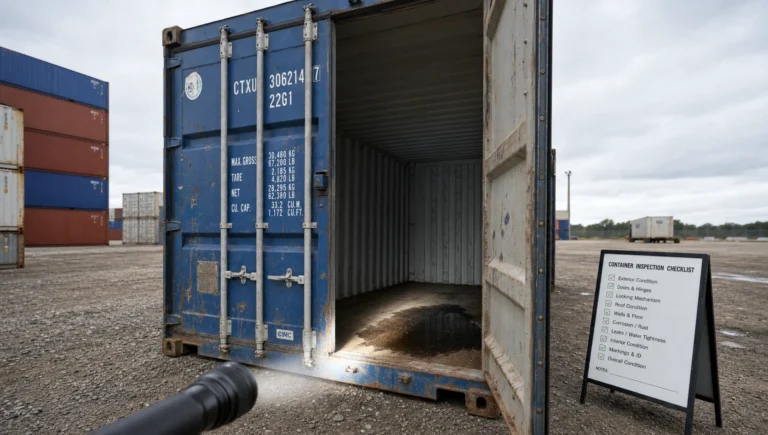
A practical access checklist you can use (and send to your supplier)
Use this to speed up coordination with your delivery team and reduce back-and-forth. The more clearly you communicate, the more predictable the delivery window becomes.
| Item to confirm | What to measure or photograph | Why it affects efficient delivery |
|---|---|---|
| Entrance width and turn-in | Photo facing entrance from street, plus width measurement | Determines whether the truck can enter without mounting soft shoulders or hitting columns |
| Route overhead clearance | Photos under trees/lines, note lowest point | Prevents damage to trees, utility lines, and the container during transit and unloading |
| Route surface condition | Photos of gravel, dirt, asphalt; note soft areas | Soft ground can cause stuck vehicles, ruts, or unsafe unloading |
| Drop zone slope | A simple level check (or note visible slope) | Excess slope can rack the container frame and make doors hard to open |
| Door orientation | Mark where you want doors facing | Avoids rework and repositioning after drop |
| Space to maneuver | Photo from drop zone looking outward | Confirms the driver has room to line up and unload safely |
Efficient delivery planning for 20ft vs 40ft containers
A 20ft container is often easier to place on tighter residential properties or smaller job sites, while a 40ft (and especially a 40ft High Cube) can push you into needing better turning space and a longer, straighter approach.
If you are still deciding:
-
Review how your intended use maps to size in how to choose shipping container size.
-
If budget is driving the decision, read the delivery cost factors in 20ft shipping container price: what to expect, because access constraints can change delivery cost regardless of the container’s base price.
For larger sites or commercial drops, you can also browse our 40ft containers inventory to compare common layouts and access considerations.
Common Raleigh and Southeast access issues (and how to solve them)
1) Wet ground and settling
North Carolina’s mix of clay and seasonal rainfall can turn a “solid yard” into a soft base overnight.
-
If you see tire impressions after normal vehicle traffic, assume a heavy delivery will rut.
-
Plan a gravel pad or stabilize the drop zone before scheduling.
2) Tree canopy conflicts
In established neighborhoods around Raleigh, trees are frequently the limiting factor.
-
Trim limbs along the full approach, not just above the final spot.
-
Confirm clearance for the unloading motion (tilt-bed drops need room above and behind the truck as the bed tilts).
3) Tight gates and decorative entrances
Columns, brick mailboxes, and fencing create pinch points.
-
Measure the narrowest point and provide that number upfront.
-
If necessary, plan temporary removal of a gate panel.
4) HOA rules and permit questions
Some communities restrict placement duration, visibility, or setbacks.
-
Confirm HOA rules before delivery day.
-
In some cases, the city or county may require permits depending on intended use (storage vs occupied space, electrical tie-ins, etc.).
If you need a unit that will be used as workspace rather than storage, review our container home office options before planning the drop zone.
Pro-Tip: Build a simple, durable pad (and avoid door problems later)
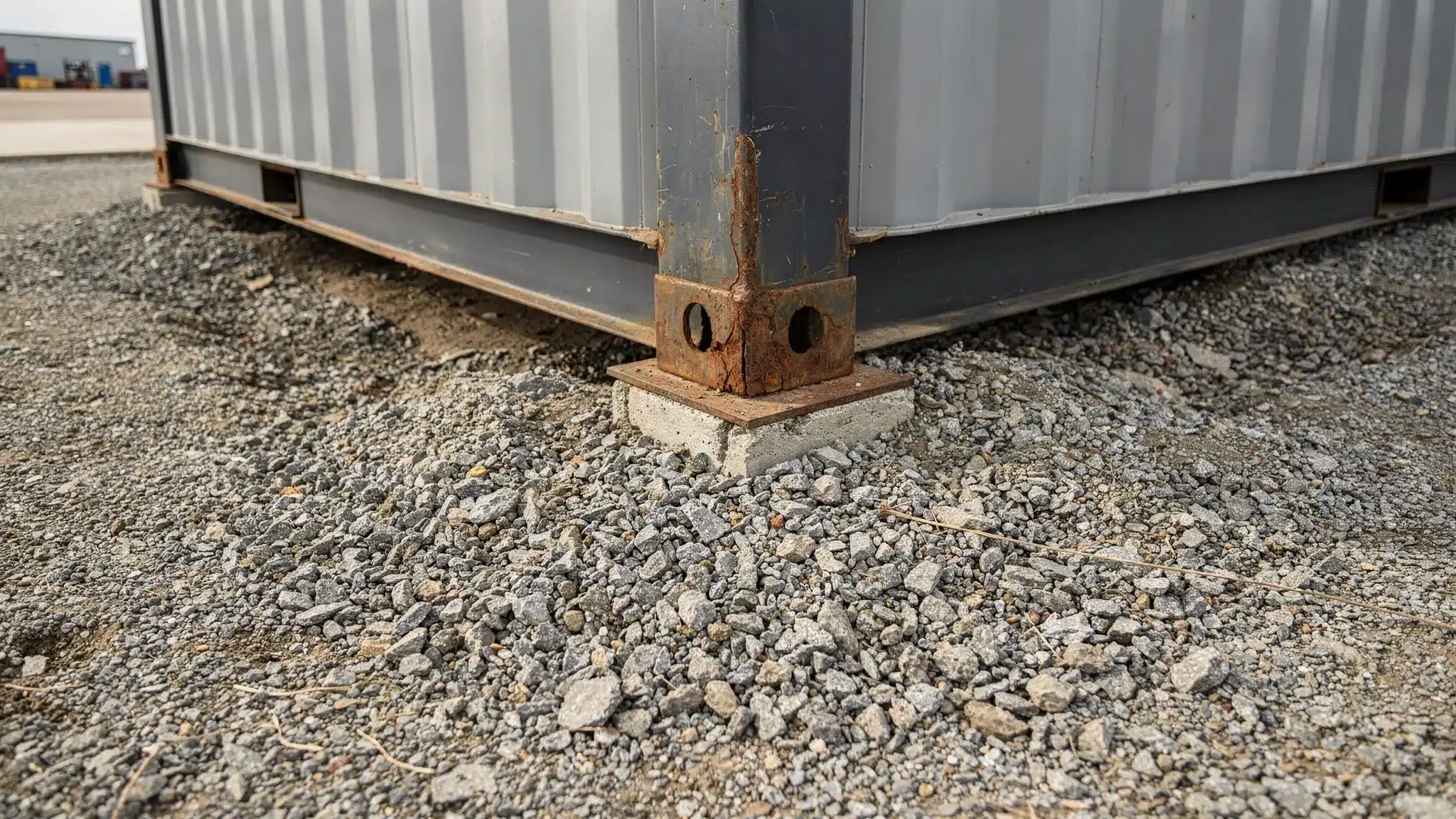
A container is strongest at the corner castings (the engineered corners used for lifting and stacking under ISO standards). Your pad plan should support the corners and keep the frame from twisting.
Practical site-prep guidance that works well across Raleigh and the Southeast:
-
Level first: If the container is racked (twisted), doors can bind and gaskets may not seal properly.
-
Use a gravel pad when possible: A compacted gravel base improves drainage and reduces settling. Avoid placing containers directly in standing water.
-
Support the corners: Many sites use concrete blocks, engineered supports, or properly placed timbers to keep the corners stable and elevated.
-
Think permits early: If your container will be used as an office, retail space, or anything with utilities, ask about local permitting before the drop.
This is one of the simplest ways to protect your investment whether you choose a One-Trip unit or a used WWT container.
Day-of-delivery plan (what we recommend customers do)
Efficient delivery is also about reducing day-of surprises.
-
Clear vehicles from the street and driveway (and ask neighbors to do the same if needed).
-
Mark the drop zone corners with cones or stakes (and mark underground utilities if applicable, call 811 ahead of digging).
-
Confirm where the doors should face.
-
If the site is tight, have a spotter available to guide the driver.
-
Keep pets and bystanders away from the unloading area.
For logistics managers or builders, it can also be worth reviewing your overall risk and coverage planning. If your operations extend internationally, for example into the UAE, tools like InsuranceHub can help teams compare insurance options online as part of broader project readiness.
FAQ
How much clearance do I need for a shipping container delivery? Most deliveries need more clearance than the container itself because you are accommodating the truck and unloading motion. Share photos and measurements with your supplier so the delivery method can be matched to your site.
Does a High Cube container change delivery access requirements? Yes. A High Cube is typically about 1 foot taller than a standard container, which can create issues with tree limbs, service lines, and overhangs along the route.
Can you deliver a container onto grass or dirt? Sometimes, but it depends on soil strength, recent rain, slope, and unloading method. In Raleigh and the Southeast, wet ground is a common reason for postponements. A compacted gravel pad is often the safest option.
Why do container doors sometimes get hard to open after delivery? The most common reason is the container is not level or the frame is twisted from uneven support. Supporting corners properly and leveling the base usually prevents door binding.
Should I buy One-Trip, Cargo Worthy, or WWT for on-site storage? One-Trip is best for clean, long-term, customer-facing uses. WWT is often the best value for property storage when cosmetics are not critical. Cargo Worthy is ideal when you need a used unit suitable for transport and stricter structural expectations. If you are still comparing grades and appearance, review our guide on new vs used shipping containers and then browse our inventory page for available units.
Need help planning a smooth container drop in Raleigh (or anywhere in the U.S.)?
Lease Lane Containers LLC coordinates nationwide delivery, but we are built for local success in Raleigh, North Carolina and the Southeast, where site conditions and access constraints are common. If you want an efficient delivery plan, send us a few site photos and your preferred placement area and we will help you choose a size, confirm a delivery method, and plan the drop.
Need help planning a smooth container delivery? Browse our inventory page to compare available units, then visit our contact us page to send your site photos, measurements, and placement details. Our team can help you confirm the right size, grade, and delivery method before your container is scheduled.