Delivering a Shipping Container to Tight Access Sites
Delivering a shipping container to a tight access site is absolutely possible, but it takes more planning than a standard open-lot drop. The challenge is not just the container itself. It is the combined length, height, turning path, unloading angle, and ground pressure of the truck, trailer, and container as one moving system.
That matters for Raleigh homeowners with narrow driveways, general contractors working on crowded infill lots, farms with uneven access roads, and small businesses placing storage behind a storefront. A successful delivery starts before the truck leaves the yard. You need the right container size, the right delivery method, a realistic drop plan, and a prepared surface that keeps the unit level after placement.
This guide explains how to think through tight access before buying, what measurements to take, and when a specialized delivery method may be worth the extra cost.
Why tight access changes the delivery plan
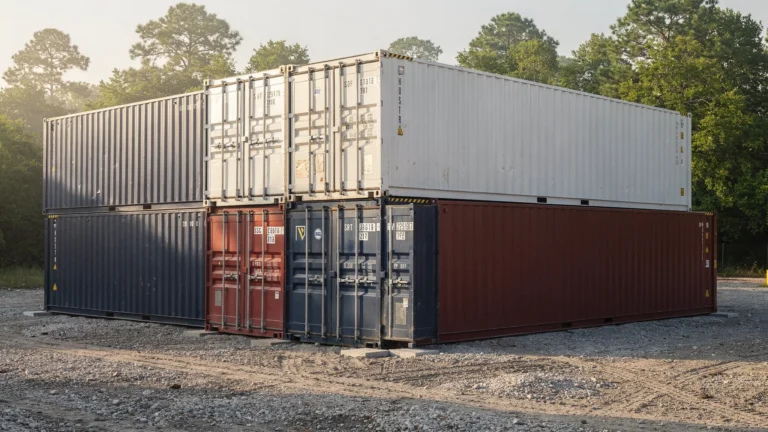
A shipping container is built to ISO standards, meaning standard dry containers share consistent exterior dimensions, corner castings, and structural design. That standardization helps with transport, stacking, and logistics. It also means the container will not flex or shrink to fit a difficult site.
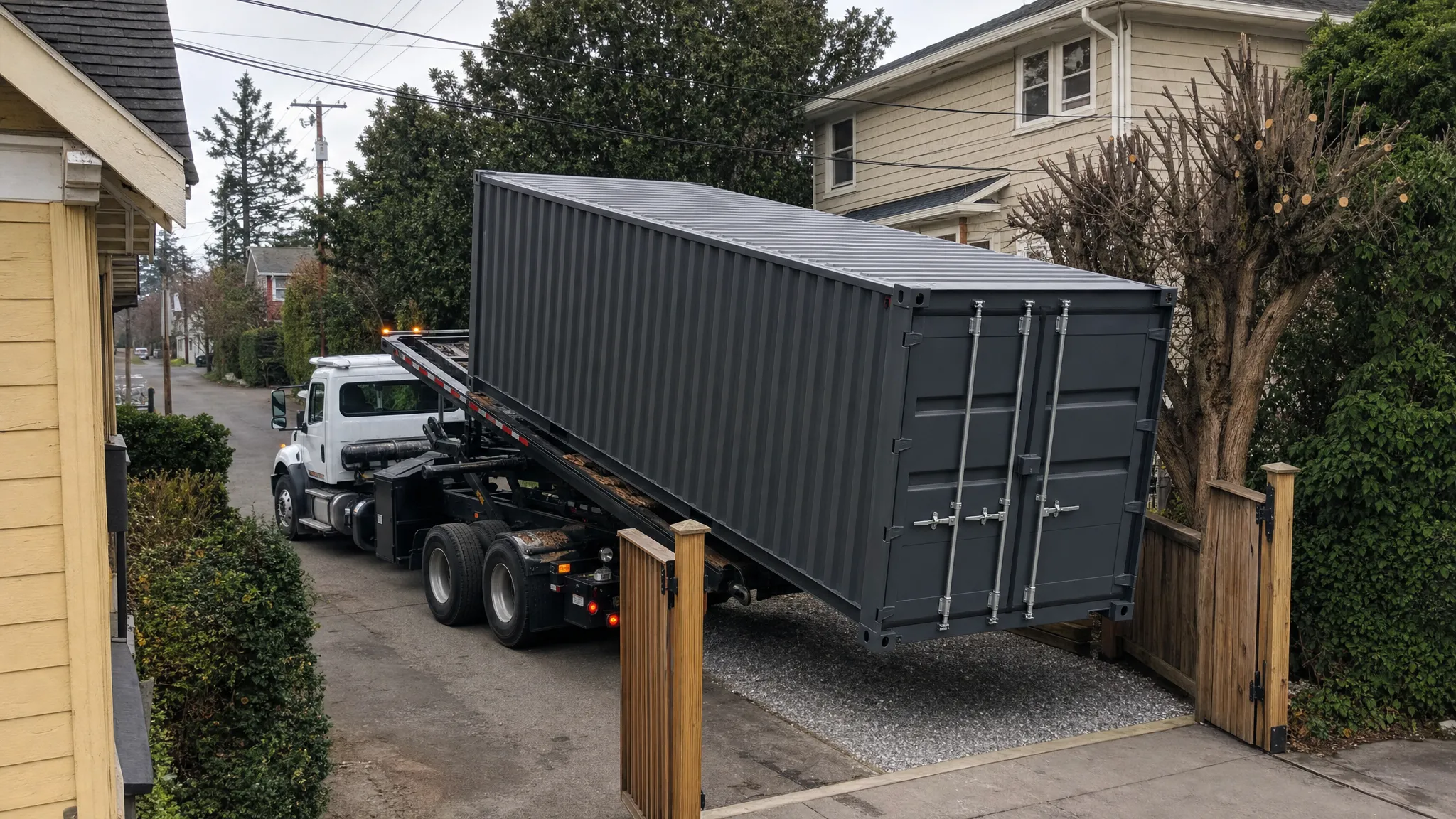
The real issue is often the delivery equipment. A 20ft container may fit neatly in a driveway once it is placed, but the tilt-bed truck may need a straight approach and extra room to slide the container off. A 40ft container may offer excellent storage value, but it can be difficult to maneuver through a narrow gate, around a cul-de-sac, or behind a building without a crane or side-loader.
Tight access also increases the importance of door orientation. If the driver cannot approach from the correct direction, your doors may end up facing the wrong way. For contractors in downtown Raleigh or tight subdivisions around Cary, Apex, Durham, and Wake Forest, that can turn a good storage plan into a daily inconvenience.
Start with container size, height, and grade
Before solving the access problem, confirm the container you actually need. Size affects maneuverability, while grade affects how confidently you can use the unit for storage, jobsite work, modifications, or transport.
| Container option | Typical exterior size | Tight-access consideration |
|---|---|---|
| 20ft standard | 20 ft L by 8 ft W by 8 ft 6 in H | Often the easiest ISO container to place in residential driveways, small lots, and compact jobsites. |
| 40ft standard | 40 ft L by 8 ft W by 8 ft 6 in H | More storage per delivered unit, but needs more approach room, swing room, and rollback space. |
| 40ft High Cube | 40 ft L by 8 ft W by 9 ft 6 in H | Great for extra interior height, but overhead clearance is more critical during transport and placement. |
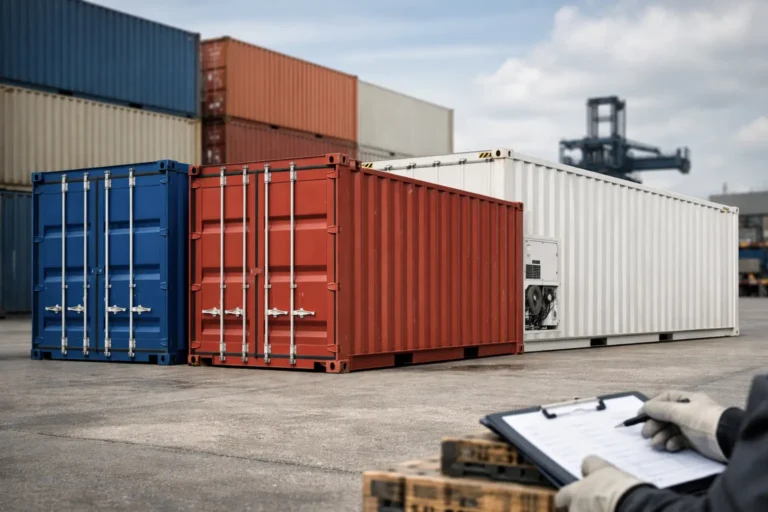
| Refrigerated container | Commonly 20ft or 40ft | Heavier, needs service access around the machinery end, and requires electrical planning. |
If access is truly limited, 20ft containers are often the most practical choice. For large storage needs, 40ft containers or 40ft High Cube units may still work, but they require a more detailed route review.
Grade matters too. Lease Lane Containers commonly discusses three major condition categories:
- One-Trip containers: These are the closest thing to new in the resale market. They typically have made one loaded ocean voyage, have cleaner Corten Steel panels, better cosmetics, and fewer wear issues. They are popular for offices, retail, residential conversions, and high-visibility storage.
- Cargo Worthy containers: These are used containers that remain structurally suitable for cargo transport when properly inspected and documented. For export, a valid CSC plate and survey requirements may apply. Cargo Worthy units are often a strong value when structural integrity matters more than appearance.
- Wind and Watertight containers: WWT units are used containers that should keep out wind and rain for stationary storage, but they are not necessarily certified for shipping cargo. They are common for jobsite storage, farm storage, and budget-conscious buyers.
For tight access sites, grade does not change the outside dimensions, but it can affect usability after placement. A used container with stiff doors needs to sit level, or the doors may become harder to operate. A One-Trip unit is often preferred when the container will be visible to customers, neighbors, tenants, or inspectors. If you are comparing used containers, ask for condition details, photos, door operation notes, and delivery assumptions before you commit.
What counts as a tight access site?
A tight access site is any location where the delivery truck cannot approach, unload, and exit safely using standard movement. The container may physically fit on the ground, but the delivery system may not fit the path.
Common tight-site issues include narrow driveways, low tree limbs, overhead power lines, steep slopes, soft shoulders, stone walls, septic areas, sharp turns, low bridges, and limited street parking. In Raleigh and the Southeast, clay soil and heavy rain can also turn a firm-looking yard into a delivery risk.
The most common mistake is measuring only the final footprint. A standard container is 8 ft wide, but the truck needs more than 8 ft of usable access. Mirrors, trailer swing, roadside ditches, fences, and mailbox placement all matter. The driver also needs a safe way to leave after the container is placed.
For a broader look at space planning, see Lease Lane Containers’ guide on how much room you need to deliver a container.
Delivery methods for tight sites
No single delivery method is best for every tight access location. The right choice depends on the container size, surface, obstacles, budget, and how precise the placement needs to be.
| Delivery method | Best fit | Limits to confirm |
|---|---|---|
| Tilt-bed trailer | Standard ground-level drops with a reasonably straight approach | Needs rollback space and firm ground. The container slides off as the trailer pulls forward. |
| Roll-off style delivery | Some shorter containers and portable storage setups | Equipment availability varies, and placement precision depends on site conditions. |
| Side-loader | Sites where the truck can park parallel to the drop zone | Needs stable ground beside the placement area and enough side clearance for stabilizers. |
| Crane delivery | Backyards, walled lots, urban sites, or locations beyond truck reach | Higher cost, rigging plan required, and overhead hazards must be reviewed carefully. |
| Flatbed or chassis delivery | Logistics customers with forklifts, cranes, or loading docks | Usually not a complete ground-placement solution by itself. |
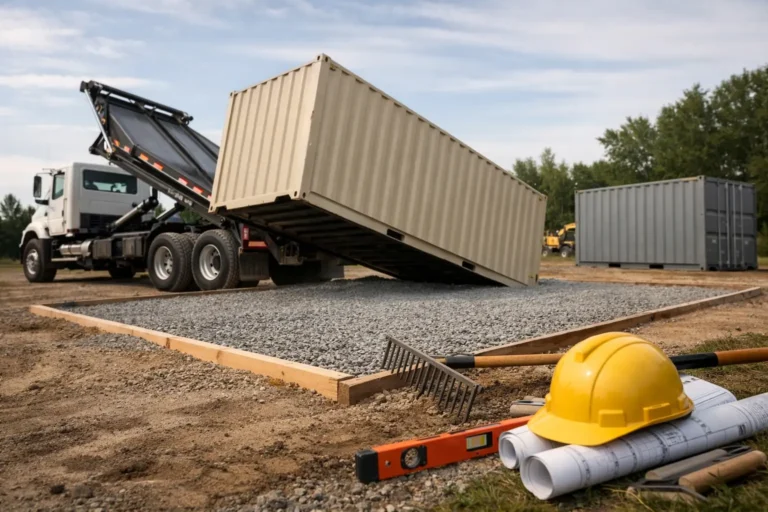
Tilt-bed delivery is common because it is efficient and cost-effective, but it is not magic. The truck usually needs to line up with the final container orientation. If the drop zone is behind a house, beyond a fence, or around a sharp turn, a crane or side-loader may be safer than forcing a tilt-bed into a poor position.
If you are unsure whether a tilt-bed can handle your location, read Can a Tilt Bed Deliver a Shipping Container? and then share site photos with your supplier.
How to measure your site before scheduling delivery
Good measurements reduce failed deliveries. They also help your supplier recommend the right truck, trailer, and container size before money is spent on dispatch.
| Measurement | What to check | Why it matters |
|---|---|---|
| Entry width | Gate openings, driveway edges, ditches, parked vehicles, posts, mailboxes | The truck needs usable width, not just container-width clearance. |
| Overhead clearance | Branches, utility lines, building overhangs, carports, signs | High Cube containers and tilt-bed unloading need more clearance than the final container height. |
| Approach length | Straight distance leading into the drop zone | Tilt-bed placement requires room for the truck to pull forward as the container slides down. |
| Turning path | Road approach, cul-de-sacs, 90-degree turns, jobsite congestion | Long trailers cut corners and need more swing room than a pickup truck. |
| Ground conditions | Soil firmness, slope, drainage, recent rain, buried utilities | Soft or uneven ground can cause truck damage, rutting, sinking, or unsafe unloading. |
Photos help, but video is often better. Walk the full route from the public road to the final drop spot while filming slowly. Include the driveway entrance, turns, overhead obstructions, the final pad, and the exit route. Place cones, stakes, paint marks, or boards where you want the container corners to land.
For construction sites, send updated photos close to the delivery date. A site that was open last week may now have dumpsters, framing materials, temporary fencing, or subcontractor vehicles blocking the route.
Pro-Tip: Build the pad before booking the truck
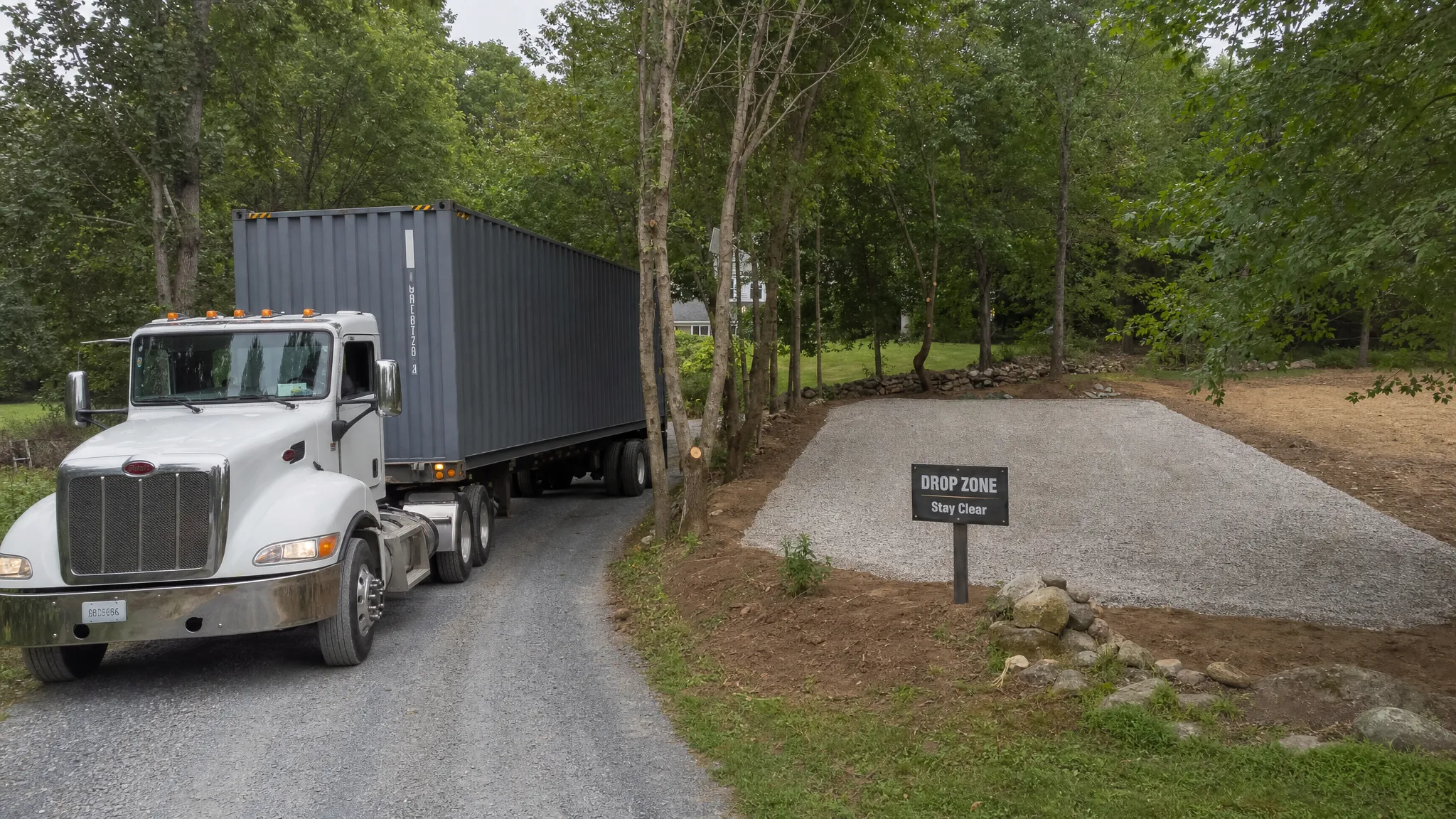
A tight access site leaves little room for adjustment, so prepare the landing area before delivery day. A compacted gravel pad is often the best balance of drainage, cost, and flexibility for storage containers in North Carolina. It helps keep the Corten Steel understructure off wet soil and reduces the risk of door alignment problems.
For most stationary storage uses, focus on four corner support, drainage, and level placement. The container does not need to bear evenly across every square inch of its underside, but the corners and frame need stable support. If one corner sinks, the doors can rack and become difficult to close.
Use a level or laser level to check the pad. Avoid placing containers directly in low spots where stormwater collects. In the Raleigh area, heavy summer rain and clay soils make drainage especially important. If you are adding gravel, consider a compacted base with a slight crown or slope away from the container footprint.
If you plan to dig, grade, trench, install anchors, or run utilities, contact Call 811 before work begins. For Raleigh, Wake County, and other municipalities in the Southeast, also check zoning, HOA rules, temporary construction placement rules, and whether any right-of-way or street-use permission is needed for the delivery truck.
When a 20ft container is the smarter tight-site choice
A 40ft container can be economical because it gives you much more space in a single unit. But tight access can erase that advantage if the delivery requires a crane, road closure, specialty rigging, or multiple site visits.
A 20ft container may be the better choice when the site has a short driveway, limited straight-line unloading room, a tight gate, or a placement area near a residence or barn. Many general contractors also prefer 20ft units for active jobsites because they can be repositioned more easily as the project changes.
For small businesses, a 20ft One-Trip container can work well for clean overflow inventory, pop-up retail storage, or customer-facing storage behind a storefront. For farms, a WWT or Cargo Worthy 20ft unit may be enough for tools, feed, fencing supplies, and seasonal equipment, provided the site is prepared and ventilation is considered.
If you need the capacity of a 40ft unit but your access is marginal, ask about alternatives before committing. Two 20ft containers, a 40ft High Cube placed by crane, or a revised pad location may be more practical than forcing a standard delivery into a difficult area.
Red flags that may require special equipment
Some tight sites are still straightforward with good preparation. Others need a different delivery approach from the start. Watch for these warning signs:
- The truck must reverse a long distance from a public road.
- The container must cross a ditch, culvert, septic field, or soft shoulder.
- The final spot is behind a house, retaining wall, fence, or narrow gate.
- Overhead lines or branches cross the unloading path.
- The site has a steep slope or uneven grade near the pad.
- The street is too narrow for a truck to stage without blocking traffic.
If any of these apply, do not assume the driver can figure it out on arrival. A failed delivery can create extra fees and scheduling delays. It can also damage asphalt, lawns, curbs, fences, or the delivery equipment.
For budgeting, review the factors that affect shipping container delivery cost before comparing quotes. The lowest container price is not always the lowest installed cost, especially on tight sites.
How container grade affects tight-site planning
A One-Trip, Cargo Worthy, and WWT container may all fit in the same footprint, but the best choice depends on what happens after delivery.
For a container office, retail use, modular build, or customer-facing storage, One-Trip is usually worth considering because the cleaner exterior, stronger cosmetic condition, and newer door hardware reduce downstream work. For export or intermodal shipping, Cargo Worthy is the correct conversation because structural standards, CSC plate status, and survey documentation matter.
For stationary storage, WWT can be a cost-effective option. It should keep out wind and rain, but it may show dents, surface rust, patches, or prior cargo wear. On a tight site, inspect door operation carefully and insist on a level pad. A WWT unit that is acceptable on flat ground may become frustrating if placed on a twisted or sinking base.
If you are still comparing grade, size, and total delivered cost, Lease Lane Containers’ shipping container buyer’s guide is a helpful starting point.
What to send before the delivery is scheduled
The more information your container supplier has, the more accurate the delivery recommendation will be. For tight access sites, send the site address, ZIP code, preferred container size, preferred grade, and the exact drop location. Add photos or a video of the entrance, route, overhead clearance, turning areas, and final pad.
Also mention any local restrictions. In Raleigh and nearby communities, that may include HOA rules, construction hours, street parking limits, neighborhood access, utility easements, and temporary right-of-way concerns. For rural North Carolina sites, mention gravel roads, low bridges, farm gates, recent rain, and whether a large truck can safely turn around.
Finally, confirm who will be onsite. Someone should be available to direct the driver, move vehicles, open gates, verify door orientation, and approve final placement. Once a container is on the ground, moving it even a few feet can require another truck visit or special equipment.
Frequently Asked Questions
Can a shipping container be delivered through a narrow driveway? Sometimes, but the driveway must fit the truck and trailer, not just the container. Width, turning angle, overhead clearance, surface strength, and exit path all matter. Send photos and measurements before scheduling.
Is a 20ft container best for tight access sites? Often, yes. A 20ft container is easier to maneuver than a 40ft container and may reduce the need for specialized equipment. However, the delivery truck still needs enough room to approach and unload safely.
Can a 40ft High Cube be delivered to a residential lot? Yes, if the site has enough access and overhead clearance. A 40ft High Cube is 9 ft 6 in tall before it is loaded on delivery equipment, so tree limbs, power lines, and unloading angles must be reviewed carefully.
What if power lines are above the drop spot? Do not attempt delivery under unsafe overhead lines. The supplier or driver may require a different placement location, utility coordination, or crane planning. Never trim near power lines yourself.
Do I need a permit for a shipping container in Raleigh, NC? It depends on the property, use, duration, zoning, and whether the container is temporary or part of a larger construction or modification project. Check City of Raleigh, Wake County, HOA, and jobsite requirements before delivery.
Does container grade matter if I only need storage? Yes. WWT may be sufficient for basic stationary storage, Cargo Worthy is stronger for transport or higher-value use, and One-Trip is preferred for cleaner appearance, longer service life, and modification projects.
Plan a tight-site delivery with Lease Lane Containers
Tight access does not have to stop your project. It just means the delivery plan needs to be built around real measurements, the right equipment, and a stable landing area.
Lease Lane Containers LLC supplies One-Trip, Cargo Worthy, Wind and Watertight, High Cube, refrigerated, and used shipping containers for Raleigh, North Carolina, the Southeast, and customers nationwide. If you are delivering a shipping container to a tight driveway, jobsite, farm lane, or commercial property, our local team can help you choose the right size, review access concerns, and plan a clear delivered quote.
For help with your site, contact the Lease Lane Containers sales team at sales@leaselanecontainers.com or visit our Raleigh office to discuss your container options in person.