Used Shipping Containers for Sale Near Me: What to Ask
Searching for used shipping containers for sale near me is often the first step toward a smart storage or transport solution. But the closest container is not always the best container. The right purchase depends on condition, grade, delivery access, site preparation, and whether the unit is being used for job-site storage, farm equipment, retail overflow, modular construction, or export cargo.
For buyers in Raleigh, across North Carolina, and throughout the Southeast, local knowledge matters. Humidity, drainage, soil conditions, delivery access, and municipal rules can all affect the real cost of a used shipping container. Before you commit to a listing, quote, or deposit, ask the questions below.
First, Ask What the Container Will Be Used For
A used container that is perfect for static tool storage may not be appropriate for international shipping. A container that works for hay, feed, and equipment may not be the best shell for a mobile office. Start with the intended use, then work backward to size, grade, delivery method, and site requirements.
Common use cases include construction-site storage, residential renovation storage, farm and agricultural storage, small business inventory overflow, pop-up retail, cold storage with a reefer unit, and export shipping. Homeowners may also use a container for seasonal items, outdoor gear, or long-term storage while traveling. If your plans include pet-friendly road trips, resources like dog-friendly hotels and destinations can help you plan where your gear is going while your container keeps the rest secure at home.
The key question is simple: will this container only sit on your property, or does it need to move cargo again?
Ask: What Grade Is the Container?
Container grade is the most important detail in any used container purchase. Sellers may use terms differently, so ask for a clear explanation in writing. At Lease Lane Containers LLC, grading transparency is central because grade affects price, lifespan, repairs, and whether the unit is suitable for storage or transport.
| Grade | What it means | Best use | Question to ask |
|---|---|---|---|
| One-Trip | A nearly new container that has typically made one loaded voyage from the factory | Premium storage, visible projects, offices, retail, long-term use | Is this actually one-trip, and can I see current photos? |
| Cargo Worthy (CW) | A used container considered structurally suitable for cargo transport, often with CSC-related inspection requirements | Export, intermodal transport, high-value storage, stacking where appropriate | Is the CSC plate valid, and is documentation available? |
| Wind and Watertight (WWT) | A used container that keeps wind and water out but is not certified for ocean cargo | Stationary storage for tools, equipment, furniture, feed, supplies | Has it passed a light test, roof check, and door gasket inspection? |
| As-Is | A unit sold without condition assurance and may have leaks, structural issues, or difficult doors | Low-budget projects where repairs are acceptable | What known defects are present, and what is excluded from the sale? |
A One-Trip container is technically not a heavily used container, but it is often compared against used options because it is sold into the resale market after its initial voyage. It usually has cleaner floors, better paint, stronger cosmetics, and a longer remaining service life.
A Cargo Worthy unit is the grade to ask about if you are a logistics manager planning international or regional cargo movement. It should have strong corner castings, intact crossmembers, functioning doors, and a structure that meets transport expectations.
A Wind and Watertight unit is usually the value choice for contractors, farms, and homeowners who need secure ground storage. It may have dents, surface rust, and cosmetic wear, but it should not leak when properly inspected.
For a deeper grade breakdown, review Lease Lane’s guide to used containers before comparing quotes.
Ask: Is This the Exact Unit I Will Receive?
Many buyers assume the photos in a listing show the exact container being sold. That is not always true. Some sellers use representative photos, depot photos, or images of a similar grade. That can be acceptable if disclosed, but you should know before you pay.
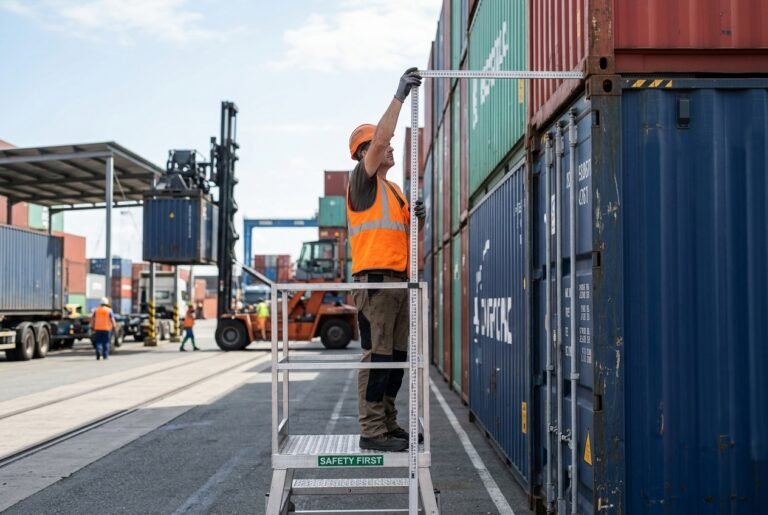
Ask for current photos of the actual unit whenever possible. Request images of the front doors, door gaskets, locking rods, roof, side walls, interior walls, floor, underside if available, corner castings, and CSC plate if the unit is being sold as Cargo Worthy.
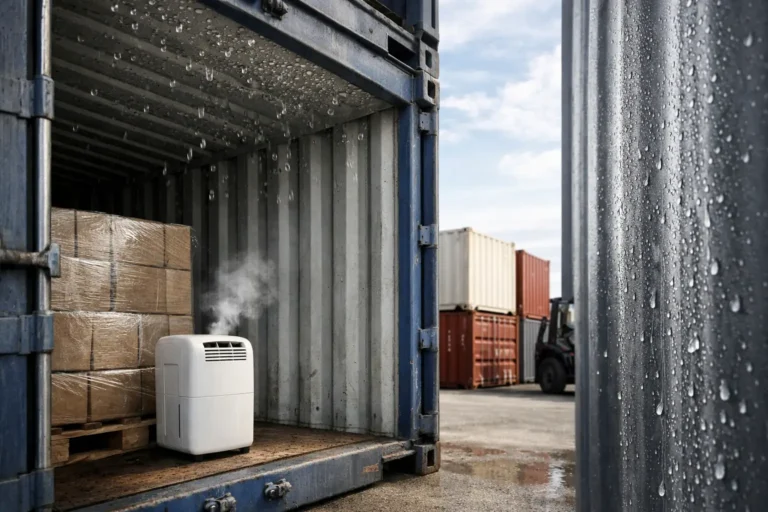
For used containers, photos should show condition, not hide it. Dents and surface rust are common on used ISO containers, especially in Raleigh and the Southeast where humidity and storms can accelerate corrosion. The concern is not minor cosmetic wear. The concern is deep corrosion, holes, bowed rails, patched roofs without explanation, soft flooring, chemical odor, and doors that do not seal.
If you are inspecting in person, step inside and close the doors safely while someone remains outside. If you see daylight through the roof, walls, or door seals, the container may not be Wind and Watertight. For a step-by-step inspection process, see this used container inspection checklist.
Ask: What Size and Height Do I Need?
Most buyers compare 20ft and 40ft containers first. A 20ft unit is easier to place on tight residential lots, smaller job sites, farms, and urban properties. A 40ft unit gives more storage volume and often better cost per square foot, but it needs more delivery room and a larger prepared pad.
High Cube containers add one foot of exterior height, typically 9 feet 6 inches instead of 8 feet 6 inches. That extra height matters for shelving, equipment, office conversions, and taller inventory. However, it also affects overhead clearance during delivery, especially near trees, rooflines, and power lines.
| Container type | Typical exterior dimensions | Typical use case | What to confirm |
|---|---|---|---|
| 20ft standard | 20' x 8' x 8'6" | Tools, residential storage, small business overflow | Driveway access, turning room, door swing |
| 40ft standard | 40' x 8' x 8'6" | Job-site storage, farm storage, bulk inventory | Straight-line delivery clearance and pad length |
| 40ft High Cube | 40' x 8' x 9'6" | Taller equipment, shelving, modular projects | Overhead clearance and local height limits |
| Reefer container | Varies by model and refrigeration unit | Cold storage, food, floral, pharmaceutical support | Power requirements, temperature testing, airflow space |
Exact measurements can vary slightly by manufacturer and condition, so verify interior dimensions if you are storing large equipment, palletized goods, or building out an office. If you are comparing 20ft containers or 40ft containers, do not choose by price alone. Choose by access, usable space, delivery feasibility, and grade.
Ask: Is the Container Built to ISO Standards?
Standard shipping containers are designed around ISO standards, which support consistent dimensions, corner castings, stacking capability, and intermodal handling. This is why a standard container can be moved by cranes, chassis, forklifts, ships, and trucks when properly certified and handled.
For storage buyers, ISO construction is still important because it means the container has a steel frame, corrugated walls, corner posts, and a standardized footprint. Most containers are built with corrosion-resistant Corten Steel, a weathering steel designed to form a protective oxide layer when exposed to the elements. However, Corten Steel is not maintenance-free. Standing water, roof dents, trapped debris, and salt exposure can still lead to rust problems.
Ask the seller whether the unit is an ISO shipping container, whether it has been modified, and whether any modifications affected the structural frame. This matters if you plan to stack, transport, convert, or resell the unit later.
Ask: What Is Included in the Delivered Price?
The lowest listed price may not be the lowest total cost. A proper quote should make the total delivered cost clear.
Ask whether the quote includes the container, delivery, fuel surcharges, taxes, placement, permits if applicable, lockbox upgrades, additional doors, repainting, refrigeration testing for reefers, and any failed-delivery or rescheduling fees.
A reliable seller should be able to explain what happens if the driver arrives and cannot safely place the container because of soft ground, insufficient clearance, low branches, a steep slope, blocked access, or an unprepared pad. In North Carolina, heavy rains can quickly turn a delivery area into soft ground. In the Southeast, clay soils and poor drainage can cause a container to settle unevenly after placement.
Also ask about payment terms. Be cautious with sellers who pressure you to wire money immediately, refuse to provide company details, avoid written quotes, or cannot explain where the container is located.
Ask: How Will Delivery Work?
Delivery is not an afterthought. It is part of the purchase. A good container at the wrong site can become an expensive problem.
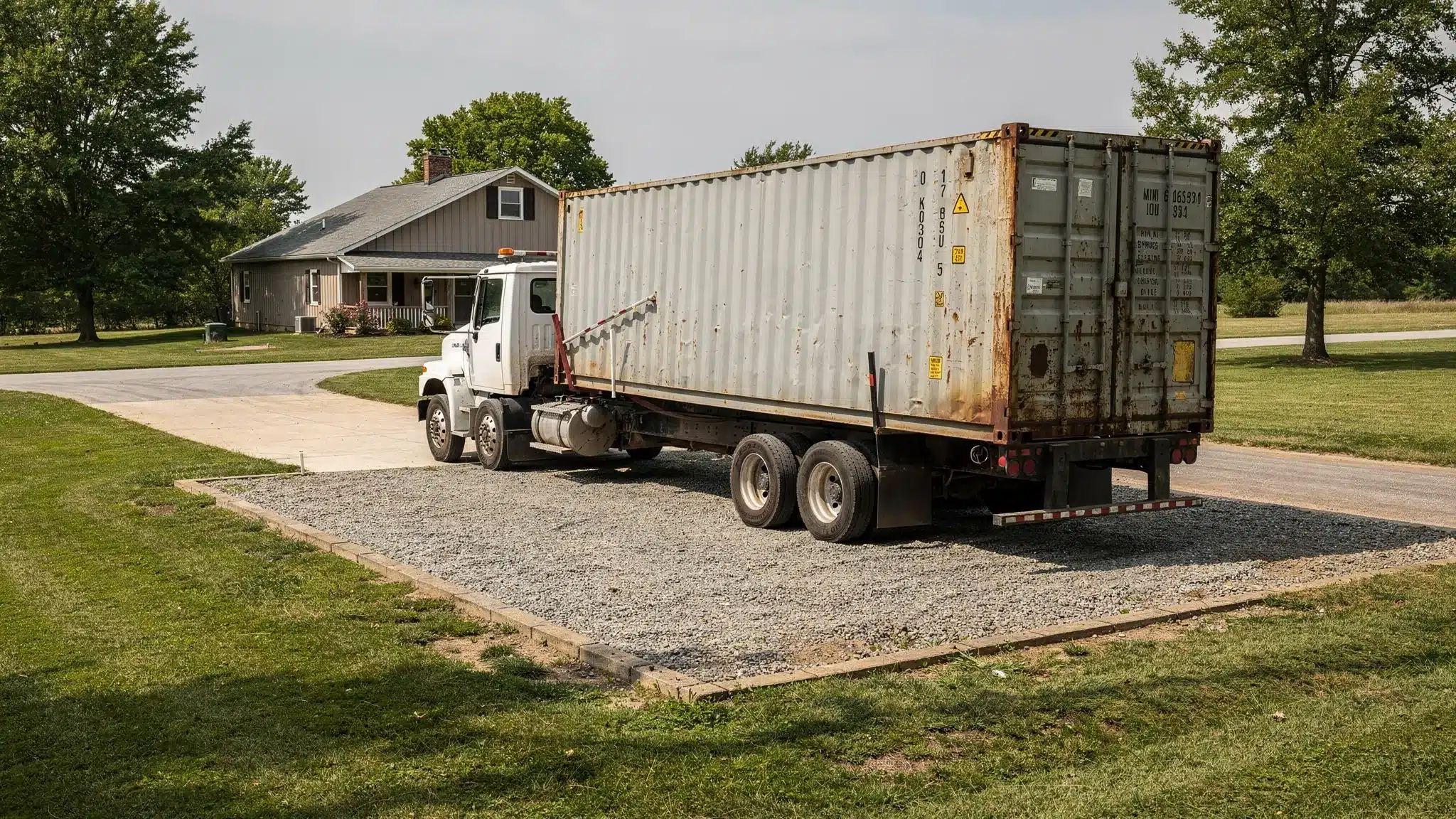
Most residential and small commercial deliveries use a tilt-bed truck or trailer. The driver raises the trailer, slides the container down, and pulls forward as the unit settles into place. This method requires a straight approach and enough room for the truck, trailer, and container length.
Flatbed delivery may require a crane, forklift, or other equipment to offload. Side-loaders can be useful in some settings but are not always available or practical. The best method depends on container size, site access, ground conditions, and placement accuracy.
Before scheduling delivery, ask these questions:
- Can the truck safely enter and exit my property?
- How much straight-line clearance is required for a 20ft or 40ft unit?
- Are there low branches, utility lines, fences, gates, or soft shoulders in the route?
- Should the doors face the street, building, driveway, or loading area?
- What happens if weather makes the site unsafe on delivery day?
For more detail, review Lease Lane’s guide to shipping container delivery requirements.
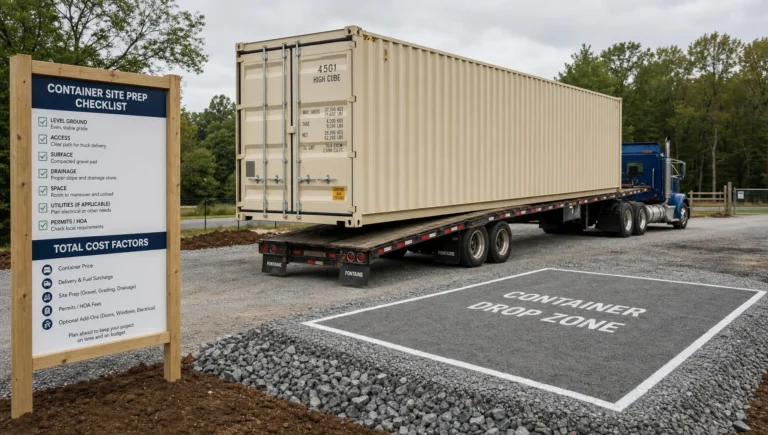
Pro-Tip: Prepare the Site Before You Buy
A used shipping container performs best when it sits level, drains properly, and is supported at the corner castings. Do not place a container directly on soft soil and hope it stays level. Even a strong Corten Steel box can twist slightly if the base settles unevenly, and that twist can make the doors hard to open.
For many Raleigh and Southeast properties, a compacted gravel pad is a practical choice. A common approach is a pad that extends beyond the container footprint, uses compacted stone over stable soil, and slopes surrounding grade away from the container. Concrete slabs, concrete piers, and heavy-duty blocks can also work when properly designed.
Before delivery, mark the exact drop location, confirm door orientation, clear the access route, check overhead clearance, and call 811 before digging or grading. Also check local zoning, HOA rules, and permit requirements. Rules can vary between Raleigh, Wake County, nearby municipalities, rural properties, commercial parcels, and agricultural land.
Ask: What Repairs or Modifications Have Been Made?
Repairs are not automatically a problem. Poorly explained repairs are. A used container may have patch panels, replaced door gaskets, repainted areas, weld repairs, or floor work. What matters is whether the repair was done correctly and whether it matches your use.
For storage, ask if the roof has been patched and whether it still passes a light test. For office or retail conversions, ask whether the floor is dry, solid, and free from strong odor. For export, ask whether repairs meet Cargo Worthy expectations and whether documentation is available.
If a container has already been modified with windows, vents, roll-up doors, personnel doors, electrical cutouts, or HVAC openings, ask how those cuts were reinforced. Cutting into the side walls or frame without proper reinforcement can affect long-term performance.
Ask: Is a High Cube Worth It?
A High Cube container can be a smart upgrade when you need vertical space. Contractors can add taller shelving. Small businesses can store stacked inventory. Developers and homeowners may prefer the extra headroom for modular builds or office conversions.
The tradeoff is delivery and clearance. A 40ft High Cube is taller and may be heavier depending on configuration. It may also require more careful planning around trees, wires, and roof overhangs. If your site is tight, the extra interior height may not matter if the delivery truck cannot safely place the unit.
Ask the seller to confirm whether the unit is standard height or High Cube, and make sure your quote reflects the correct size.
Questions by Buyer Type
Different buyers should prioritize different questions. A general contractor has different risks than a homeowner or logistics manager.
| Buyer type | Best questions to ask |
|---|---|
| General contractors and builders | Is it WWT or better, are the doors easy to operate, can it be delivered close to the work area, and can a lockbox be added? |
| Small business owners | Is the unit clean enough for inventory, can it handle shelving, and will the site allow customer-safe access if used for retail or pickup? |
| Homeowners and farms | Is the floor solid, does it have odors, will it stay dry in humid weather, and do local rules allow long-term placement? |
| Real estate developers | Is the shell suitable for modification, are the walls and frame straight, and is a One-Trip or Cargo Worthy unit a better investment? |
| Logistics managers | Is the unit Cargo Worthy, is the CSC plate valid, and does the container meet the requirements for the intended transport route? |
Red Flags When Shopping “Near Me”
Local search results can include reputable suppliers, national brokers, marketplace listings, and scams. Use caution if a seller cannot explain grading, avoids delivery details, or offers a price far below the local market without a clear reason.
Watch for these warning signs:
- No physical business information or verifiable local presence
- Stock photos only, with no current container photos
- Vague condition terms like “good shape” instead of WWT, CW, or One-Trip
- No written quote showing delivery and fees
- Pressure to pay quickly by wire, gift card, crypto, or payment app
- No explanation of delivery access, site requirements, or failed-delivery policy
- Refusal to discuss roof, floor, doors, gaskets, corner castings, or CSC plate
A trustworthy seller should help you compare condition, delivery, and total cost clearly.
Local Supplier or National Broker?
A local supplier near Raleigh can often give more practical guidance about site conditions, routes, permitting concerns, and delivery access in the Triangle and surrounding North Carolina markets. A national supplier may offer wider inventory coverage, especially for specialty units, reefers, or specific High Cube configurations.
The best option is a supplier that combines both strengths: local support and broad delivery capability. Lease Lane Containers LLC is headquartered in Raleigh, NC and works with buyers looking for clean new One-Trip containers, used WWT and Cargo Worthy units, trailers, refrigerated containers, and custom modular solutions. The goal is to help you choose the right unit before it arrives, not after a delivery issue or grading surprise.
Frequently Asked Questions
What is the best used shipping container grade for storage? For most stationary storage needs, a Wind and Watertight container is often the practical value choice. It should keep out rain and wind when properly inspected, but it is not the right grade for ocean export.
Should I buy Cargo Worthy or Wind and Watertight? Buy Cargo Worthy if the container needs to move cargo, meet transport requirements, or provide higher structural confidence. Choose Wind and Watertight if the container will stay on-site for tools, equipment, household goods, farm supplies, or inventory.
Is a One-Trip container better than a used container? A One-Trip container usually has better cosmetics, newer paint, cleaner floors, and a longer remaining life. It costs more, but it can be worth it for visible projects, offices, retail uses, modular builds, or long-term storage.
Can a used shipping container be delivered to a residential property? Often, yes, but it depends on access, clearance, ground conditions, zoning, and HOA rules. A 20ft container is usually easier to place than a 40ft unit on tight residential lots.
What should I inspect before buying a used container? Inspect the roof, doors, locking rods, gaskets, floor, walls, corner castings, underside, odors, and signs of daylight inside. Ask whether it passes a light test and whether photos show the exact unit.
Are used shipping containers available near Raleigh, NC? Availability changes with market conditions, but Raleigh and the wider Southeast generally have access to 20ft, 40ft, High Cube, WWT, Cargo Worthy, One-Trip, and refrigerated units through qualified suppliers.
Ready to Ask the Right Questions Before You Buy?
If you are comparing used shipping containers for sale near Raleigh, across North Carolina, or anywhere in the USA, Lease Lane Containers LLC can help you match the right size, grade, and delivery plan to your project.
Contact the sales team at sales@leaselanecontainers.com or visit the Raleigh office to discuss 20ft containers, 40ft containers, High Cube options, WWT and Cargo Worthy used units, One-Trip containers, reefers, trailers, and modular solutions.