Shipping Container Specifications Every Buyer Should Know
Buying a container is easier when you know which specifications actually matter. A 40 ft High Cube may look similar to a standard 40 ft unit from the outside, but the extra interior height can change how you store palletized goods, frame a mobile office, or plan a modular build. A Cargo Worthy unit may cost more than a Wind & Watertight container, but that grade matters if the container will go back into transport.
For buyers in Raleigh, North Carolina, the Southeast, and across the USA, shipping container specifications should be reviewed before you compare quotes. Dimensions, grade, material, door opening, payload, flooring, ventilation, and delivery requirements all affect the total value of the container.
This guide breaks down the key specs every buyer should understand before choosing a 20 ft container, 40 ft container, High Cube unit, used container, or refrigerated container.
What shipping container specifications really include
Shipping container specifications are more than length and width. A complete spec review tells you whether the unit fits your site, protects your cargo, supports your intended use, and can be delivered safely.
At a minimum, buyers should compare:
| Specification | Why it matters |
|---|---|
| Exterior dimensions | Determines site fit, delivery clearance, and permit considerations |
| Interior dimensions | Tells you usable storage or build-out space |
| Door opening | Confirms whether equipment, pallets, furniture, or machinery can fit through the doors |
| Tare weight | The empty weight of the container, important for transport and placement |
| Payload capacity | The maximum cargo weight the container was designed to carry in transport |
| Maximum gross weight | Container plus cargo weight, important for logistics and export use |
| Grade and condition | Affects leak resistance, structural integrity, price, and lifespan |
| Material | Most ISO containers use Corten Steel for weather resistance and durability |
| Floor type and condition | Critical for forklifts, heavy equipment, food-adjacent storage, and conversions |
| Certification | CSC and ISO compliance matter for international shipping and intermodal use |
A buyer using a container for backyard storage in Wake County will care most about weather tightness, site placement, and door operation. A logistics manager exporting cargo through an ocean carrier will need verified structural condition, a valid CSC plate, and Cargo Worthy status.

Standard shipping container dimensions
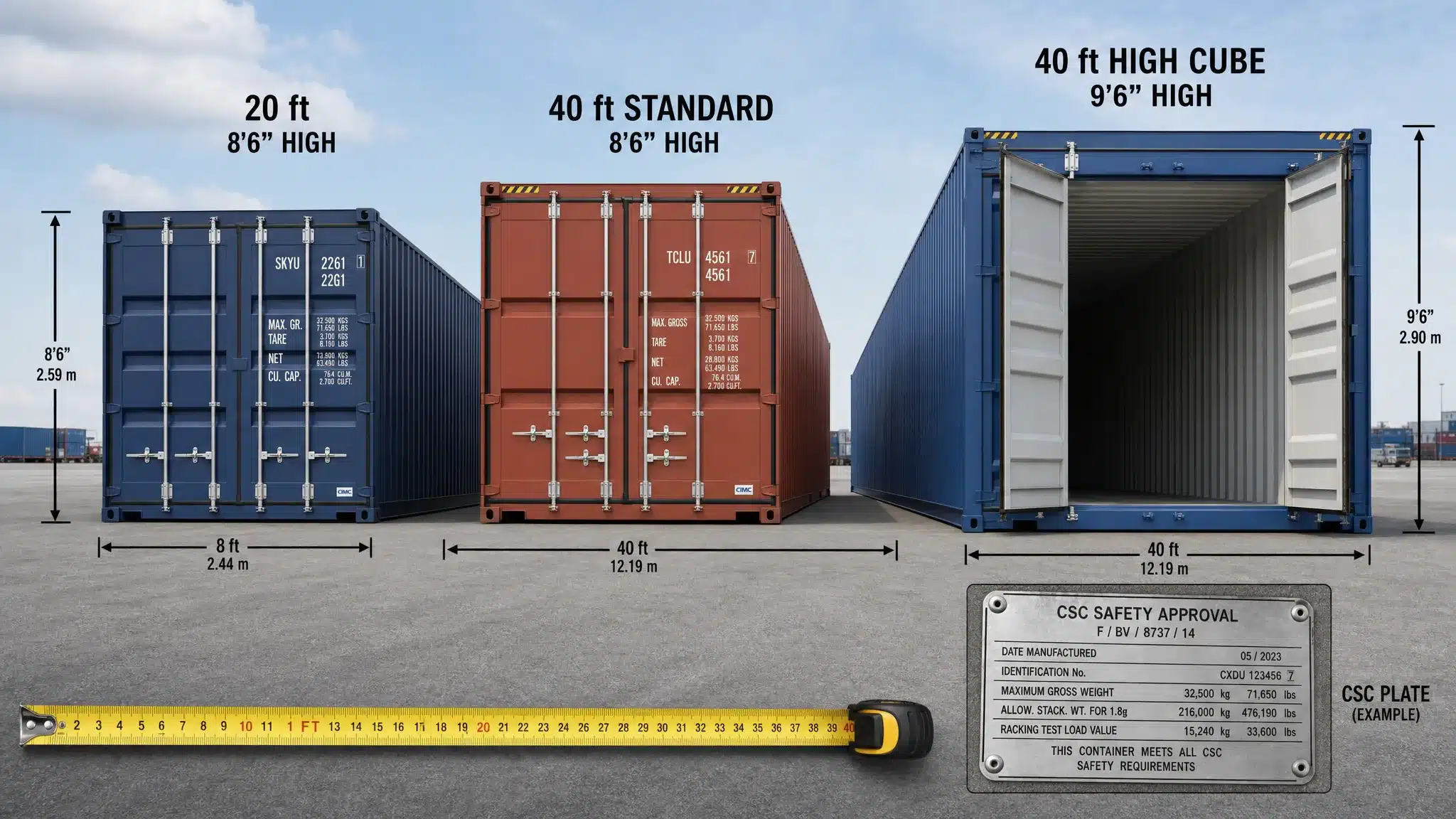
Most buyers compare 20 ft, 40 ft, and 40 ft High Cube containers first. These sizes are built around ISO standards, which help containers move through global shipping networks by truck, rail, and vessel. The international standard most commonly referenced for container dimensions and ratings is ISO 668, although exact measurements can vary slightly by manufacturer, age, and container type.
Use the table below as a practical planning guide, not a substitute for verifying the exact unit you are buying.
| Container type | Typical exterior dimensions | Typical interior dimensions | Typical door opening | Approx. cubic capacity | Approx. tare weight |
|---|---|---|---|---|---|
| 20 ft standard | 20 ft L x 8 ft W x 8 ft 6 in H | 19 ft 4 in L x 7 ft 8 in W x 7 ft 10 in H | 7 ft 8 in W x 7 ft 5 in H | 1,170 cu ft | 4,800 to 5,000 lb |
| 40 ft standard | 40 ft L x 8 ft W x 8 ft 6 in H | 39 ft 5 in L x 7 ft 8 in W x 7 ft 10 in H | 7 ft 8 in W x 7 ft 5 in H | 2,390 cu ft | 8,000 to 8,500 lb |
| 40 ft High Cube | 40 ft L x 8 ft W x 9 ft 6 in H | 39 ft 5 in L x 7 ft 8 in W x 8 ft 10 in H | 7 ft 8 in W x 8 ft 5 in H | 2,690 cu ft | 8,600 to 8,900 lb |
If you are deciding between sizes, start with the container footprint and delivery path. A 20 ft container is easier to place on tighter residential lots, smaller farms, and urban construction sites. A 40 ft container offers far more storage per delivered unit, but it requires more room for truck access and placement. For a deeper size comparison, review Lease Lane Containers’ guide to 20 ft, 40 ft, and High Cube shipping container dimensions.
20 ft vs. 40 ft vs. High Cube: how to choose by spec
A 20 ft standard container is often the practical choice for contractors, homeowners, and small businesses that need secure storage without taking over the entire site. It is shorter, easier to maneuver, and better suited for tight Raleigh-area driveways or compact job sites. If you are researching 20 ft containers for purchase, it helps to compare both size and condition in a complete buying workflow, such as the Lease Lane Containers Buyers Guide.
A 40 ft standard container is a strong fit when the goal is maximum storage capacity. General contractors use them for material staging, small businesses use them for inventory overflow, and agricultural buyers use them for feed, tools, and seasonal equipment. When comparing 40 ft containers, pay close attention to door swing clearance and access around the unit, not just the length of the container.
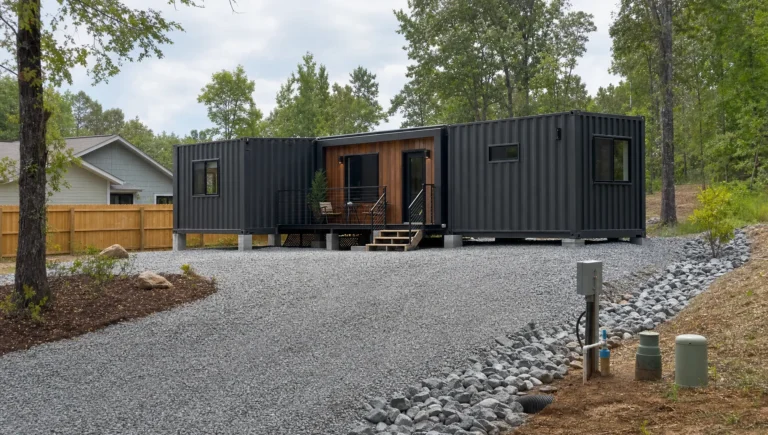
A 40 ft High Cube container adds one foot of exterior height and roughly one foot of interior height compared with a standard unit. That extra height matters for tall shelving, palletized inventory, insulation, HVAC chases, interior framing, and container office conversions. Buyers considering build-outs should also read the detailed guide to High Cube container dimensions and door specs.
Weight ratings: tare, payload, and gross weight
Weight specifications are often overlooked by storage buyers, but they are essential for logistics, delivery, and safe use.
Tare weight is the empty weight of the container. Payload is the maximum cargo weight the container is designed to carry. Maximum gross weight is the combined weight of the container and its cargo.
Typical ratings are:
| Container type | Approx. max gross weight | Approx. max payload | What buyers should remember |
|---|---|---|---|
| 20 ft standard | 52,900 lb | 47,000 to 48,000 lb | High payload for dense cargo, but site surface must support concentrated weight |
| 40 ft standard | 67,200 lb | 58,000 to 59,000 lb | Better for volume than dense heavy cargo compared with a 20 ft unit |
| 40 ft High Cube | 67,200 lb | 58,000 lb range | Extra height increases volume, not necessarily legal road payload |
These ratings come from the container’s original intermodal design. They do not mean every used container should be loaded to maximum capacity on private property. Floor condition, crossmembers, foundation type, soil stability, and local road limits all matter. If a container will carry heavy machinery, tile, stone, metal stock, or dense agricultural supplies, ask about the floor, crossmembers, and structural grade before buying.
Corten Steel and structural construction
Most standard shipping containers are built with corrugated Corten Steel panels, also called weathering steel. Corten Steel forms a protective oxidation layer that helps resist atmospheric corrosion. This is one reason shipping containers perform well in humid environments like Raleigh and the broader Southeast when they are placed correctly and maintained.
Key structural components include:
| Component | Function | What to inspect |
|---|---|---|
| Corner castings | Allow lifting, stacking, and secure intermodal handling | Cracks, deformation, heavy corrosion, impact damage |
| Corner posts | Carry stacking and vertical loads | Buckling, weld damage, structural repairs |
| Top and bottom rails | Tie the container frame together | Rust, bowing, dents, compromised welds |
| Corrugated side panels | Provide wall strength and weather protection | Holes, sharp dents, patch quality, rust-through |
| Roof panel | Protects against rain and debris | Ponding dents, pinholes, rust-through, patching |
| Crossmembers | Support the floor underneath | Heavy corrosion, bent members, signs of floor sag |
| Marine-grade floor | Supports cargo and daily use | Soft spots, odors, chemical staining, delamination |
| Door gaskets and hardware | Seal and secure the container | Cracked rubber, bent rods, stiff cams, poor alignment |
For storage buyers, a few dents are usually cosmetic. Deep roof dents that hold water, rust-through, twisted frames, damaged corner castings, and doors that do not seal properly are more serious.
ISO standards, CSC plates, and export readiness
ISO standards make shipping containers compatible with global transport systems. Standard dimensions, corner castings, and structural ratings allow containers to be lifted, stacked, transported, and secured across vessels, trains, and trucks.
The CSC plate is also important. CSC stands for International Convention for Safe Containers. The International Maritime Organization.aspx) explains the convention as a safety framework for containers used in international transport.
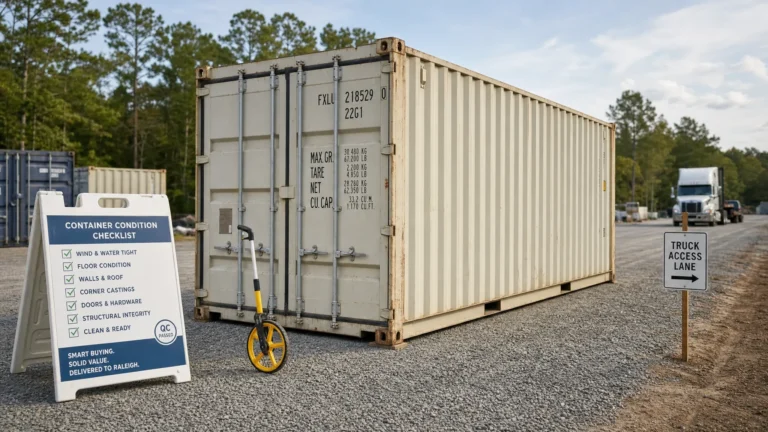
A CSC plate typically lists manufacturer details, approval information, maximum gross weight, stacking test load, and racking test load. For export or ocean freight, a container usually needs to be Cargo Worthy, have a valid CSC plate or current inspection status, and meet the carrier’s requirements.
For stationary storage, a valid CSC plate may not be necessary. However, the structural standards behind the container still matter if you want a durable unit that will hold up over time.
Container grades: One-Trip, Cargo Worthy, and Wind & Watertight
Condition grade is one of the most important shipping container specifications because it connects price, appearance, structural performance, and suitable use.
| Grade | What it means | Best use cases | Buyer caution |
|---|---|---|---|
| One-Trip | A newer container that has usually made one loaded trip from the factory to its destination market | Customer-facing storage, offices, retail pop-ups, container homes, long-term ownership | Usually costs more, but offers cleaner appearance and longer expected life |
| Cargo Worthy | A used container that is structurally sound for cargo transport and can typically be certified for shipping when inspected | Export, intermodal transport, high-value storage, structural modifications | Cosmetic wear is normal, documentation matters if shipping cargo |
| Wind & Watertight | A used container that keeps out wind and rain when properly closed, but is not certified for cargo transport by default | Jobsite storage, farm storage, household goods, equipment storage | Not the same as Cargo Worthy, inspect roof, doors, gaskets, and floor carefully |
| As-Is | Sold with no condition guarantee or limited assurance | Parts, temporary use, buyers prepared to repair | Higher risk of leaks, structural issues, door problems, or floor damage |
One-Trip containers are typically the closest option to new in the resale market. They may still have minor handling marks, forklift scuffs, or small dents, but they generally offer strong cosmetics and long-term durability.
Cargo Worthy containers are used units that meet a higher structural standard than basic storage-grade containers. For international shipping, you should verify survey requirements, CSC status, and carrier acceptance before loading cargo.
Wind & Watertight containers are often the value choice for ground-level storage. They should keep out rain and wind, but they are not automatically approved for export or stacking. If you are comparing used containers, Lease Lane Containers’ used shipping container grades guide explains how grades translate into real-world condition.
Door, floor, and ventilation specs buyers should check
A container can have the right length and still be wrong for your cargo if the door opening is too small or the floor condition is poor.
Door openings are especially important for compact tractors, skid steer attachments, retail fixtures, restaurant equipment, wide pallets, and construction materials. Standard container doors are narrower and shorter than the full exterior dimensions because the frame, gaskets, and door hardware take space.
Floor specifications also matter. Many dry containers use heavy plywood or bamboo flooring supported by steel crossmembers. A floor in good condition should feel solid underfoot, with no major soft spots, rot, severe delamination, or chemical odor. For food-adjacent storage, offices, or retail conversions, floor cleanliness and prior cargo history can matter as much as structural strength.
Ventilation is another practical spec. Standard dry containers usually have small passive vents. These vents help reduce trapped air pressure and moisture, but they do not eliminate condensation on their own. In North Carolina’s humid climate, buyers storing paper goods, furniture, textiles, tools, or electronics may need added vents, desiccants, insulation, or climate control depending on the use.
Refrigerated container specifications
Refrigerated containers, often called reefers, are specialized units built with insulation, an integrated refrigeration system, and interior airflow channels. They are used for cold storage, food distribution, florals, pharmaceuticals, events, and other temperature-sensitive operations.
Reefers have different specifications than dry containers. Interior dimensions are smaller because insulation and the refrigeration machinery take up space. Electrical requirements are also critical. Many reefer units require 3-phase power, and buyers should verify voltage, phase, plug type, amperage, and site electrical capacity before delivery.
Important reefer specs include:
| Reefer spec | Why it matters |
|---|---|
| Temperature range | Confirms the unit can hold the required set point |
| Power requirements | Prevents failed startup or expensive electrical surprises |
| Machine hours | Helps estimate wear on the refrigeration system |
| Pre-trip inspection status | Shows whether the reefer has been tested before delivery |
| Interior airflow | Protects product quality by allowing proper circulation |
| Drainage | Helps manage condensation and washdown needs |
If cold storage is part of your operation in Raleigh or elsewhere in the Southeast, review the refrigerated shipping container buyer guide before choosing a unit.
Matching specifications to common buyer needs
The right specifications depend on how the container will be used. A general contractor, farm owner, retail operator, real estate developer, and freight manager will not prioritize the same details.
| Buyer type | Recommended specs to prioritize | Common fit |
|---|---|---|
| General contractors and home builders | Wind & Watertight or Cargo Worthy grade, secure doors, solid floor, easy ground-level access | 20 ft or 40 ft dry container for tools and materials |
| Small business owners | Clean appearance, door access, ventilation, optional High Cube height, strong lockbox | One-Trip or clean Cargo Worthy unit for inventory, pop-up retail, or mobile office projects |
| Homeowners and agriculture buyers | Weather resistance, floor condition, drainage, site placement, long-term durability | 20 ft, 40 ft, or 40 ft High Cube depending on property space |
| Real estate developers | One-Trip grade, High Cube height, clean structure, minimal corrosion, modification potential | 40 ft High Cube for offices, modular concepts, or build-outs |
| Logistics managers | Cargo Worthy condition, CSC documentation, ISO compatibility, payload and gross weight ratings | 20 ft or 40 ft Cargo Worthy unit for transport or export |
| Cold chain operators | Reefer performance, power requirements, insulation, pre-trip testing | 20 ft or 40 ft refrigerated container |
For many buyers, the smartest container is not the cheapest one. It is the unit whose specifications match the use case, site, delivery route, and expected lifespan.
Delivery specifications: the spec sheet does not stop at the container
A container’s dimensions also affect delivery. A container that fits on paper may still be difficult to place if the truck cannot turn, the driveway is too narrow, the ground is soft, or overhead branches block the tilt-bed.
In the Raleigh area, buyers should pay special attention to tree canopies, sloped lots, soft clay soils, drainage patterns, and HOA or municipal rules. Across the Southeast, wet ground and poor drainage can also create long-term leveling and rust problems if the container is placed directly on soil.
Common delivery planning specs include:
| Delivery factor | Planning consideration |
|---|---|
| Access width | Gates, driveways, and jobsite entrances must fit the truck and trailer |
| Straight-line clearance | Tilt-bed delivery requires extra room in front of the final placement area |
| Overhead clearance | Trees, wires, roof eaves, and signs can prevent safe unloading |
| Surface strength | Gravel, concrete, or compacted base helps support container and truck weight |
| Slope | Excessive slope can affect unloading safety and door operation |
| Door orientation | Doors should face the direction that makes loading and access practical |
For more details, see Lease Lane Containers’ guide to shipping container delivery requirements.
Pro-Tip: prepare the site before you choose final placement
A great container can perform poorly if it sits on an uneven, wet, or unstable base. Before delivery, prepare a level pad that supports the container at the corners and keeps the steel understructure away from standing water.
For most storage uses in Raleigh and the Southeast, a compacted gravel pad is a practical solution because it drains well and can be adjusted more easily than bare soil. Concrete pads, piers, railroad ties, and concrete blocks can also work when designed and leveled correctly. The key is to support the container evenly, prevent twisting, and keep the doors operating smoothly.
A practical pre-delivery site plan should include:
- A level landing area longer and wider than the container footprint
- Compacted gravel or another stable base with positive drainage
- Corner support points that prevent sinking and frame twist
- Clear overhead access, including branches, wires, and roof overhangs
- Enough room for the delivery truck to enter, unload, and exit safely
- Permit, zoning, or HOA confirmation before the delivery date
If you are unsure about local requirements, check with the City of Raleigh, Wake County, your municipality, or your HOA before ordering. Rural properties, commercial sites, and temporary construction projects may have different rules than residential neighborhoods.
Specification mistakes that cost buyers money
Most container buying mistakes come from comparing only the price and length. A low-cost unit may not be a good deal if the grade is unclear, the roof leaks, the doors bind, or the delivery site requires special equipment.
Avoid these common specification mistakes:
- Assuming Wind & Watertight means Cargo Worthy
- Buying a standard-height container when a High Cube is needed for insulation or tall cargo
- Forgetting to measure the door opening, not just the container exterior
- Ignoring floor condition when storing heavy equipment or valuable goods
- Comparing quotes without confirming grade, delivery, taxes, and placement method
- Buying a reefer without verifying power requirements and test status
- Placing the container directly on soft soil without drainage or leveling
A professional quote should clearly identify size, type, grade, delivery assumptions, and any limitations. If a seller cannot explain the difference between One-Trip, Cargo Worthy, and Wind & Watertight, that is a red flag.
Final buyer checklist for container specifications
Before you approve a quote or schedule delivery, confirm the following:
| Checklist item | Confirmed? |
|---|---|
| Container length, width, and height match your site and use case | |
| Interior dimensions and door opening fit your cargo or build-out plan | |
| Grade is clearly stated as One-Trip, Cargo Worthy, Wind & Watertight, or another defined condition | |
| Photos or inspection notes show roof, doors, floor, seals, rails, and corner castings | |
| CSC status is verified if the container will be used for export or intermodal transport | |
| Delivery method and site access have been reviewed | |
| Ground pad, drainage, and leveling plan are ready before delivery | |
| Local permits, zoning, or HOA requirements have been checked | |
| Total delivered cost is clear, including placement assumptions |
The best buying decision is usually made before the truck arrives. Clear specifications reduce surprises, protect your budget, and help you choose a container that will perform for years.
Frequently Asked Questions
What are the most important shipping container specifications? The most important specifications are size, interior dimensions, door opening, grade, structural condition, tare weight, payload rating, floor condition, material, and delivery requirements. For export, CSC status and Cargo Worthy condition are also critical.
What is the difference between One-Trip, Cargo Worthy, and Wind & Watertight containers? One-Trip containers are newer units that have typically made one loaded trip and offer cleaner appearance and longer expected life. Cargo Worthy containers are used units that are structurally suitable for cargo transport when properly inspected. Wind & Watertight containers are used storage-grade units that should keep out wind and rain but are not automatically certified for shipping.
Are all 20 ft and 40 ft shipping containers the same size? Most ISO dry containers follow standard exterior dimensions, but interior dimensions, tare weight, door openings, floor condition, vents, and hardware can vary by manufacturer, age, and container type. Always verify the actual unit specs before buying.
Is a High Cube container worth it? A High Cube container is often worth it when you need extra headroom for shelving, insulation, HVAC, equipment, pallets, or a container office. The tradeoff is that it requires more overhead clearance for delivery and placement.
Do I need a Cargo Worthy container for storage? Not always. For stationary storage, a Wind & Watertight container may be enough if it passes inspection and protects your contents. Choose Cargo Worthy if you need stronger structural assurance, may ship the container later, or are storing higher-value goods.
What specifications matter most for Raleigh and Southeast buyers? In Raleigh and the Southeast, buyers should prioritize weather tightness, roof condition, drainage, site leveling, humidity control, and delivery access. Local soils, tree cover, and seasonal rain can affect placement and long-term performance.
Get expert help choosing the right container specifications
If you are comparing shipping container specifications for storage, construction, agriculture, modular projects, or logistics, Lease Lane Containers LLC can help you match the right size, grade, and delivery plan to your site.
Our Raleigh-based team supplies high-quality One-Trip and used containers, including 20 ft, 40 ft, High Cube, Cargo Worthy, Wind & Watertight, and refrigerated options with nationwide delivery support.
To discuss your project, contact the sales team at sales@leaselanecontainers.com or visit the Raleigh office for local guidance on container selection, site preparation, and delivery planning.